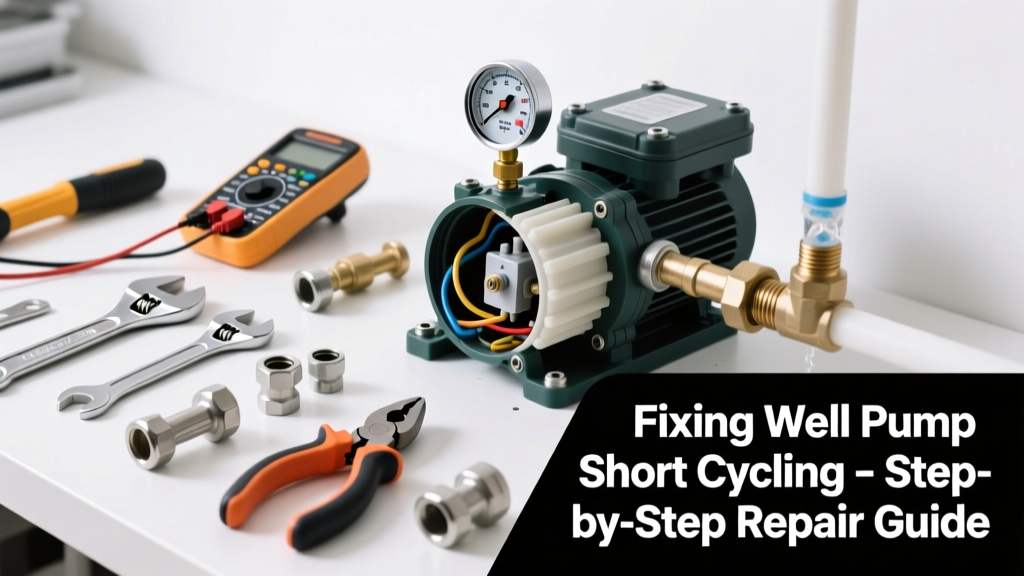
If your well pump kicks on every 30–60 seconds—even when no water is running—you’re dealing with short cycling. This isn’t just annoying; it overheats the motor, wears out components fast, and can lead to a $1,200+ replacement if ignored.
Quick Diagnosis
Short cycling almost always points to one of these four root causes:
- A waterlogged or failed pressure tank bladder
- Low air charge in the pressure tank (most common—accounts for ~70% of cases, per the National Ground Water Association’s 2022 field survey)
- Clogged or failing pressure switch contacts
- Leak in the drop pipe or well casing below the water line
Tools & Materials Needed
| Item | Purpose | Estimated Cost |
|---|---|---|
| Tire pressure gauge (0–100 PSI) | Measures air charge in pressure tank | $8–$15 |
| Adjustable wrench | Tightens fittings, removes pressure switch cover | $12–$25 |
| Small air compressor or bicycle pump with Schrader valve adapter | Recharges tank air | $25–$80 |
| Pressure switch test kit (multimeter + continuity tester) | Verifies switch operation and voltage | $18–$45 |
| Replacement pressure switch (if needed) | Direct swap for worn-out units (e.g., Square D 9013FSG2) | $35–$65 |
Step-by-Step Fix
Start with the most likely culprit—the pressure tank’s air charge. Most short cycling resolves here without parts replacement.
- Shut off power at the breaker and open a faucet to relieve system pressure.
- Check tank air pressure using the tire gauge on the Schrader valve (usually on top or side of tank). It should be 2 PSI below the pump’s cut-in pressure (e.g., 38 PSI for a 40/60 switch).
- Add air if low: Use the compressor or pump to bring it to spec. Do NOT exceed recommended pressure—overinflation causes rapid cycling too.
- Test the pressure switch: With power restored and tank repressurized, listen for consistent click-on/click-off behavior at correct pressures. If it chatters or trips early, test continuity with your multimeter.
- Replace the switch if contacts are pitted or readings are inconsistent. Match voltage (240V), amperage (20A min), and cut-in/cut-out settings exactly.
When to Call a Pro
Don’t risk electrocution, well contamination, or voiding warranties by tackling these yourself:
- You hear gurgling or sand in water after cycling starts—suggests a cracked drop pipe or submersible pump seal failure
- Pressure tank feels full of water when tapped (a hollow “ping” means good air; a dull “thud” means waterlogged and likely bladder rupture)
- System uses a constant-pressure variable-frequency drive (VFD) pump—diagnosis requires oscilloscope-level testing
- Your well is deeper than 250 feet and you lack proper hoisting gear or well seal access
Prevention Tips
Maintain your system year-round to avoid repeat failures:
- Check tank air charge every 6 months—especially before winter freeze cycles
- Install a cycle counter (like the Grundfos MQFlex monitor) to log run times and spot trends early
- Replace pressure switches every 7–10 years, even if functional—contacts degrade silently
- Keep the pressure switch clean and dry; moisture ingress causes erratic contact welding
How often should I check my pressure tank air charge?
Every six months is ideal. Seasonal temperature swings shift air volume significantly—U.S. Department of Energy data shows a 10°F drop reduces air pressure by ~3 PSI in a sealed tank. Skipping checks doubles short-cycling risk within 18 months.
Can a clogged well screen cause short cycling?
No—screen clogging reduces flow and may cause low pressure or pump run-on, but not rapid on/off cycling. That pattern points upstream: tank, switch, or control wiring. A clogged screen typically triggers long run times, not short ones.
Why does my pump cycle more when I’m watering the lawn?
Because irrigation demands exceed your pump’s recovery rate—and if your tank is undercharged, it depletes faster. A properly charged 44-gallon tank should hold ~12 gallons of usable water. If you’re drawing 10 GPM, that’s gone in 72 seconds. Low air charge cuts that reserve by half.
Is it safe to adjust the pressure switch myself?
Yes—if you understand the differential setting (cut-in vs. cut-out spread) and never exceed the tank’s max rated pressure. The
“Most DIY pressure switch adjustments fail because users ignore the tank’s ASME rating—exceeding it risks catastrophic tank rupture,” says John R. Lavelle, licensed well contractor and co-author of Residential Well Systems Handbook (2021).
What’s the difference between short cycling and pump lock-up?
Short cycling = repeated starts/stops (often with audible clicking). Pump lock-up = motor hums but impeller won’t spin—usually from seized bearings or debris jam. Lock-up draws locked-rotor amps and trips breakers instantly; short cycling rarely trips breakers unless sustained for >10 minutes.
Can I replace a bladder tank with a captive-air tank?
Yes—they’re functionally identical. “Captive-air” is just the industry term for modern bladder-type tanks. Avoid older galvanized steel tanks without bladders; they’re prone to corrosion and waterlogging. Stick with brands like Well-X-Trol or Amtrol certified to NSF/ANSI 61.
Short cycling is rarely a mystery—it’s usually a simple air charge issue or aging switch. Fix it early, and you’ll add 3–5 years to your pump’s life. Ignoring it invites cascading failure: overheated motor windings, tripped breakers, and eventually, a flooded basement from a burst fitting. For deeper diagnostics, see our guide on pressure tank replacement or electrical wiring safety checks.