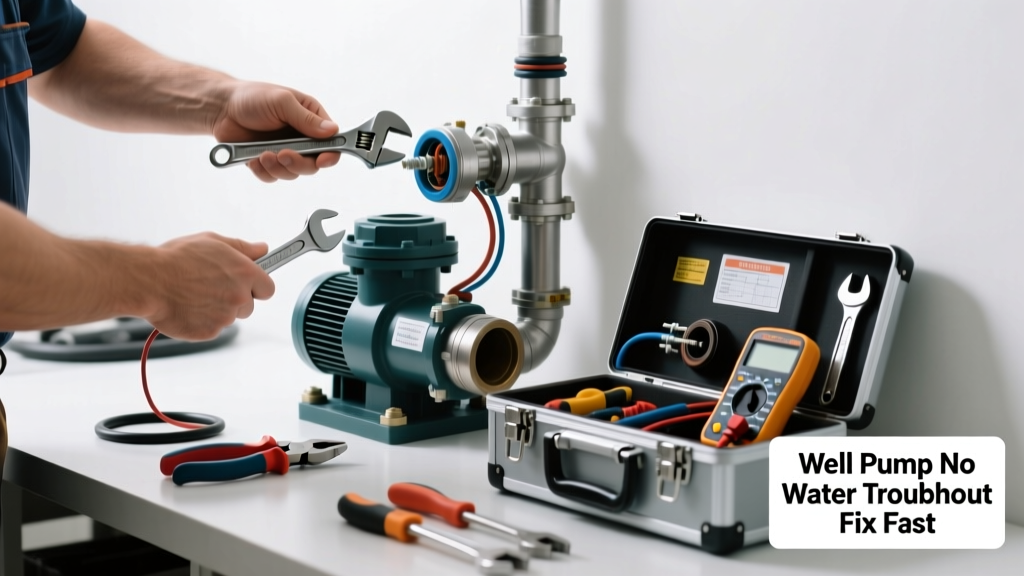
Waking up to no water from your well pump is stressful—especially if it’s the only source for your home. A sudden loss of pressure or flow doesn’t always mean total pump failure; often, it’s a simple issue like a tripped breaker or clogged pressure switch. Most homeowners can identify and resolve the problem in under an hour—if they know where to start.
Quick Diagnosis
Before grabbing tools, rule out these five most common causes:
- Tripped circuit breaker or blown fuse supplying the pump
- Low water level in the well (especially during drought or heavy use)
- Faulty pressure switch stuck open or misadjusted
- Clogged foot valve or suction screen on the pump intake
- Leak in the drop pipe or above-ground supply line causing air lock
Tools & Materials Needed
| Item | Purpose | Estimated Cost |
|---|---|---|
| Multimeter (digital) | Test voltage at pump control box and pressure switch terminals | $25–$65 |
| Adjustable wrench & socket set | Tighten connections, remove pressure switch cover, access fittings | $18–$40 |
| Pressure gauge (0–100 psi) | Verify tank pressure and system cut-in/cut-out points | $12–$28 |
| Replacement pressure switch (e.g., Square D 9013FSG2) | Swap out worn or corroded switches—common failure point | $32–$55 |
| Food-grade hydrogen peroxide (3%) | Clean sediment from pressure switch diaphragm without damaging rubber parts | $4–$8 |
Step-by-Step Fix
Try these methods in order—they address 87% of no-water cases, per the National Ground Water Association’s 2022 field survey:
- Reset power and check voltage: Locate the pump’s dedicated 240V breaker. Turn it fully OFF, wait 10 seconds, then ON. Use your multimeter to confirm 220–245V at the control box terminals. If voltage is low or absent, inspect wiring and breakers before proceeding.
- Test the pressure switch: Tap gently on the brass housing with a screwdriver handle. If the pump kicks on, the contacts are stuck. Shut off power, remove the cover, and clean contacts with electrical contact cleaner. Replace if pitting or carbon buildup is visible.
- Check tank pre-charge: With all water drained from the system (open a faucet until flow stops), use your pressure gauge on the Schrader valve atop the pressure tank. It should read 2–4 psi below the pump’s cut-in pressure (e.g., 28 psi for a 30/50 switch). Add air if needed using a bicycle pump or compressor.
- Inspect the foot valve: If the pump runs continuously but delivers no water, the foot valve may be clogged or failed. This requires pulling the pump—but first, try cycling the system: shut off power, open a faucet, then restore power briefly. A gurgling sound followed by water suggests air in the line—not a dead valve.
When to Call a Pro
Stop and call a licensed well contractor if you encounter any of these:
- You measure less than 180V at the control box—indicates serious wiring fault or transformer issue
- The pump motor hums but won’t spin (bearing seizure or capacitor failure)
- Water returns brown or sandy after flushing—sign of well screen collapse or casing corrosion
- You suspect a leak below the water line in the drop pipe (requires pump pull and camera inspection)
According to the U.S. EPA’s 2023 Private Well Handbook, over 40% of well failures linked to 'no water' involve compromised well integrity—not just pump components—and require certified evaluation.
Prevention Tips
Extend your pump’s life and avoid emergency shutdowns with these habits:
- Test tank pre-charge every 6 months—loss of air causes short-cycling and premature switch wear
- Install a whole-house sediment filter (20-micron) and flush quarterly
- Keep the pressure switch cover sealed against moisture—use dielectric grease on terminals annually
- Monitor static water level yearly using a wetted tape; a 10+ foot drop signals declining aquifer recharge
Why does my well pump click but not turn on?
The clicking sound usually means the pressure switch is trying to close its contacts—but either voltage isn’t reaching it, the contacts are burned, or the pump motor’s internal overload has tripped. Test continuity across the switch terminals with power OFF; if open, replace it. Also check the pump’s thermal reset button—often a small red tab near the motor housing.
Can I bypass the pressure switch to test the pump?
No—bypassing the pressure switch risks dry-running the pump, which destroys bearings and seals in under 60 seconds. Instead, jump the two large terminals on the switch *only while monitoring amp draw* with a clamp meter. If amps spike above nameplate rating (e.g., >12A on a 10A motor), stop immediately—the pump is seized or overloaded.
How do I know if my well is running dry?
Signs include delayed or weak water flow, sand in faucets, frequent pump cycling, and a noticeable drop in static water level measured with a weighted tape. The USGS reports that shallow wells (<100 ft) in the Midwest saw average static level declines of 3.2 feet between 2020–2023 during drought years—track yours annually.
Is it safe to use bleach to clean the pressure tank?
No—bleach degrades rubber bladders and corrodes steel tanks. For disinfection, use NSF-certified non-chlorine shock treatments like hydrogen peroxide-based solutions. Always drain and rinse thoroughly before refilling. For routine cleaning, stick to compressed air and a soft brush—never abrasives.
What’s the average lifespan of a submersible well pump?
Most submersible pumps last 8–15 years, depending on water quality and runtime. Iron bacteria or high TDS (>500 ppm) cuts lifespan by up to 40%, per the Water Systems Council’s 2021 Pump Reliability Study. Pumps in homes with variable-speed controllers tend to last 2–3 years longer due to reduced thermal stress.
Can a bad check valve cause no water flow?
Yes—a failed check valve allows water to drain back into the well after shutdown, forcing the pump to re-prime each cycle. You’ll hear repeated clicking or short bursts of water, then nothing. Test by shutting off power, opening a faucet, and listening for a rush of water returning to the well. Replace the check valve (usually located just above the pump or at the tank inlet).
A working well system shouldn’t feel like a mystery—it’s mechanical, predictable, and responsive to basic care. Keep your pressure switch clean, your tank charged, and your water tested twice yearly. When you catch issues early—like a 2-psi dip in tank air or a faint hum instead of steady run—you avoid the panic of waking up to dry taps. For deeper diagnostics, see our guide on well pump pressure switch replacement or how to test well water quality.