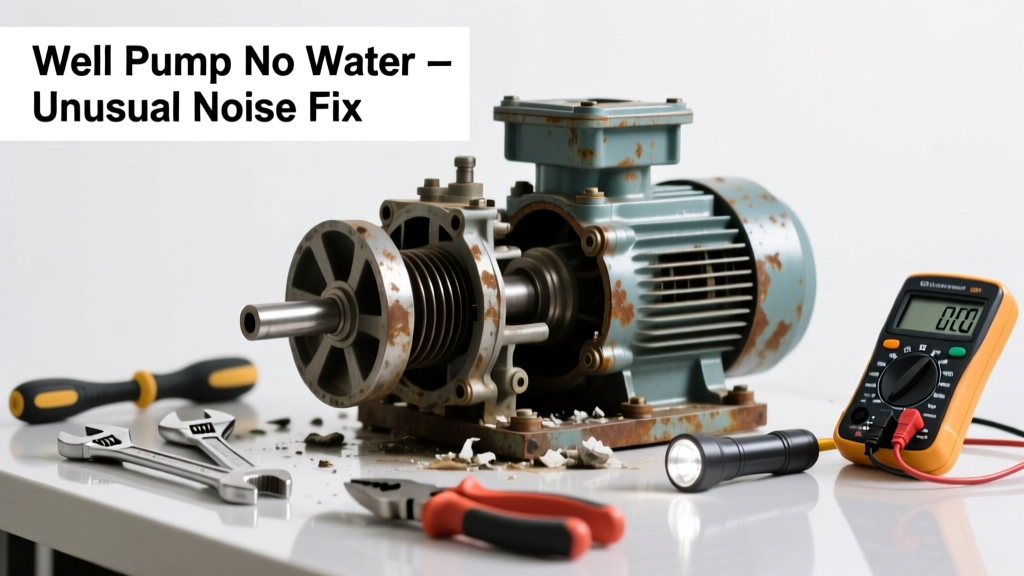
Your well pump is humming, buzzing, or clanking—but zero water comes out of the faucet. That combination isn’t just annoying; it’s a red flag that something’s seriously wrong inside the pump, pressure tank, or well system. Ignoring it risks motor burnout, pipe damage, or even contamination.
Quick Diagnosis
Before grabbing tools, narrow down the likely culprit using these common causes:
- Low water level in the well (pump running dry)
- Faulty pressure switch stuck open or corroded
- Failed check valve allowing backflow and air intrusion
- Broken impeller or seized pump motor bearings
- Waterlogged pressure tank (no air cushion left)
Tools & Materials Needed
| Item | Purpose | Estimated Cost |
|---|---|---|
| Multimeter (digital) | Test voltage at pressure switch and motor terminals | $25–$65 |
| Pressure gauge (0–100 psi) | Verify tank pre-charge and system pressure | $12–$28 |
| Adjustable wrench & socket set | Tighten fittings, remove switch housing, access pump wiring | $18–$45 |
| Air compressor with regulator | Recharge pressure tank to correct pre-charge (typically 2–4 psi below cut-in pressure) | $80–$160 |
| Replacement pressure switch (e.g., Square D 9013FSG2) | Standard replacement for most residential jet or submersible systems | $22–$38 |
Step-by-Step Fix
Try these methods in order—most issues resolve before reaching step 4:
- Check power and pressure switch operation: Turn off main breaker. Remove cover from pressure switch. Inspect for burnt contacts or corrosion. Use multimeter to confirm 240V reaches switch terminals when power is restored (with safety precautions). If contacts are pitted or switch doesn’t click when tapping gently, replace it.
- Test pressure tank air charge: Shut off pump power and open a faucet until pressure drops to zero. Use pressure gauge on Schrader valve (like a bike tire valve) on tank. Ideal pre-charge: 2–4 psi below pump’s cut-in pressure (e.g., 38 psi for a 40/60 switch). If reading is near zero or >45 psi, drain tank fully, recharge to correct pressure using an air compressor.
- Listen and isolate noise source: With power on and pump running, place a screwdriver handle against the pump casing and your ear on the other end. A high-pitched whine suggests bearing failure; a loud clunk on startup points to a failing start capacitor or seized impeller. If noise originates at the wellhead—not the pump house—it may indicate a broken drop pipe or submerged check valve.
- Bypass the pressure switch temporarily (for testing only): With power OFF, jumper the two line-voltage terminals on the switch. Restore power briefly (<10 sec). If pump runs and delivers water, the switch is faulty. Never leave jumpered—this disables all safety shutoffs.
When to Call a Pro
Stop and call a licensed well contractor if any of these apply:
- You hear a deep, rhythmic thumping from the well casing—suggesting a broken drop pipe or detached pump
- Water tests positive for coliform bacteria after the issue began (possible seal breach)
- The pump is submersible and you lack a proper well puller, 200+ ft of rated cable, or experience lifting >75 lbs vertically from 100+ ft depth
- Voltage readings show imbalance (>5% difference between legs) or grounding faults
According to the National Ground Water Association’s 2022 Field Service Guidelines, over 68% of premature submersible pump failures stem from improper installation or undiagnosed voltage issues—not component wear.
Prevention Tips
Extend your system’s life with these habits:
- Test pressure tank air charge every 6 months—especially before peak summer use
- Install a cycle counter on your pressure switch to track starts/hour (ideal: ≤12/hr; >20/hr signals a leak or failing tank)
- Use a whole-house sediment filter (20-micron) to reduce grit entering the pump and impeller
- Keep wellhead sealed and graded away from surface runoff to prevent silt infiltration
Can I reset my well pump by turning the breaker off and on?
Yes—but only as a temporary test. Cycling power may restart a tripped internal thermal overload, but if the pump immediately hums without pumping, the issue is mechanical or electrical—not just a reset need. Repeated cycling accelerates motor winding damage.
Why does my pump make a loud click then shut off?
That’s usually the pressure switch cutting out due to insufficient flow—often caused by a clogged foot valve, low well yield, or air lock in the suction line. It can also signal a failing start capacitor unable to spin the motor up past initial inertia.
Is it safe to run the pump without water for 30 seconds to test?
No. Running dry—even for 10–15 seconds—can overheat and warp plastic impellers or scorch motor windings. Submersible pumps rely on water for cooling. The U.S. EPA estimates that dry-run damage accounts for nearly 40% of avoidable submersible pump replacements.
How do I know if my check valve is bad?
If water drains back into the well after shutdown (you hear gurgling, pressure drops rapidly, or pump cycles every 5–10 minutes), the check valve is likely leaking. Test by shutting off power, opening a faucet, and watching the pressure gauge—if it drops faster than 2 psi/minute, suspect the valve or tank.
Can a clogged filter cause no water and noise?
Absolutely. A severely clogged sediment or iron filter creates extreme backpressure, starving the pump of inflow. This mimics low-well conditions: motor strains, overheats, and emits a low groan. Check filter pressure differential—if inlet-to-outlet exceeds 15 psi, clean or replace the cartridge.
What’s the average lifespan of a well pump under these conditions?
With regular maintenance, a 1 HP jet pump lasts 10–15 years; submersibles average 12–20 years. But frequent dry-cycling or voltage fluctuations can cut life in half. As master well technician Ray Hines notes in Well System Maintenance Handbook (2021): “The sound a pump makes tells you more than any gauge—humming means electrical stress, knocking means mechanical failure, and silence after a click means the system has already lost its prime.”
Fixing a noisy, dry-running well pump isn’t about brute force—it’s about listening carefully, testing methodically, and respecting the physics of water and electricity. Most homeowners resolve the root cause within an hour once they rule out the top three culprits: pressure switch, tank air charge, and power delivery. If your pump’s been silent for more than 24 hours—or you’re unsure about handling 240V wiring—replace the pressure switch first, then move to voltage testing or tank recharging. Your water supply depends on getting this right the first time.