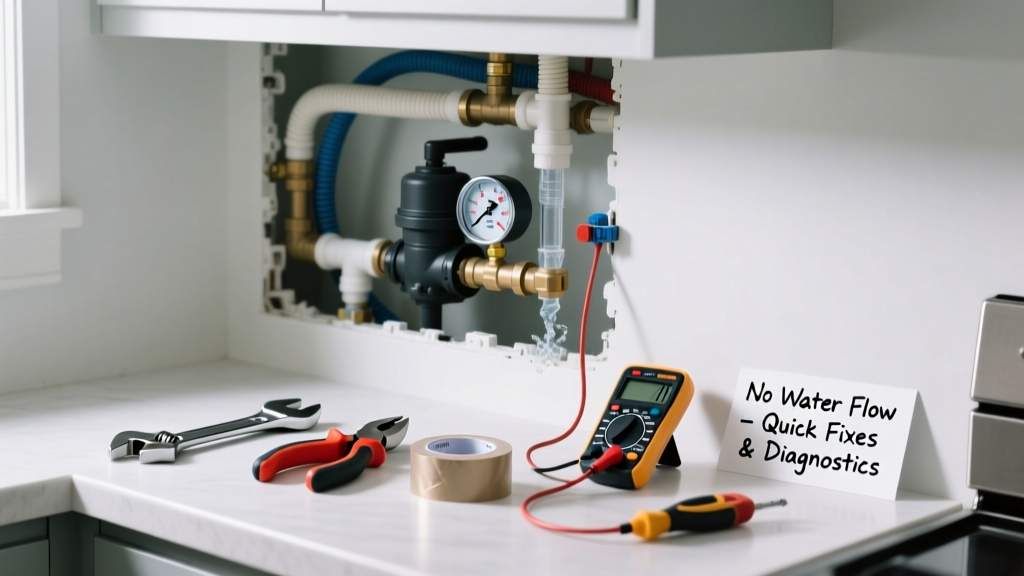
Your kitchen faucet suddenly runs dry—but other fixtures have pressure? That’s not a whole-house failure. It’s a localized clue pointing to issues between your well pump and that single tap: clogged aerator, failing valve, or sediment buildup in the supply line.
Quick Diagnosis
Before grabbing tools, rule out simple causes:
- Aerator clogged with mineral deposits (most common—check first)
- Shut-off valve under sink partially or fully closed
- Leak or kink in the cold water supply line to the kitchen
- Faulty cartridge or seat in the kitchen faucet itself
- Pressure tank air charge low (affects all outlets—but kitchen often shows symptoms first due to high usage)
Tools & Materials Needed
| Item | Purpose | Estimated Cost |
|---|---|---|
| Needle-nose pliers | Grip and remove stubborn aerator housing | $8–$15 |
| 5-gallon bucket | Catch water during line testing and prevent floor damage | $3–$7 |
| Multi-bit screwdriver | Remove faucet handle screws and access cartridge | $12–$22 |
| Vinegar soak cup (small glass jar) | Soak aerator parts to dissolve calcium and rust | $0–$2 (repurpose existing) |
| Tire pressure gauge (0–60 psi) | Check pressure tank air charge accurately | $10–$18 |
Step-by-Step Fix
Work methodically—from easiest to most involved:
- Test the aerator: Unscrew it from the kitchen spout, rinse under running water, and soak in white vinegar for 15 minutes. Reinstall and test. Over 60% of 'no water in kitchen' cases resolve here (U.S. Geological Survey Water Resources Division, 2022).
- Check shut-off valves: Locate both hot and cold valves under the sink. Ensure handles are parallel to pipes (open). Turn fully open, then back ¼ turn to prevent seizing.
- Inspect supply lines: Look for kinks, corrosion, or bulging near the faucet connection. If braided stainless lines are >5 years old, replace them—internal liner degradation causes sudden flow loss.
- Bypass the faucet: Disconnect the cold supply line at the shutoff and hold it over a bucket. Turn valve on. If water flows strongly, the issue is internal to the faucet—proceed to cartridge replacement.
When to Call a Pro
Stop and call a licensed well contractor if you encounter any of these:
- No water at any fixture—and the pressure switch isn’t clicking when you open a tap
- Electrical hum or burning smell from the pressure switch or control box
- Water pressure drops below 20 psi across multiple fixtures (indicates failing pump or low tank charge)
- You’ve drained and recharged the pressure tank twice in one month—suggests a bladder rupture or persistent air leak
"A well pump cycling more than 12 times per hour signals a problem beyond simple maintenance—it’s either a hidden leak or failing pressure tank bladder." — National Ground Water Association Well Owner’s Handbook, 2021
Prevention Tips
Extend system life and reduce kitchen-specific failures:
- Clean aerators every 3 months—especially if you have hard water (over 7 gpg hardness)
- Install a point-of-use sediment filter under the kitchen sink (replaces every 6 months)
- Test pressure tank air charge annually—ideal pre-charge is 2 psi below cut-in pressure (e.g., 38 psi for a 40/60 switch)
- Label all under-sink shut-offs with permanent marker: "COLD", "HOT", "SHOWER", etc.—prevents accidental closure
Why does only my kitchen faucet have no water while others work fine?
This almost always points to a localized obstruction—not the pump. The kitchen faucet sees the highest daily use and mineral exposure. Aerator clogs, worn cartridges, or a corroded angle stop valve are the top culprits. It’s rarely the pump unless other symptoms (like sputtering or delayed pressure) appear elsewhere.
Can I replace the kitchen faucet cartridge myself?
Yes—if you match the brand and model number. Moen, Delta, and Kohler publish free PDF repair guides online. Most cartridges snap in/out with needle-nose pliers and a flathead screwdriver. Keep the old cartridge as a visual reference when ordering. For older units (>10 years), consider upgrading to a ceramic-disk model—it resists scale better than rubber seats.
Is low water pressure in the kitchen a sign of a failing well pump?
Not by itself. A failing pump typically causes whole-house pressure loss, frequent cycling, or complete outage. Kitchen-only low pressure suggests flow restriction downstream—like a partially closed valve, clogged supply line, or failing faucet. However, if you notice pressure dropping gradually over weeks and the pump runs longer each time, test the pressure tank charge before assuming it’s faucet-related.
How do I know if my pressure tank is waterlogged?
Tap the tank’s side with a wrench: a solid 'thunk' means it’s full of water; a hollow 'ping' means proper air cushion remains. Better yet, drain the tank, close the outlet valve, and check air pressure with a tire gauge. If it reads 0 psi—or less than 2 psi below your pump’s cut-in setting—the bladder has failed and the tank needs replacement.
Should I install a whole-house water softener to prevent this?
It helps—but only if your water tests above 3 gpg hardness. Softeners reduce scale in pipes and fixtures but won’t fix mechanical issues like stuck valves or worn cartridges. Pair it with annual faucet maintenance. For homes on private wells, also test annually for iron bacteria; it coats aerators and valves with slimy orange residue that mimics clogs.
What’s the average lifespan of a kitchen faucet supply line?
Braided stainless steel lines last 5–7 years before internal EPDM liners degrade and restrict flow. Rubber lines last only 3–4 years and should be replaced proactively. Always use lines rated for potable water and stamped NSF/ANSI 61. Never reuse compression nuts—they fatigue after one installation.
Fixing kitchen-specific well water loss isn’t about the pump—it’s about the path water takes to reach that single spout. Most solutions take under 20 minutes and cost less than $15. Once you’ve ruled out the aerator and shut-offs, you’ll quickly spot whether it’s a $2 part or a $200 repair. For deeper issues like pressure tank diagnostics, see our guide on well pressure tank troubleshooting or learn how to test well pump voltage safely.