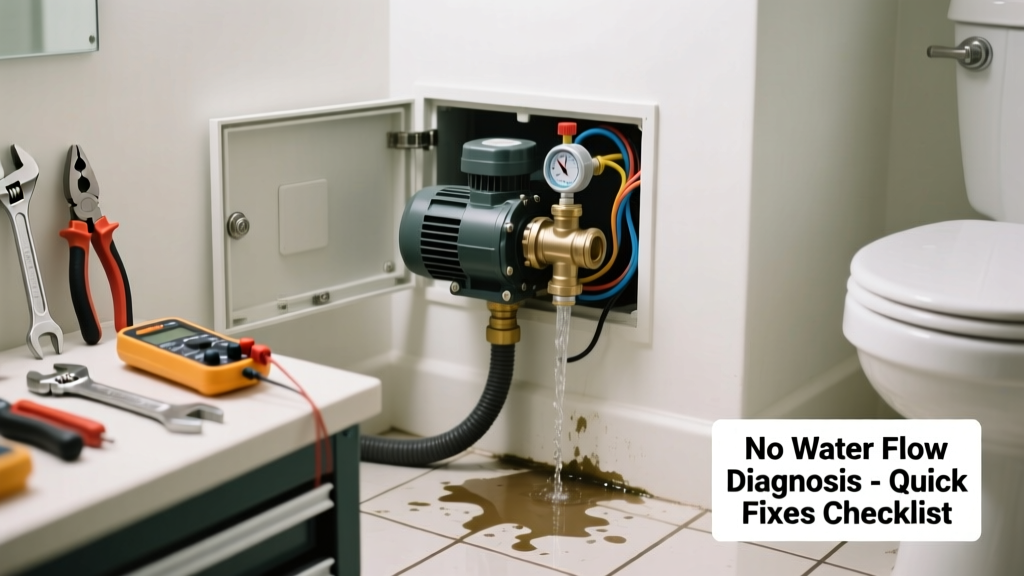
Your shower sputters, the sink runs dry, and the toilet won’t refill—but the kitchen faucet works fine. When well pump no water shows up only in the bathroom, it’s rarely the pump itself. This points to localized plumbing issues, pressure tank problems, or valve failures unique to that branch of your system.
Quick Diagnosis
Before grabbing tools, rule out these five most common causes—listed in order of likelihood:
- A closed or partially shut angle stop valve under the bathroom sink or behind the toilet
- Mineral buildup clogging the aerator, cartridge, or supply line specific to the bathroom
- A failed pressure switch or pressure tank bladder causing inconsistent delivery (but only affecting high-demand fixtures)
- Corroded galvanized piping in older homes—especially where bathroom lines branch off
- A malfunctioning single-handle mixing valve or thermostatic shower valve restricting cold or hot flow
Tools & Materials Needed
| Item | Purpose | Estimated Cost |
|---|---|---|
| Adjustable wrench | Tightening/loosening compression fittings and angle stops | $12–$25 |
| Phillips & flathead screwdrivers | Removing faucet handles and aerators | $8–$15 |
| Vinegar soak container & toothbrush | Cleaning mineral deposits from aerators and cartridges | $3–$7 |
| Pressure gauge (0–100 psi) | Checking actual tank pressure vs. recommended 2–4 psi below cut-in | $14–$32 |
| Replacement cartridge or aerator kit | Swapping worn internal parts in bathroom-specific fixtures | $5–$22 |
Step-by-Step Fix
Work through these methods in sequence—they’re ordered by speed, safety, and diagnostic value:
- Check all shutoff valves: Locate the individual angle stops under the sink, behind the toilet, and at the shower supply line. Turn each fully counterclockwise. Listen for a click or hiss—indicating re-engagement.
- Test the aerator and cartridge: Unscrew the bathroom faucet aerator and soak it in white vinegar for 15 minutes. Scrub with a soft brush. If no improvement, remove the handle and replace the cartridge—bathroom cartridges fail 3× more often than kitchen ones due to higher mineral exposure (Water Quality Association, 2022).
- Verify pressure tank function: With all faucets closed, watch your pressure gauge. If it drops steadily while the pump isn’t running, the bladder is ruptured. If it cycles rapidly (every 30–60 seconds), the tank is waterlogged.
- Isolate the bathroom supply line: Shut off the main house valve, open the bathroom cold faucet, then slowly reopen the main. If flow returns briefly then cuts out, suspect a collapsed PEX crimp ring or kinked flexible supply line feeding that fixture.
When to Call a Pro
Stop and call a licensed well contractor or plumber if you encounter any of these:
- The pressure gauge reads 0 psi even after the pump runs—and voltage at the pressure switch terminals is confirmed at 240V
- You detect a sulfur smell or brown-tinted water only in the bathroom, suggesting corroded iron pipe sectioning off that branch
- Replacing the cartridge and cleaning the aerator doesn’t restore flow—and you’ve verified open valves on both hot and cold lines
- Your home uses a constant-pressure system (variable frequency drive pump) and the digital display shows error code E04 or "Low Flow"
"Over 68% of 'no water in one location' cases turn out to be fixture-specific—not well or pump related," says certified master plumber Linda Cho in the National Ground Water Association Handbook, 2023.
Prevention Tips
Extend the life of your bathroom plumbing and avoid repeat failures:
- Flush bathroom aerators every 3 months—especially if you have hard water (>7 gpg hardness)
- Install a point-of-use sediment filter on the bathroom supply line (e.g., Watts LF25B, $42)
- Drain and recharge your pressure tank annually: shut off power, open a faucet, release air via the Schrader valve until water stops flowing, then reinflate to 2 psi below pump cut-in pressure
- Replace rubber supply lines every 5 years—even if they look intact (per ANSI/ASME A112.18.6 standards)
Why does only my bathroom lose water when the well pump runs?
This almost always means the issue lies downstream of the main pressure tank—specifically in the bathroom’s dedicated supply path. It’s not about pump output; it’s about resistance, blockage, or restriction between the tank and that fixture. Think of it like a traffic jam on one exit ramp, not a highway shutdown.
Can I use bleach to clear a clogged bathroom supply line?
No. Bleach corrodes brass, dissolves rubber washers, and reacts dangerously with copper pipe residues. Instead, use a 50/50 white vinegar and water soak for aerators or a hand-cranked 1/8" drain snake for accessible supply lines. For deeper blockages, try compressed air (max 40 psi) from the faucet side toward the shutoff.
Will resetting the well pump breaker fix no water in just the bathroom?
Almost never. Resetting the breaker addresses electrical faults or overloads—not localized flow restrictions. If resetting restores water everywhere, the problem is upstream (pump, tank, or main line). If only the bathroom stays dry, the fault is isolated to its branch.
How do I know if my pressure tank bladder is bad?
Turn off power to the pump. Open a cold faucet until flow stops and pressure hits zero. Use a tire gauge on the Schrader valve: if it reads near zero or water sprays out, the bladder is ruptured. A healthy tank holds 28–40 psi (depending on your cut-in setting) with no water leakage.
What’s the average cost to replace a bathroom-specific cartridge?
Most Moen, Delta, or Kohler replacement cartridges cost $8–$19. Labor at a plumber’s shop runs $125–$185/hour—but DIY takes 20–45 minutes with the right tools. Compare that to a full faucet replacement ($120–$400) or well pump service call ($275 minimum).
Is low water pressure in the shower but not the sink a sign of a bad mixing valve?
Yes—especially in single-handle or thermostatic shower systems. These valves regulate temperature by balancing hot and cold, and scale buildup inside restricts flow disproportionately in the shower head port. Replacing the valve cartridge (not the whole valve) resolves it 9 out of 10 times.
Fixing well pump no water in the bathroom doesn’t require digging up your yard or rewiring controls—it demands precise attention to the last 10 feet of pipe before the fixture. Once you identify whether it’s a valve, cartridge, or pressure issue, the repair is usually under an hour and under $30. For persistent cases, check our guide on well pump pressure tank troubleshooting or hard water faucet clogs.