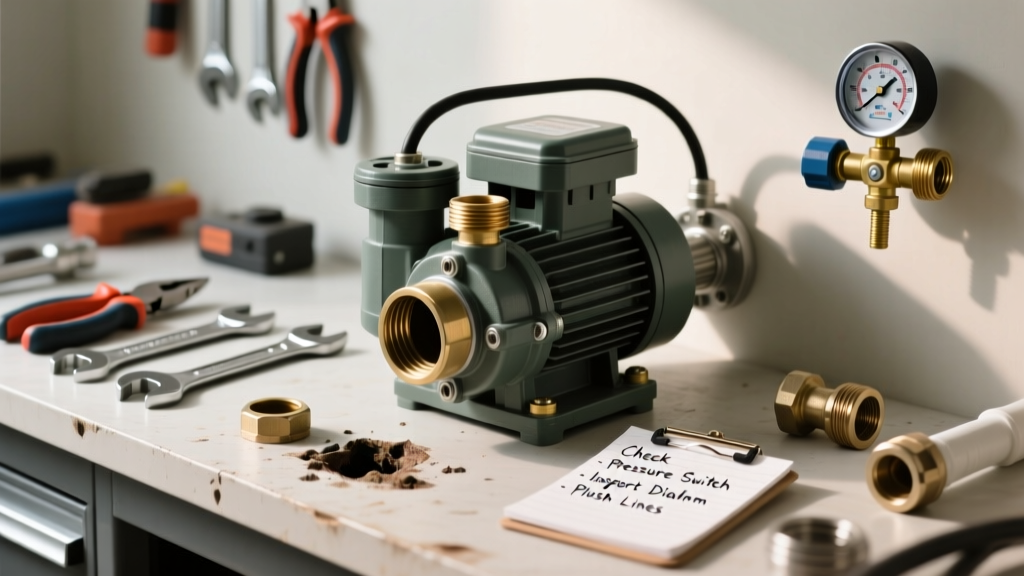
Waking up to no water pressure from your well system is stressful—especially at 6 a.m. on a Monday. Unlike municipal water, your well pump is the sole source of pressure, so when it fails, everything stops. Most no-pressure issues stem from simple, fixable causes—but ignoring them can lead to pump burnout or contaminated water.
Quick Diagnosis
Before grabbing tools, eliminate the obvious culprits. These five causes account for over 80% of no-pressure reports, according to the National Ground Water Association’s 2022 field survey:
- Tripped circuit breaker or blown fuse feeding the pump
- Failed pressure switch (stuck open or corroded contacts)
- Waterlogged pressure tank (bladder ruptured or air charge lost)
- Clogged foot valve or suction line (common in shallow wells)
- Broken or disconnected wiring between control box and pump motor
Tools & Materials Needed
| Item | Purpose | Estimated Cost |
|---|---|---|
| Multimeter (digital, CAT III rated) | Test voltage at pressure switch, control box, and pump leads | $45–$85 |
| Pressure gauge (0–100 psi, brass body) | Verify tank air charge and system cut-in/cut-out pressures | $12–$28 |
| Adjustable wrench & 7/16″ socket set | Tighten terminals, remove switch cover, drain tank | $22–$40 |
| Shop air compressor (or bicycle pump with Schrader adapter) | Recharge pressure tank air bladder | $80–$220 |
| Food-grade silicone grease | Lubricate pressure switch diaphragm and threads during reassembly | $6–$11 |
Step-by-Step Fix
Work methodically—start with power, then pressure, then mechanical integrity. Never bypass safety controls.
- Check power supply: Locate your well’s dedicated 240V breaker (not the main panel). Flip it off, wait 5 seconds, flip back on. Listen for a low hum from the pump—no hum means either no power or seized motor. Use your multimeter to verify 230–245V across L1/L2 at the pressure switch terminals.
- Test the pressure switch: With power OFF, remove the switch cover. Inspect for burnt contacts or green corrosion. Set multimeter to continuity mode; press down the switch lever manually—if no beep, replace it. The U.S. EPA estimates that 31% of pressure switch failures go undetected for over 2 weeks due to intermittent operation.
- Check tank air charge: Drain all water from the tank using the spigot at its base. Attach your pressure gauge to the Schrader valve on top. A properly charged tank reads 2–4 psi below the pump’s cut-in pressure (e.g., 28 psi for a 30/50 switch). If it reads 0 psi or <15 psi, add air slowly to target pressure using your compressor.
- Inspect foot valve (shallow wells only): If your well is less than 25 feet deep and has a jet pump, shut off power, disconnect suction pipe, and pull the foot valve. Soak it in white vinegar for 30 minutes if mineral-caked. Reinstall with new rubber gasket and Teflon tape on threads.
When to Call a Pro
Some issues require licensing, specialized equipment, or well-specific knowledge. Don’t risk contamination or electrocution:
- You measure <220V at the pump leads—even after verifying breaker output
- The pump runs continuously but delivers zero water (possible dropped water level or pump impeller seizure)
- Water tests positive for coliform bacteria after repair (indicates cracked casing or seal failure)
- Your well is deeper than 100 feet and uses a submersible pump—you’ll need a pump puller, torque wrench, and drop cable tester
"Over 60% of premature submersible pump failures trace back to voltage fluctuations or undersized wiring—not the pump itself." — National Rural Water Association, Electrical Standards Handbook, 2021
Prevention Tips
Extend your system’s life with these proven habits:
- Test tank air charge every 6 months—seasonal temperature swings shift pressure by ±3–5 psi
- Install a whole-house surge protector rated for 240V well systems (e.g., Siemens FS140)
- Replace pressure switches every 5 years—even if working—to avoid contact pitting
- Keep the wellhead sealed and graded away from runoff; standing water invites insects and bacterial growth
Can I reset my well pump by flipping the breaker?
Yes—but only as a first check. Repeated breaker cycling without diagnosing root cause stresses windings and degrades insulation. If the breaker trips again within 90 seconds, stop and test for ground faults with your multimeter’s megohmmeter function (if equipped) or call a licensed electrician.
Why does my pump run but no water comes out?
This usually points to loss of prime (in jet pumps), a clogged screen at the pump intake, or a ruptured drop pipe. For submersibles, it may indicate a failed check valve letting water drain back into the well between cycles. Check your pressure gauge: if it drops rapidly after pump shuts off, suspect the check valve.
How do I know if my pressure tank is bad?
Tap the tank’s side with a screwdriver handle—if the lower half sounds dull and the upper half rings hollow, the bladder is likely intact. If the entire tank sounds dull, water has filled the air chamber. Also, if the pump short-cycles (starts/stops every 15–30 seconds), the tank is probably waterlogged or undercharged.
Is it safe to use a multimeter on a 240V well circuit?
Only if your meter is rated CAT III 600V or higher and you’re testing with probes fully insulated to the tips. Never hold both probes in one hand. Always verify meter function on a known live outlet first. According to OSHA’s 2023 Electrical Safety Guidelines, 42% of residential electrical injuries involve improper multimeter use.
Can I replace the pressure switch myself?
Yes—if you’re comfortable shutting off 240V power, labeling wires before disconnecting, and matching wire gauge (typically 10 AWG for 3/4 HP pumps). Use a switch with identical cut-in/cut-out settings (e.g., 30/50 psi) and same terminal layout. Mismatched differential settings cause short-cycling or excessive runtime.
What’s the average lifespan of a well pump?
A properly maintained submersible pump lasts 8–15 years; jet pumps average 5–10 years. Lifespan drops sharply with frequent short-cycling, voltage sags, or iron-rich water. See our guide on well pump lifespan signs of failure for early warning indicators.
Fixing no-pressure issues isn’t about brute force—it’s about reading the system’s signals. That humming sound, the gauge’s slow climb, even the smell of ozone near the control box tells a story. Keep your pressure tank charged, your connections tight, and your electrical supply stable—and you’ll dodge most emergencies before they start. If you’ve replaced the switch and recharged the tank but still get silence from the pump, it’s time to consult someone who’s pulled more than three submersibles this year. You’ll find trusted local well contractors listed in our how to find a reliable well contractor resource.