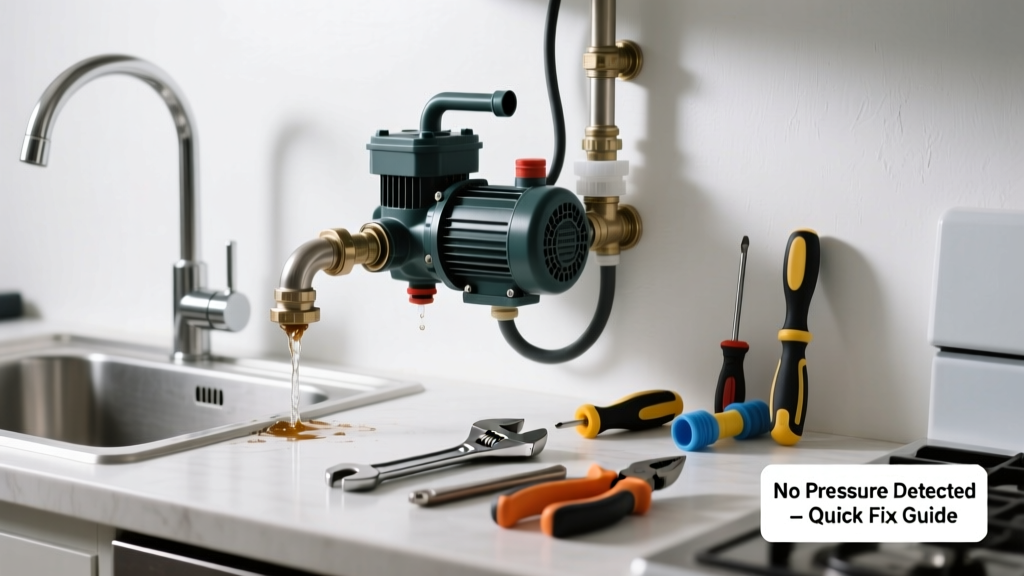
Your kitchen faucet sputters, then goes dry—while the well pump hums steadily in the background. That’s not a clogged aerator; it’s a symptom pointing to something deeper in your well system. Don’t shut off the whole house yet—many causes are simple, fast, and fully DIY.
Quick Diagnosis
Before grabbing tools, rule out the obvious:
- Kitchen-specific issue (aerator clogged, shutoff valve partially closed under sink)
- Pressure tank air charge too low (common after power outages or prolonged use)
- Leak in the supply line between well tank and kitchen (often near crawl space or basement wall)
- Faulty pressure switch contact points (causing pump to run but not build pressure)
- Failed check valve in submersible pump or jet pump assembly
Tools & Materials Needed
| Item | Purpose | Estimated Cost |
|---|---|---|
| Tire pressure gauge (0–60 psi) | Measures air charge in pressure tank bladder | $8–15 |
| Adjustable wrench & socket set | Tightens fittings, removes pressure switch cover, loosens tank drain | $25–45 |
| Small funnel + food-grade air compressor | Recharges bladder without over-pressurizing | $12–30 |
| Multi-meter (digital) | Tests voltage at pressure switch and pump terminals | $20–60 |
| Replacement pressure switch (if needed) | Standard 30/50 or 40/60 psi model for residential wells | $35–55 |
Step-by-Step Fix
- Check the kitchen shutoff valve and aerator: Turn off cold water under sink, unscrew aerator, rinse debris under tap. Fully open both hot and cold shutoff valves—sometimes they’re accidentally turned halfway.
- Test pressure tank air charge: Shut off pump breaker. Drain all water from tank via spigot until pressure reads zero on gauge. Use tire gauge on Schrader valve (like a bike tire). Should match cut-in pressure minus 2 psi (e.g., 28 psi for a 30/50 switch). Add air if low—never exceed 38 psi on a standard 30/50 tank.
- Inspect for wet spots near main supply line: Follow 1-inch PVC or galvanized pipe from pressure tank toward kitchen—look for damp insulation, mineral stains, or pooling water behind baseboards or in crawl spaces. A pinhole leak here can bleed pressure before it reaches the kitchen.
- Verify pressure switch operation: With power ON and pump running, use multimeter to confirm 240V across terminals. If voltage present but pump runs continuously without building pressure, the switch may be stuck or contacts pitted—replace per pressure switch replacement guide.
When to Call a Pro
Stop and call a licensed well contractor if you encounter any of these:
- No voltage at pump terminals despite correct breaker status (indicates wiring fault or control box failure)
- Water tastes or smells metallic, sulfurous, or like rotten eggs (possible well casing breach or bacterial contamination)
- Pump cycles every 60–90 seconds—even after tank recharge (sign of a failing submersible pump or deep well leak)
- You hear grinding, screeching, or intermittent thumping from the pump—especially underwater models
According to the National Ground Water Association’s 2022 Well Owner’s Handbook, nearly 37% of premature well pump failures stem from undetected air leaks or improper pressure tank maintenance—issues that escalate quickly without expert diagnosis.
Prevention Tips
- Test tank air charge every 6 months—especially before winter and after major power outages
- Install a whole-house sediment filter (20-micron) where water enters the house to protect valves and fixtures
- Label all shutoff valves with permanent marker—kitchen, laundry, outdoor spigots—to avoid accidental closure
- Keep a log of pump runtime and pressure readings; sudden changes signal developing issues
Why does only my kitchen have low pressure while other faucets work fine?
This almost always points to a localized obstruction or valve issue—not the well system itself. Check the flexible supply lines under the sink for kinks, corrosion, or mineral buildup inside braided hoses. Also inspect the angle stop valve: older compression-style valves often seize or erode internally, restricting flow even when handle appears open.
Can I bypass the pressure tank temporarily to test the pump?
No—bypassing the pressure tank risks immediate pump burnout and voids most warranties. The tank absorbs hydraulic shock and prevents short-cycling. Running the pump directly into pipes without a tank can cause pressure spikes exceeding 120 psi, damaging fittings, valves, and even your kitchen faucet cartridge.
Is low kitchen pressure dangerous?
Not immediately—but persistent low pressure can indicate a hidden leak that wastes hundreds of gallons weekly. The U.S. EPA estimates that 14% of household water usage is from leaks, costing the average homeowner $100+ annually. Worse, unseen moisture invites mold growth behind cabinets or in walls.
How do I know if my pressure switch is bad?
If the pump runs constantly but pressure never climbs above 20 psi—or shuts off at 30 psi instead of 50 psi—the switch’s internal contacts are likely fused or corroded. Visually inspect for blackened terminals or arcing marks inside the switch housing. Replace it before the next outage—it’s a $45 part that prevents $800+ emergency service calls.
Will a water softener cause low kitchen pressure?
Yes—if resin beads escape the softener tank due to cracked distributor tubes or worn seals, they can clog the small orifices in kitchen faucet cartridges or inline filters. Flush the softener’s brine tank and check for bead discharge at the drain hose. If you see amber granules, replace the softener’s lower distributor screen and flush all downstream lines.
What’s the difference between low pressure and no pressure in just the kitchen?
Low pressure suggests partial restriction (aerators, supply lines, or failing angle stops). No pressure—with working toilets and showers elsewhere—means either a fully closed shutoff valve, a collapsed PEX line (common in cold garages), or a broken solder joint in copper feeding only that fixture branch. Trace the pipe path from the main manifold to the kitchen using a stud finder or thermal camera.
A well pump that delivers water everywhere except your kitchen isn’t broken—it’s sending a clear message about localized plumbing health. Most fixes take under an hour and cost less than $20 in parts. Stay systematic, document each step, and remember: pressure problems rarely lie in the well itself—they live in the path between tank and tap.