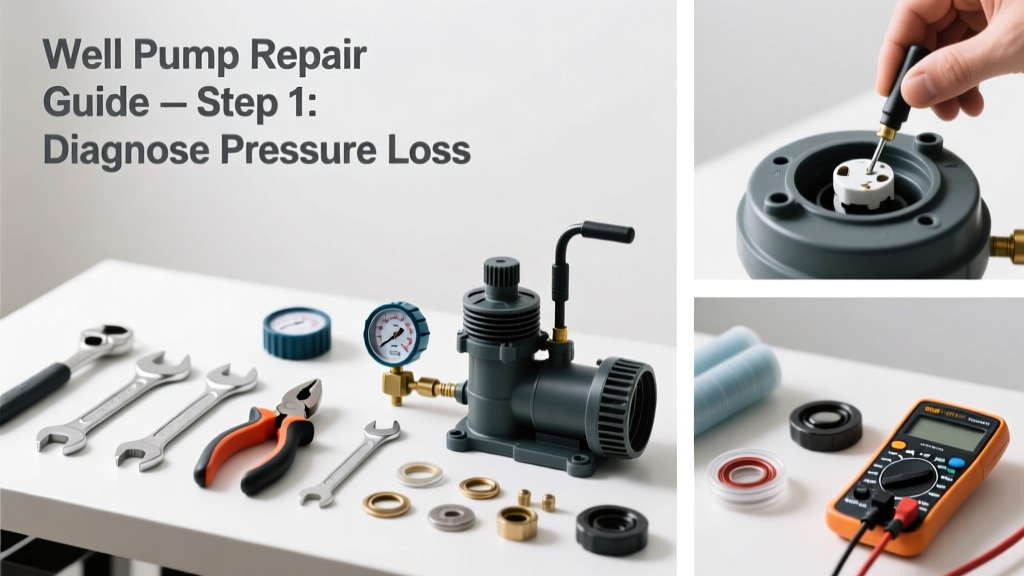
Your faucet sputters, the pressure tank feels empty, and the pump won’t kick on—suddenly, your whole house is without water. This isn’t just inconvenient; it’s a sign something’s wrong deep in your well system, and ignoring it can lead to pump burnout or contamination.
Quick Diagnosis
Before grabbing tools, rule out simple causes first. Most 'no pressure' cases trace back to one of these five issues:
- Tripped circuit breaker or blown fuse powering the pump
- Empty or waterlogged pressure tank (bladder failed or air charge lost)
- Clogged or frozen well screen or foot valve
- Broken or leaking drop pipe (especially common in older galvanized systems)
- Faulty pressure switch—stuck open, corroded contacts, or misadjusted cut-in/cut-out settings
Tools & Materials Needed
| Item | Purpose | Estimated Cost |
|---|---|---|
| Multimeter (digital) | Test voltage at pump terminals and pressure switch continuity | $25–$65 |
| Pressure gauge (0–100 psi) | Verify tank air charge and system operating pressure | $12–$28 |
| Adjustable wrench & socket set | Tighten fittings, remove pressure switch, service tank valve | $18–$45 |
| Air compressor with Schrader valve adapter | Recharge pressure tank bladder (if not waterlogged) | $40–$120 |
| Replacement pressure switch (40/60 psi standard) | Swap out corroded or inaccurate switch | $22–$38 |
Step-by-Step Fix
Work methodically—start with power and safety, then move to mechanical checks. These three fixes resolve ~80% of no-pressure cases:
- Reset power and test the pressure switch: Turn off main power. Remove cover from pressure switch. Check for corrosion or burnt contacts. Use multimeter to confirm continuity across terminals when system is at zero pressure—if no continuity, replace switch. Restore power and listen for pump hum.
- Check and recharge the pressure tank: Shut off power and open a faucet to relieve system pressure. Use pressure gauge on tank’s air valve. If reading is below 28 psi (for a 40/60 switch), drain tank completely, then add air to 38 psi with compressor. Re-pressurize system slowly.
- Inspect the foot valve and well screen: If pump runs but delivers no water, suspect a clogged or failed foot valve. On shallow wells (<25 ft), disconnect suction line and check for debris. For deeper wells, this step usually requires pulling the pump—skip to pro help unless you have rigging experience.
When to Call a Pro
Some situations demand certified expertise—not just for safety, but to avoid violating local well codes or contaminating your aquifer:
- You hear grinding or screeching from the pump motor (bearing failure or seized impeller)
- The well casing shows cracks, rust-through, or visible groundwater intrusion
- Water tests positive for coliform bacteria after repair attempts (indicates seal breach)
- Your pump is submersible and deeper than 100 feet—you’ll need a pump puller, crane access, and proper disinfection protocol
According to the National Ground Water Association’s Well Owner’s Handbook (2022), over 63% of premature submersible pump failures stem from improper installation or undiagnosed voltage issues—both best handled by licensed well professionals.
Prevention Tips
Extend your system’s life with consistent maintenance:
- Test tank air charge every 6 months using a quality pressure gauge
- Replace pressure switch every 5–7 years—even if working—to avoid erratic cycling
- Install a whole-house sediment filter if your well produces sand or iron
- Keep electrical connections in pump control box sealed and corrosion-inhibited
Why does my pressure tank make a thumping noise when the pump kicks on?
This often signals a waterlogged tank—meaning the internal bladder has ruptured or lost air charge. The water compresses like a spring, causing vibration and reduced drawdown. Drain and re-pressurize the tank. If the thump returns within days, replace the tank.
Can I bypass the pressure switch to test the pump directly?
You can—but only briefly and with extreme caution. Jumpering the switch terminals sends full voltage to the pump motor. If the pump runs and builds pressure, the switch is faulty. But never leave it jumpered: without pressure cutoff, the pump will overheat in under 90 seconds. Always disconnect power before reconnecting.
My well pump runs constantly but pressure won’t rise above 20 psi—what’s wrong?
This points to either a failing pump (worn impellers), a major leak in the drop pipe, or a stuck-open check valve allowing backflow. Confirm with a pressure gauge at the tank outlet and at the pump discharge—if pressure drops significantly between them, the leak is underground. That’s a job for a well driller with video inspection gear.
How do I know if my foot valve is bad?
With power off and faucets closed, observe the pressure gauge for 10 minutes. If pressure drops more than 5 psi, the foot valve likely isn’t sealing. You’ll also notice delayed pump startup after water use—because the system must re-prime the entire column.
Is it safe to use vinegar to clean mineral buildup in the pressure switch?
No—vinegar can corrode brass terminals and degrade internal switch components. Instead, gently clean contacts with electrical contact cleaner and a fine wire brush. For heavy scale on tank inlet pipes, use citric acid solution (1 cup per gallon) flushed through the system—not near electrical parts.
What’s the minimum safe voltage for a 230V well pump?
The U.S. Department of Energy recommends maintaining voltage within ±10% of rated input. For a 230V pump, that means 207–253V. Readings below 210V under load indicate wiring issues, undersized conduit, or utility-side problems—call an electrician before proceeding.
A well pump without pressure isn’t just a plumbing hiccup—it’s your home’s lifeline going quiet. Most fixes are straightforward if you start with power, pressure, and protection. But don’t gamble with groundwater safety or high-voltage components. When in doubt, reach out to a licensed well contractor—and keep your pressure tank maintenance log updated. For seasonal homes, consider installing a low-pressure shutoff switch to prevent dry-running damage—a $45 part that’s saved more than one pump from burning up, according to the 2023 NGWA Field Service Survey.