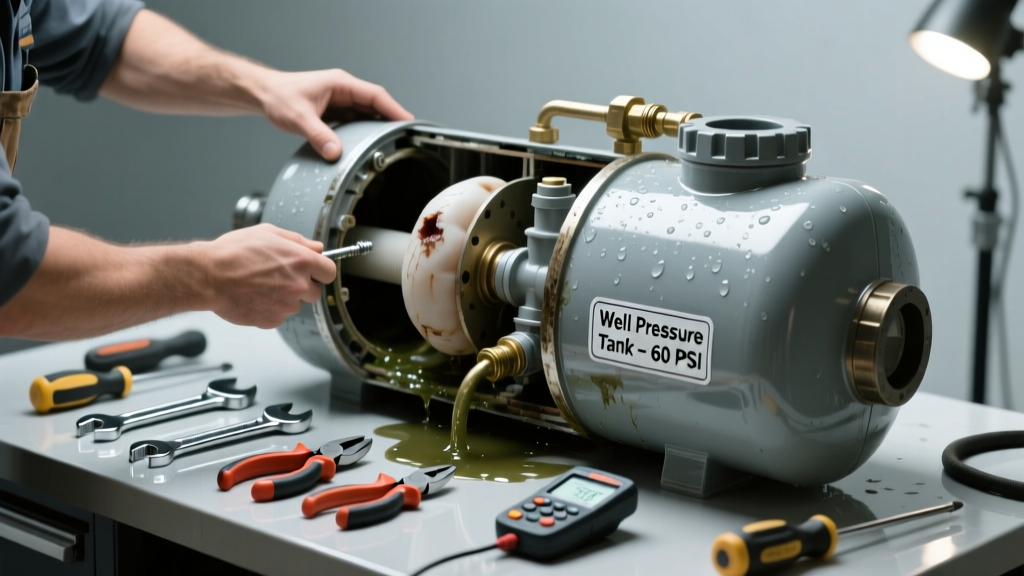
If your well system suddenly sounds like a drum solo—banging, groaning, or short-cycling every 30 seconds—you’re likely dealing with a waterlogged pressure tank. This isn’t just annoying; it stresses your pump, spikes energy use, and can lead to premature failure.
Quick Diagnosis
Before grabbing tools, rule out these common culprits:
- Abnormal air charge loss (most frequent cause)
- Failed internal bladder (in bladder-type tanks)
- Clogged air valve or corroded Schrader valve stem
- Leaking tank body or rust-perforated steel shell
- Incorrect pressure switch settings (learn how to test and adjust)
Tools & Materials Needed
| Item | Purpose | Estimated Cost |
|---|---|---|
| Tire pressure gauge (0–100 PSI, digital preferred) | Accurately measures pre-charge air pressure | $12–$25 |
| Bicycle pump or small air compressor | Recharges air without overpressurizing | $20–$80 |
| Adjustable wrench & 7/16" socket | Accesses Schrader valve and drain fitting | $15–$35 |
| Bucket & garden hose | Drains tank safely before recharging | $5–$12 |
| Pressure switch tester (multimeter) | Verifies cut-in/cut-out pressures match tank charge | $18–$40 |
Step-by-Step Fix
Follow this sequence—skip steps only if you’ve confirmed the issue via diagnosis:
- Shut off power to the well pump at the breaker panel. Tag it so no one turns it on.
- Drain the tank: Close the main water shutoff, open a faucet downstairs until flow stops, then attach a hose to the tank’s drain valve and empty completely.
- Check air charge: Use your tire gauge on the Schrader valve (looks like a bike tire valve on top). It should read 2 PSI below your pump’s cut-in pressure (e.g., 38 PSI for a 40/60 switch).
- Recharge if low: Add air slowly with a pump until reaching correct pre-charge. Never exceed 5 PSI below cut-in—overcharging damages bladders.
- Test operation: Restore power, open shutoff, and monitor for 3–5 cycles. Quiet, steady pressure buildup = success.
When to Call a Pro
Don’t risk safety or system damage in these scenarios:
- You hear hissing air from the tank body—indicates a ruptured bladder or micro-crack in steel
- The tank feels spongy or bulges when tapped (sign of internal corrosion)
- After recharging, pressure still drops rapidly or pump runs >2 minutes continuously
- Your tank is older than 10 years and has never had its air charge verified (bladder fatigue is likely)
- You’re unsure whether your tank is bladder-type or air-over-water—misdiagnosis risks flooding or explosion
According to the National Ground Water Association’s Well Owner’s Handbook (2022), “Over 68% of premature well pump failures trace back to undiagnosed or improperly maintained pressure tanks.”
Prevention Tips
Maintain consistent performance with these habits:
- Check air charge every 6 months—especially before winter and after heavy summer use
- Install a pressure gauge near the tank to spot early fluctuations
- Keep the tank’s mounting bolts tight and base level to prevent stress fractures
- Replace rubber isolation mounts every 5 years—they degrade and transmit noise
- Consider upgrading to a high-efficiency diaphragm tank with built-in air maintenance (like the Grundfos DDA series)
How often should I check my pressure tank’s air charge?
Every six months minimum—and always after any major pressure fluctuation, pump replacement, or seasonal temperature shift over 20°F. Temperature changes directly affect air volume: a 30°F drop can reduce pre-charge by up to 5 PSI.
Can I use bleach to clean inside the tank?
No. Bleach corrodes steel tanks and degrades EPDM bladders. If sediment is suspected, flush the system using a dedicated well cleaning kit—not chemical additives. For persistent grit, consult a licensed well contractor about hydrofracturing or line flushing.
Why does my tank make a loud ‘thunk’ when the pump kicks on?
This is usually water hammer caused by missing or failed air cushion. A properly charged tank absorbs hydraulic shock. If the thunk persists after recharging, inspect your water hammer arrestor or install one near the pump discharge (see our arrestor installation guide).
Is it safe to tap the tank with a wrench to check for hollow sound?
Light tapping is fine—but avoid forceful strikes. A dull thud instead of a ring suggests waterlogging or internal delamination. If the tank sounds inconsistent across its surface, stop testing and call a pro: hidden corrosion may compromise structural integrity.
What’s the difference between cut-in pressure and pre-charge?
Cut-in is the pressure at which the pump starts (e.g., 40 PSI); pre-charge is the air pressure inside the tank when empty (always 2 PSI lower). Confusing them causes chronic undercharging. Always verify both with calibrated gauges—not assumptions.
Can a waterlogged tank cause low water pressure upstairs?
Yes—especially during simultaneous use. A waterlogged tank loses its ability to store pressurized water, forcing the pump to run constantly. That reduces peak flow and delays pressure recovery. You’ll notice weaker shower pressure and slower faucet fill times.
A waterlogged tank doesn’t have to mean a full system overhaul—just careful diagnostics and timely intervention. With the right tools and a methodical approach, most homeowners can restore quiet, efficient operation in under an hour. And remember: that groan isn’t just noise—it’s your system asking for attention before something more expensive breaks.