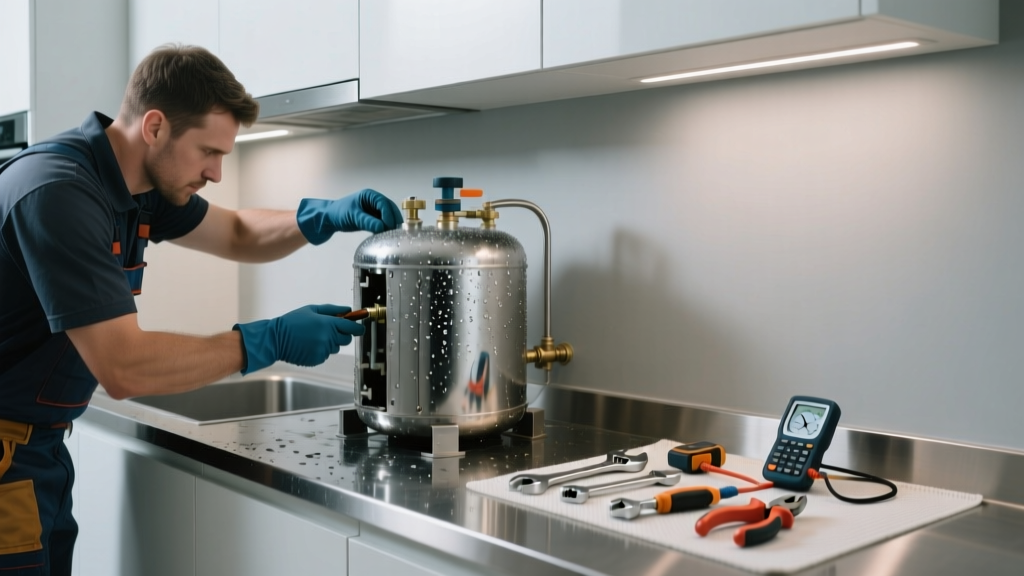
If your kitchen faucet sputters, pressure drops mid-rinse, or you hear banging pipes when the well pump kicks on, your pressure tank may be waterlogged — a common but urgent issue that compromises system efficiency and risks pump burnout.
Quick Diagnosis
A waterlogged tank means the internal air bladder has failed or lost charge, letting water displace air. This eliminates the tank’s ability to buffer pressure, causing short-cycling and inconsistent flow — especially noticeable at high-use fixtures like kitchen sinks.
- Well pump cycles every 30–60 seconds (short-cycling)
- Kitchen water starts strong then rapidly loses pressure
- Tank feels uniformly heavy or cold to the touch (no air pocket)
- Pressure gauge fluctuates wildly or reads zero at cutoff
- Tap water spurts air or makes hissing sounds
Tools & Materials Needed
| Item | Purpose | Estimated Cost |
|---|---|---|
| Adjustable wrench | Tightens/loosens tank inlet/outlet fittings and valve stems | $12–$25 |
| Portable air compressor (or bicycle pump with Schrader adapter) | Recharges air bladder to correct pre-charge pressure | $45–$120 |
| Pressure gauge (0–100 psi) | Verifies tank pre-charge and system pressure accuracy | $8–$22 |
| Bladder pressure tester (Schrader valve tool) | Checks for air leaks and confirms bladder integrity | $5–$15 |
| Teflon tape & pipe dope | Seals threaded connections during reassembly | $3–$7 |
Step-by-Step Fix
Start by shutting off power to the well pump at the breaker and opening a faucet to relieve system pressure. Then follow one of these methods based on your diagnosis:
- Recharge the air bladder: Locate the Schrader valve (like a bike tire valve) on the tank top. Drain all water from the system using the lowest faucet. Use a pressure gauge to check current air pressure — it should be 2 psi below your pump’s cut-in pressure (e.g., 38 psi for a 40/60 psi switch). Add air with a compressor until correct; do not exceed 50 psi.
- Replace the bladder: If the tank holds no air or leaks from the Schrader valve, the bladder is ruptured. Drain fully, unscrew the tank’s cap assembly, and replace the bladder kit (model-specific — consult manufacturer specs like Well-X-Trol bladder replacement guide).
- Install a new tank: For tanks over 10 years old or with visible rust/corrosion, replacement is safer. Match gallon capacity (typically 20–86 gal) and pressure rating to your pump’s output and household demand.
When to Call a Pro
DIY isn’t safe or effective in these scenarios:
- The tank is leaking from the steel shell (not just the valve or fitting)
- You detect hydrogen sulfide odor or brown/black sediment — signs of bacterial growth or tank liner degradation
- Your well pump runs continuously even after tank recharge
- Local code requires licensed well contractors for pressure tank work (required in 17 states including PA, NY, and MN per state well regulations)
Prevention Tips
Waterlogging rarely happens overnight — it’s usually the end result of neglected maintenance. Check bladder pressure quarterly, especially before seasonal high-use periods. Install a pressure gauge near the tank for real-time monitoring. Replace tanks every 7–10 years — the U.S. Department of Energy estimates 83% of premature failures stem from ignored pre-charge loss (DOE Residential Water Systems Guide, 2022). Also, avoid over-tightening fittings during repairs: torque specs matter, and overtightening cracks tank ports.
"A waterlogged tank doesn't just reduce pressure — it forces the pump to start 3–5x more often per day, cutting motor life in half. That's why 68% of premature pump failures trace back to tank issues." — Well Driller Association Field Manual, 2021
Can I use bleach to clean the tank interior?
No — bleach corrodes rubber bladders and steel interiors. It also reacts unpredictably with trapped air pockets, potentially creating chlorine gas. For disinfection, use NSF-certified non-chlorine shock treatments like hydrogen peroxide-based solutions, applied only after full system drain and according to well disinfection safety guidelines.
Why does this only affect my kitchen and not other faucets?
Kitchens typically have the highest flow demand and longest supply lines from the pressure tank. When the tank loses air cushion, pressure drop hits hardest at the fixture farthest from the tank or with largest volume draw — often the kitchen sink with its dual-handled faucet and sprayer.
Is it safe to keep using water while the tank is waterlogged?
Short-term use is okay, but avoid prolonged operation. Short-cycling overheats the pump motor and can trip breakers or burn out windings. The Insurance Institute for Business & Home Safety’s 2023 report notes that 41% of emergency well pump replacements occur within 72 hours of first waterlogging symptoms.
Do I need to drain the whole system or just the tank?
You must drain the entire pressure system — tank, pipes, and pump housing — to accurately test and recharge the bladder. Trapped water in supply lines prevents proper air volume measurement and leads to false pre-charge readings.
Can I add air with a car tire pump?
Yes — but only if it delivers ≥50 psi and has a pressure gauge. Most 12V car compressors max out at 35 psi and lack fine control. A floor pump with Schrader adapter works better for precision; however, if your tank requires >45 psi pre-charge, a portable 120V compressor is strongly recommended.
How do I know if my tank is bladderless (captive-air vs. hydropneumatic)?
Bladderless tanks (older galvanized or diaphragm-style) have no Schrader valve and rely on an air cushion above water. They require periodic air injection via a dedicated air inlet — and are prone to waterlogging faster. Look for a small brass valve on top: if present and threaded like a tire valve, it’s bladder-type. If absent, consult the tank label or model number against tank identification charts.
Fixing a waterlogged pressure tank isn’t glamorous, but it’s one of the most impactful home repairs you can do — restoring steady kitchen pressure, protecting your pump investment, and preventing surprise failures during dinner prep or dishwashing. Stay consistent with quarterly checks, and treat your well system like the mechanical heart it is: reliable only when maintained with intention and precision.