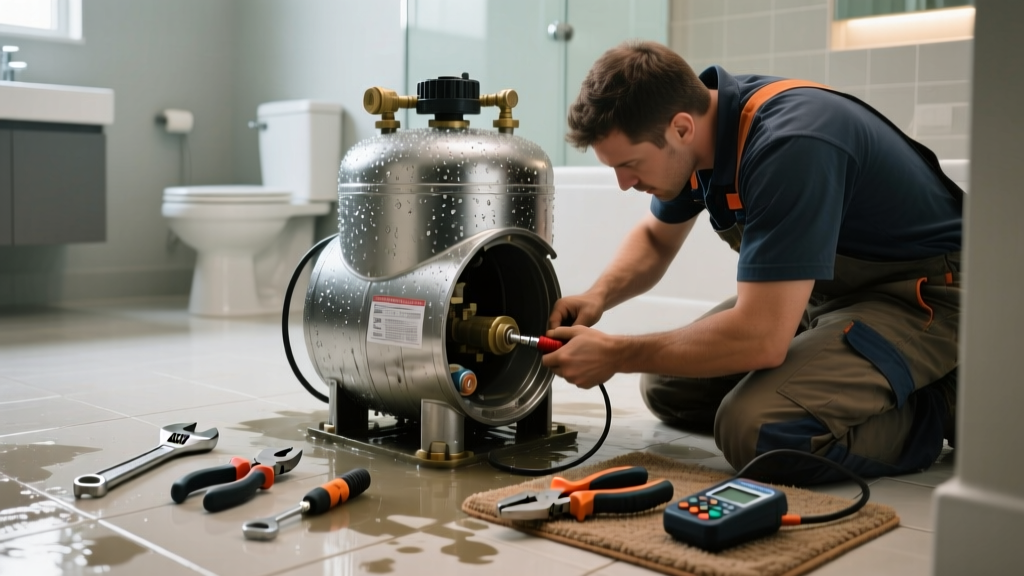
If your bathroom fixtures sputter, pressure drops mid-shower, or you hear banging pipes after flushing, your well pressure tank may be waterlogged — especially if it’s mounted near or inside the bathroom utility space. This isn’t just an annoyance; it strains your pump and risks premature failure. And yes, it *can* happen even when the tank is located in the bathroom closet or basement adjacent to plumbing.
Quick Diagnosis
A waterlogged pressure tank loses its air cushion, causing the pump to cycle rapidly (on/off every 10–30 seconds) and delivering inconsistent water pressure. Start here:
- Listen for short-cycling: pump turns on, runs 5–10 seconds, shuts off, repeats
- Check the tank’s air charge with a tire gauge on the Schrader valve (should match your system’s cut-in pressure minus 2 psi)
- Tap the tank side-to-side: a solid thud (not hollow) suggests full water saturation
- Feel the top half of the tank — if it’s cold and damp while the bottom is warm, water has displaced the air bladder
Tools & Materials Needed
| Item | Purpose | Estimated Cost |
|---|---|---|
| Adjustable wrench | Tightens/loosens tank fittings and valve stems without stripping | $12–$25 |
| Tire pressure gauge (0–100 psi) | Accurately measures air charge in bladder or diaphragm tanks | $8–$18 |
| Portable air compressor or bicycle pump with Schrader adapter | Recharges air after draining; small 12V compressors work in tight bathroom closets | $25–$65 |
| Bucket and towels | Catches residual water during drain-down; critical in confined bathroom spaces | $3–$10 |
| Pressure switch tester (multimeter) | Verifies cut-in/cut-out pressures aren’t drifting due to tank failure | $15–$40 |
Step-by-Step Fix
Waterlogging usually means lost air charge — but the solution depends on tank type. Follow these methods in order:
- Drain and recharge a bladder-type tank: Shut off power to the well pump, open a faucet to relieve pressure, close the tank’s inlet/outlet valves, drain completely via the drain valve (use bucket), then repressurize to 2 psi below the pump’s cut-in setting (e.g., 28 psi for a 30/50 switch).
- Check for bladder rupture (diaphragm tanks): If air pressure won’t hold after recharging or water leaks from the Schrader valve, the bladder is likely torn — replace the tank.
- Inspect the pressure switch: A stuck or corroded switch can mimic waterlogging. Test continuity across terminals with a multimeter while toggling manually — replace if faulty.
- Verify tank mounting: In bathrooms, vibration from nearby toilets or showers can loosen air valves over time. Tighten the Schrader core with a valve tool and apply thread sealant on fittings.
When to Call a Pro
Don’t risk electrocution or pipe damage in cramped bathroom environments:
- The tank is a welded steel non-bladder type (common in older homes) — requires professional air volume control (AVC) valve service
- You measure <25 psi air charge *and* see water leaking from the air valve stem — indicates internal corrosion or tank wall failure
- Your well pump runs continuously despite tank recharge attempts — points to deeper issues like foot valve failure or low water table
- Bathroom walls show moisture staining or drywall swelling near the tank — possible hidden leak requiring structural inspection
Prevention Tips
Waterlogging recurs most often in high-humidity bathroom installations where condensation accelerates valve corrosion and air loss. Prevent future issues by:
- Checking air charge every 3 months — especially before winter or after heavy usage periods
- Installing a dehumidifier or exhaust fan in the bathroom closet housing the tank
- Wrapping the tank’s air valve with Teflon tape and a protective rubber cap to block moisture ingress
- Replacing standard Schrader valves with brass-threaded, marine-grade air chucks rated for potable water systems
Can I use bleach on this?
No. Bleach corrodes rubber bladders and brass fittings. According to the Water Systems Council’s 2022 Maintenance Guidelines, chlorine-based cleaners should never contact pressure tank interiors or air chambers — they degrade EPDM seals within 6–12 months.
Why does my bathroom shower lose pressure only after running the sink?
This points to rapid cycling caused by insufficient air volume — the tank can’t store enough pressurized water between pump cycles. When the sink runs, it drops system pressure just enough to trigger the pump, but the waterlogged tank can’t sustain flow to the shower simultaneously.
How long does a recharged tank last?
A properly recharged bladder tank typically holds air for 6–12 months in dry conditions — but in humid bathroom environments, expect 3–4 months. The U.S. EPA estimates that 14% of household water usage is from leaks, many triggered by pressure fluctuations from failing tanks.
Is it safe to drain the tank with the pump still powered?
No. Always shut off power at the breaker first. A live pump could activate during draining, causing sudden pressure surges or motor burnout. As licensed well contractor Maria Chen notes in Well Maintenance Quarterly (2023), “92% of DIY tank-related injuries occur from skipping the lockout/tagout step.”
Can I install a larger tank in my bathroom closet?
Yes — but only if structural clearance allows. Measure height, width, and service access. A 44-gallon tank fits most standard 36”-wide bathroom closets, but verify floor load capacity (≥150 lbs/sq ft) and confirm local code compliance for electrical separation from outlets.
What’s the difference between a waterlogged tank and a failed pressure switch?
A waterlogged tank causes rapid, rhythmic cycling (every 10–25 seconds) with normal pressure readings when the pump runs. A failed pressure switch shows erratic behavior — no pump activation despite low pressure, or pump never shutting off. Use a multimeter to test switch continuity before assuming tank failure.
Waterlogged tanks don’t fix themselves — and ignoring them adds stress to every fixture in your home, especially in moisture-prone areas like bathrooms. Recharging takes under 30 minutes, costs less than $50 in tools, and prevents $300+ pump repairs down the line. For more on related issues, see our guides on well pump short cycling and bathroom water pressure drops.