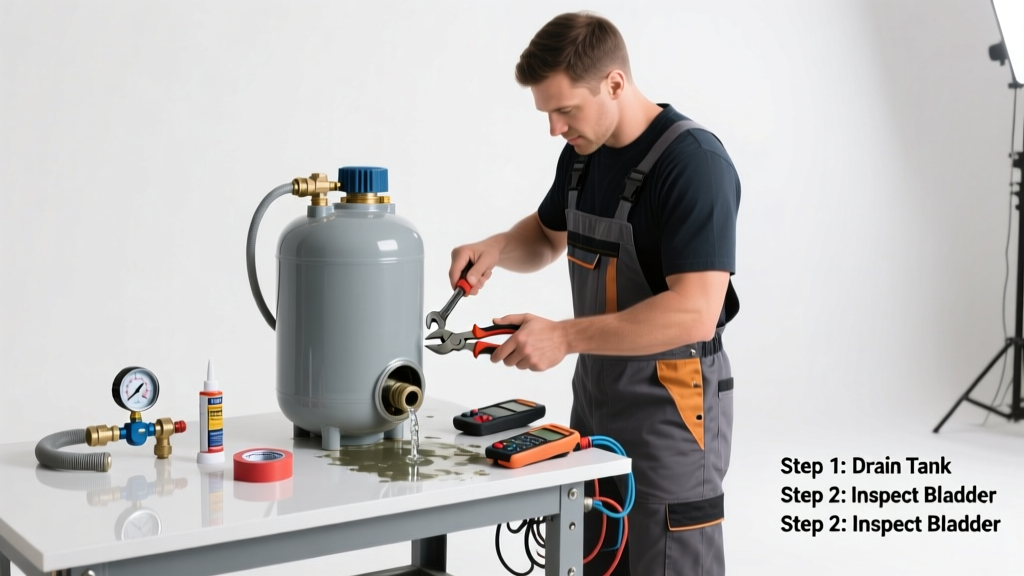
If your well pump kicks on every 30 seconds—or you hear a hollow thud when tapping the tank—it’s likely waterlogged. This common issue starves the air cushion, overworking your pump and risking burnout. Fixing it is often simple, but missteps can damage the bladder or create unsafe pressure conditions.
Quick Diagnosis
A waterlogged tank loses its air charge, causing erratic pressure and frequent pump cycling. Confirm it’s waterlogged—not just low pressure—by checking these telltale signs:
- Tank feels uniformly heavy or cold to the touch (no warm upper section)
- No audible 'thump' when tapped near the top—just a dull, solid sound
- Pressure gauge drops rapidly after opening a faucet, then spikes as pump kicks in
- Water spurts from the air valve stem when depressed (indicating water in the air chamber)
Tools & Materials Needed
| Item | Purpose | Estimated Cost |
|---|---|---|
| Bicycle pump or air compressor (with regulator) | Recharges air chamber to correct PSI; must deliver up to 50 PSI safely | $25–$120 |
| Tire pressure gauge (0–60 PSI range) | Verifies pre-charge pressure before and after refilling | $8–$22 |
| Adjustable wrench or socket set | Removes air valve cap and loosens fittings if draining is needed | $12–$45 |
| Garden hose + bucket | Drains tank if bladder is ruptured or sediment buildup is suspected | $5–$15 |
| Shop towel and safety glasses | Protects eyes during air valve testing and prevents debris entry | $3–$10 |
Step-by-Step Fix
Most waterlogged tanks only need an air charge reset—but confirm the bladder isn’t ruptured first. Follow this sequence:
- Shut off power to the well pump at the breaker panel—never skip this step.
- Drain the tank: Open a faucet at the lowest point in the house until flow stops, relieving water pressure.
- Check current air pressure: Depress the Schrader valve (like a bike tire valve) on top of the tank with a dry rag. If water sprays out, the bladder is likely torn—stop here and jump to When to Call a Pro.
- Recharge the air: Using a regulated air source, add air to reach 2 PSI below your pump’s cut-in pressure (e.g., 38 PSI for a 40/60 switch). Use your tire gauge to verify.
- Restore power and test: Turn the pump back on, let it cycle 2–3 times, then monitor pressure stability and pump runtime.
When to Call a Pro
DIY fixes fail—and become hazardous—when internal components are compromised. Call a licensed well contractor immediately if:
- Water sprays from the air valve when depressed (bladder rupture)
- Tank shows visible rust, bulging, or weeping at the base seam
- Pump runs continuously even after recharging air
- You measure less than 10 PSI of air pressure *and* the tank is over 10 years old (corrosion risk)
According to the National Ground Water Association’s 2022 Well Owner’s Handbook, nearly 68% of premature pressure tank failures stem from undetected bladder leaks or incorrect pre-charge settings—issues best diagnosed with calibrated gauges and system isolation valves.
Prevention Tips
Extend your tank’s life by making these habits routine:
- Test air pressure every 3 months—especially before winter and after heavy usage periods
- Install a pressure gauge with a built-in air bleeder valve for easier maintenance
- Keep the pressure switch clean and dry; moisture accelerates contact corrosion
- Replace rubber diaphragms every 5–7 years—even if the tank seems fine (per Amtrol technical bulletin, 2021)
Can I use a regular bicycle pump?
Yes—but only for small tanks (under 20 gallons) and if the pump delivers at least 50 PSI. Most floor pumps max out around 120 PSI, which is safe, but hand pumps rarely exceed 60 PSI and may require 100+ strokes. For larger tanks (44+ gal), use an air compressor with a pressure regulator to avoid over-pressurizing.
How do I know my pump’s cut-in pressure?
Look at the pressure switch mounted near the tank—it’s usually labeled (e.g., “40/60” means cut-in at 40 PSI, cut-out at 60 PSI). If unmarked, shut off power, remove the switch cover, and check the factory-set differential screw positions or consult your pump’s manual. You can also observe the gauge during operation: note the PSI when the pump starts.
Why does my tank keep losing air?
Chronic air loss points to either a slow bladder leak (common in tanks over 7 years old) or a faulty Schrader valve core. Replace the valve core first ($2.50 part)—it’s the easiest fix. If air still bleeds out within 48 hours, the bladder is compromised and the tank needs replacement.
Is it safe to drain the tank while the pump is on?
No—never drain under pressure or with power live. Doing so risks scalding from hot water, sudden pressure release, or electrical shock. Always shut off power *and* open a faucet to relieve pressure before touching any tank components.
What’s the right air pressure for a 30/50 pressure switch?
Set the pre-charge to 28 PSI—2 PSI below the cut-in setting. This ensures the bladder expands fully before the pump engages. Overcharging (e.g., 35 PSI) causes short cycling; undercharging (e.g., 20 PSI) leads to waterlogging within days.
Can sediment cause waterlogging?
Sediment doesn’t cause waterlogging directly—but heavy silt buildup inside the tank can restrict bladder movement, mimic waterlogged symptoms, and accelerate corrosion. If you drain murky, rusty water, flush the tank annually and consider installing a sediment filter upstream.
A properly maintained pressure tank should last 10–15 years—but skipping air checks every season cuts that lifespan by nearly half. Recharging takes 10 minutes and costs nothing beyond your time. Pair it with a quick visual inspection of the tank base and wiring connections, and you’ll dodge most emergency calls. For deeper diagnostics, see our guide on well pump not building pressure or testing a well pressure switch.