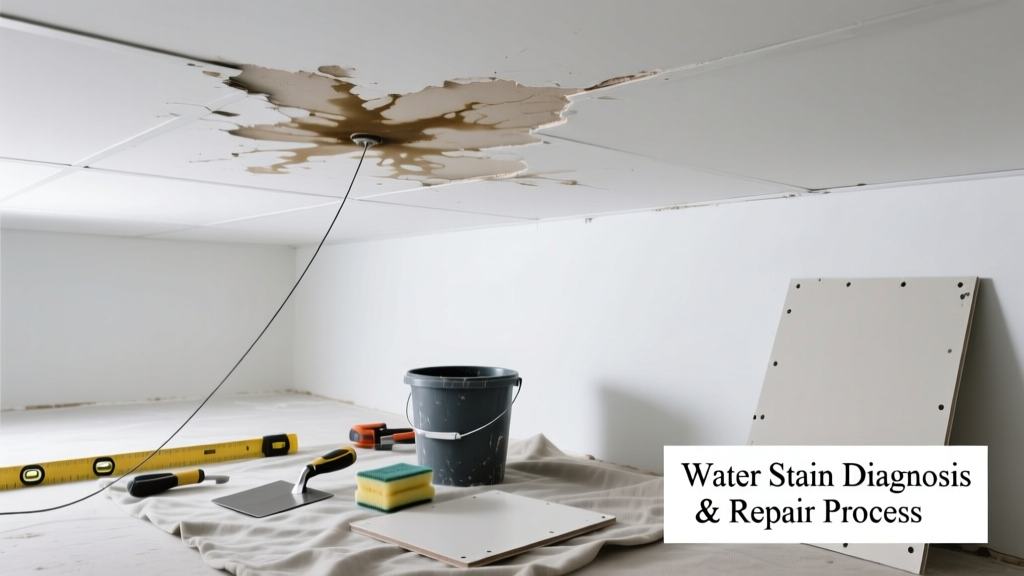
That faint *pop*, *creak*, or intermittent *drip-squeak* coming from a water-stained patch on your ceiling isn’t just annoying—it’s your home screaming for attention. Unlike silent stains, noisy ones mean trapped moisture is actively shifting, warping drywall, or pressurizing behind the surface. Ignoring it risks sagging, mold growth, or sudden collapse.
Quick Diagnosis
Start here—don’t grab tools yet. Listen and observe closely:
- Intermittent ticking or popping during temperature swings (e.g., furnace cycling on/off) — indicates expanding/contracting wet drywall or framing
- Wet-sounding squish or drip-squeak when walking upstairs — suggests saturated insulation pressing against compromised drywall
- Low-frequency hum or vibration near the stain — often tied to leaking plumbing above (e.g., a loose washer in a second-floor bathroom faucet)
- Dripping only after rain — points to roof or flashing failure, not plumbing
- Stain growing + audible moisture movement — high risk of gypsum core delamination; drywall integrity is failing
Tools & Materials Needed
| Item | Purpose | Estimated Cost |
|---|---|---|
| Multimeter with non-contact voltage detector | Verifies no live wires near suspected leak path before cutting into ceiling | $25–$45 |
| 12-inch utility knife with snap-off blades | Clean, controlled access cut into drywall without damaging lath or joists | $8–$15 |
| Moisture meter (pin-type) | Measures exact % moisture content in drywall and framing—critical for confirming active saturation | $60–$120 |
| 3M Scotchgard Mold & Mildew Resistant Primer | Seals tannin bleed and blocks spores; required before repainting over repaired area | $22–$28 |
| 1/2" drywall patch kit with mesh tape | Replaces damaged section; mesh prevents future cracking at repair seams | $12–$20 |
Step-by-Step Fix
- Shut off water and power: If noise correlates with plumbing use, turn off the main water supply. Flip the circuit breaker for lights/fans near the affected zone—even if wiring seems distant, moisture can track along conduits.
- Confirm active moisture: Use your pin-type moisture meter. Readings above 17% in drywall or >19% in wood framing indicate active saturation—not just dried residue.
"Over 80% of ceiling collapses linked to water damage occur within 72 hours of first audible distortion," says the National Association of Home Builders' 2022 Structural Safety Bulletin.
- Make a diagnostic access hole: Cut a 6" × 6" square centered just below the lowest edge of the stain using your utility knife. Probe gently with a screwdriver—if drywall feels spongy or gives slightly, stop and call a pro (see next section). If firm but damp, proceed.
- Trace and stop the source: Shine a flashlight upward. Look for wet joists, dripping pipes, or pooled insulation. For roof-related leaks, check attic ventilation—condensation buildup mimics leak noise. Repair flashing or replace rotted decking as needed. For plumbing, tighten compression fittings or replace corroded shutoff valves—compression fitting replacement takes under 20 minutes with the right wrench.
- Repair and seal: Remove all wet drywall and insulation. Let cavity air-dry 48–72 hours (use a dehumidifier set to 35% RH). Prime bare wood with oil-based primer, then patch drywall. Finish with mold-resistant joint compound and humidity-resistant ceiling paint.
When to Call a Pro
Don’t gamble with safety. Call a licensed contractor or water restoration specialist immediately if you observe any of these:
- Stain larger than 24 inches across with concurrent sagging or bulging
- Moisture meter readings >22% in structural framing members
- Musty odor + visible black mold (especially Stachybotrys) around or behind the stain
- Noise accompanied by flickering lights or tripped breakers—indicates compromised electrical wiring
- Leak originates from a flat roof, skylight, or shared wall in a condo—requires building-wide coordination
Prevention Tips
Stop recurrence before it starts:
- Install smart water leak detectors (like the Moen Flo) under sinks and near water heaters—they alert you to drips before they reach the ceiling
- Inspect roof valleys and chimney flashing annually; reseal with urethane caulk every 3 years
- Run bathroom fans for 20 minutes post-shower—even in winter—to reduce condensation buildup in attic spaces
- Keep attic insulation level and uncompressed—bunched insulation traps warm, moist air that condenses on cold roof sheathing
Can I paint over the stain without fixing the leak?
No. Covering a wet stain with regular paint or primer traps moisture, accelerating drywall deterioration and encouraging hidden mold growth behind the surface. Even stain-blocking primers like Kilz require a fully dry substrate—applying them over active moisture voids their warranty and creates a false sense of security.
Why does the noise get louder at night?
Ambient noise drops, yes—but more critically, household water pressure rises when demand falls (e.g., midnight), pushing more water through compromised seals. Also, cooler nighttime temperatures cause wet drywall and framing to contract slightly, releasing built-up tension with audible pops. The U.S. EPA estimates that 14% of household water usage is from undetected leaks—many of which announce themselves first through sound.
Is the stain safe to touch?
Wear nitrile gloves and an N95 mask before touching. Water-damaged drywall often harbors Aspergillus or Penicillium spores—even without visible mold. If the area feels cool, damp, or leaves residue on your glove, assume biological contamination is present and avoid skin contact.
Can attic ventilation fix this?
Sometimes—but only if the noise stems from condensation, not a true leak. Proper attic airflow (1:150 net free vent area per square foot) reduces dew-point differentials that cause moisture to condense on cold roof decks and drip onto insulation. However, if you see water trails on rafters or rust on nails, ventilation alone won’t solve it.
How long until the ceiling collapses?
There’s no fixed timeline—but once audible deformation begins, structural degradation accelerates. According to the Insurance Institute for Business & Home Safety's 2023 report, ceilings with active water intrusion and audible movement have a 68% chance of partial failure within 5 days if left unaddressed. Don’t wait for dripping to become streaming.
Will a dehumidifier in the room help?
Marginally—and only if the source is stopped first. A portable dehumidifier pulls ambient moisture from the air but cannot extract water already absorbed deep into drywall or insulation. It may slow secondary damage but won’t silence the noise or prevent structural compromise. Focus upstream: find and stop the leak.
That odd sound isn’t background noise—it’s physics telling you something’s physically shifting overhead. Addressing it now protects not just your ceiling, but your home’s structural health and indoor air quality. Most repairs take one weekend, cost under $150 in materials, and prevent thousands in potential water damage claims later. Grab your moisture meter, listen carefully, and act before the next pop becomes a crack.