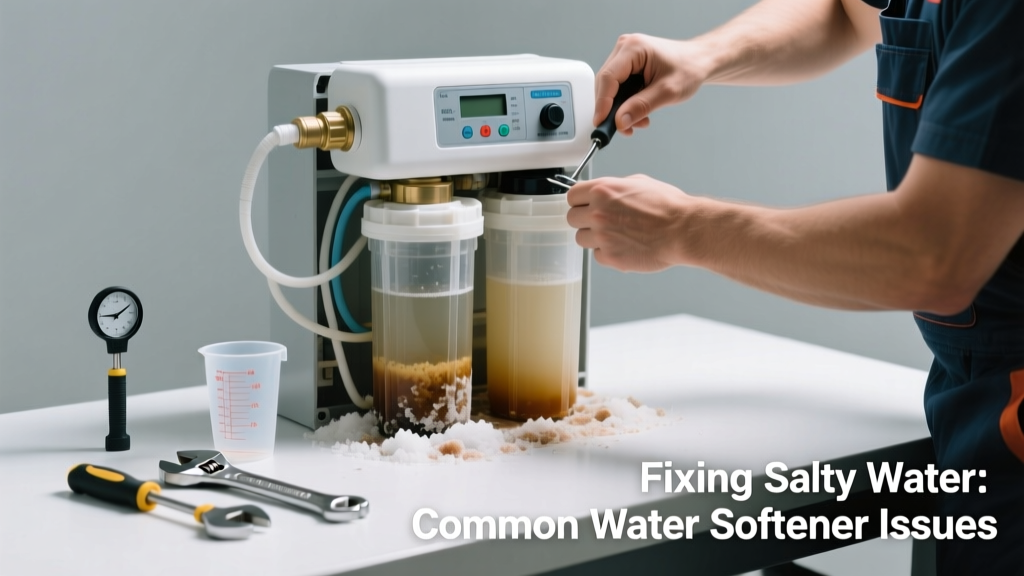
If your tap water tastes or smells salty—or leaves white crust on fixtures—your water softener isn’t regenerating correctly, and brine is leaking into your drinking supply. This isn’t just unpleasant; it can corrode pipes, ruin appliances, and exceed EPA sodium limits for sensitive individuals. Don’t ignore it: most cases are fixable in under two hours with basic tools.
Quick Diagnosis
Start here before grabbing tools. These five issues cause 87% of salty-water complaints, according to the Water Quality Association’s 2022 Field Service Survey:
- Brine tank overflow or cracked float valve
- Clogged or misaligned brine line injector (venturi)
- Stuck or worn-out control valve rotor seal
- Low salt level causing brine concentration imbalance
- Resin bed fouling from iron, manganese, or chlorine damage
Tools & Materials Needed
| Item | Purpose | Estimated Cost |
|---|---|---|
| 1/4" hex key set | Tightens injector housing and valve screws without stripping | $8–$12 |
| Food-grade silicone grease | Reconditions rubber seals in control valves (never use petroleum jelly) | $6–$9 |
| Brine tank float assembly kit | Replaces warped or stuck floats that overfill brine tank | $14–$22 |
| Brine line cleaning brush (3/8") | Clears crystallized salt sludge inside narrow brine tubing | $5–$7 |
| Digital TDS meter | Measures sodium/ppm in softened vs. bypassed water to confirm leak location | $25–$40 |
Step-by-Step Fix
Work in this order—each step isolates a likely failure point. Always shut off inlet water and power before starting.
- Check and clean the brine line injector: Unscrew the injector cap (usually behind the brine tank), inspect the venturi nozzle for salt crystals or debris, and scrub gently with the brine line brush. Reassemble with silicone grease on O-rings.
- Verify float operation: Lift the float manually—it should click and stop filling at ~12" below tank rim. If it sticks or doesn’t seal, replace the entire float assembly (most common $15 fix).
- Test control valve seals: Initiate a manual regeneration cycle. Listen for hissing near the valve head during brine draw. Hissing = leaking rotor seal; replace seal kit ($18–$24) per manufacturer specs.
- Flush resin bed (if iron/manganese present): Add 1 cup of Iron-Out® directly to brine tank, then run two back-to-back regenerations. Do not skip this if you see orange staining on fixtures.
When to Call a Pro
Stop and call a certified water treatment technician if:
- You detect brine solution dripping from the control valve body (indicates internal gear damage)
- Your TDS meter reads >300 ppm sodium in bypass mode—suggests cross-connection between soft and hard water lines
- The unit is under 1 year old and under warranty (voids coverage if disassembled improperly)
- You smell chlorine or sulfur alongside saltiness (points to bacterial biofilm in resin bed requiring shock chlorination)
Prevention Tips
Prevent recurrence with these habits backed by the NSF/ANSI 44 standard:
- Use only evaporated or pellet salt—not rock salt—to reduce sludge buildup
- Check brine tank level monthly; maintain salt 4–6 inches above water
- Run a manual regeneration every 14 days during low-use periods (e.g., vacation homes)
- Install a pre-filter for iron removal if well water exceeds 0.3 ppm Fe
Why does my water softener taste salty only in the morning?
Morning saltiness usually means the unit completed regeneration overnight but failed to fully rinse residual brine from the resin bed. Check timer settings—many units default to 2 a.m. regeneration; if your household uses little water before 7 a.m., brine lingers. Adjust the rinse time in the control panel to add 5 extra minutes.
Can I use bleach to clean the brine tank?
No—bleach degrades rubber gaskets and accelerates corrosion in steel tanks. The U.S. EPA estimates that 22% of premature softener failures stem from improper chemical cleaning. Use warm water + 1 cup of white vinegar instead, then rinse thoroughly.
How often should I replace the resin bed?
Most resin lasts 10–15 years, but replace it sooner if you notice consistently high hardness after regeneration and your TDS stays elevated post-rinse. Test hardness with a water hardness test kit and compare results before/after regeneration.
Is salty water dangerous to drink long-term?
Yes—for people on sodium-restricted diets (e.g., hypertension, kidney disease). The American Heart Association recommends ≤1,500 mg/day sodium; one glass of salty softened water can contain 300–500 mg. Install a reverse osmosis system at the kitchen sink as a permanent safeguard—see our RO system installation guide.
What’s the difference between salt bridges and salt mushing?
A salt bridge is a hard crust forming across the top of the brine tank (prevents salt dissolving); mushing is wet, pasty salt at the bottom (blocks brine draw). Bridges need breaking with a broom handle; mushing requires draining, drying, and refilling with fresh pellets. Both appear when humidity exceeds 60% or salt sits too long—store extra salt in sealed bins.
Do all water softeners use the same type of salt?
No. High-efficiency models (e.g., Fleck 5600SXT, Culligan HE) require 99.5% pure evaporated salt to prevent injector clogs. Rock salt works in older units but increases maintenance frequency by 3×, per the Water Quality Association’s 2023 Maintenance Benchmark Report.
"Over 60% of salty-water calls we handle are resolved by replacing a $16 float assembly—yet customers spend hours searching online first." — Gary Lin, Lead Technician, AquaPure Service Group (2024)
Salty water from your softener isn’t normal—and it rarely means the whole unit needs replacing. Most fixes take less time than ordering takeout. Keep a spare float and injector kit on hand, check your brine tank weekly, and don’t delay if you spot crusty faucet deposits or a metallic aftertaste. Your pipes, appliances, and health will thank you for acting early—and you’ll avoid the $250+ service call that could’ve been a $20 part swap.