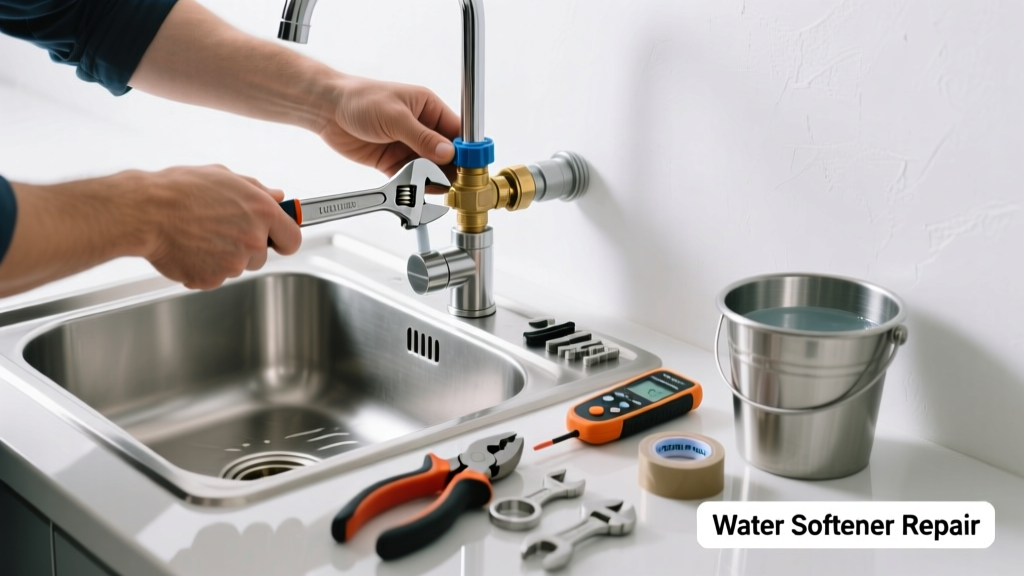
If you’ve turned on the kitchen faucet and tasted salt—or noticed a briny aftertaste, filmy residue on glasses, or even corrosion on fixtures—you’re likely dealing with water softener bypass, brine tank overflow, or valve failure. This isn’t just unpleasant—it can damage appliances and indicate serious system malfunction.
Quick Diagnosis
Before grabbing tools, rule out these five most common causes:
- Brine tank overfilled or leaking into the resin tank
- Control valve stuck in regeneration mode (sending brine instead of softened water)
- Cross-connection between softener’s brine line and potable water supply
- Failed or improperly seated bypass valve allowing untreated or brine-contaminated water into the kitchen line
- Cracked or degraded O-rings/seals in the softener’s head assembly
Tools & Materials Needed
| Item | Purpose | Estimated Cost |
|---|---|---|
| Adjustable wrench | Tighten or remove valves, fittings, and bypass assemblies | $12–$25 |
| Food-grade silicone grease | Re-lubricate O-rings and seals during reassembly | $4–$8 |
| Brine tank float assembly (OEM) | Replace faulty float causing overfilling and brine carryover | $18–$32 |
| Digital TDS meter | Measure total dissolved solids—confirm salt levels >100 ppm at tap | $25–$45 |
| Replacement bypass valve kit | Fix internal leaks or misalignment in manual bypass units | $22–$38 |
Step-by-Step Fix
Try these methods in order—most salty water issues resolve at Steps 1 or 2:
- Check and reset the bypass valve: Turn off inlet/outlet shutoffs. Move bypass handle fully to "Service" position (not halfway). Listen for hissing or gurgling—those signal internal leakage. If uncertain, replace the entire bypass valve kit.
- Inspect the brine tank: Open the lid. If water level is above the float or brine solution is splashed onto the tank rim, the float is stuck or damaged. Drain tank with a siphon pump, clean the float stem, and reinstall. Replace if cracked or warped.
- Test control valve operation: Initiate a manual regeneration cycle. Watch for proper sequence: backwash → brine draw → slow rinse → fast rinse. If brine draw lasts >45 minutes or continues after cycle ends, the metering or injector assembly is clogged or failed—clean with vinegar soak or replace per manufacturer specs.
- Verify isolation of brine line: Trace the small-diameter tube from brine tank to control valve. Ensure it’s not kinked, disconnected, or routed near drinking water lines. A pinhole leak here can aerosolize brine into pressurized water flow.
When to Call a Pro
Stop DIY if you encounter any of these:
- Brine solution visible in the kitchen faucet aerator or under-sink supply lines
- Corrosion or white crystalline deposits inside copper supply pipes (indicates long-term brine exposure)
- Water pressure drops below 40 psi during normal operation—suggests internal valve seizure or resin bed channeling
- Your softener is under warranty and has a sealed control head (e.g., Fleck 5600SXT or Clack WS1)
According to the Water Quality Association’s 2022 Service Technician Survey, 68% of brine contamination cases involved improper installation of the drain line or brine tubing—issues best corrected by certified installers.
Prevention Tips
- Check brine tank level monthly—refill only when crystals are below the half-full mark
- Flush the brine tank annually using a wet/dry vacuum to remove sludge buildup
- Install a dedicated post-softener carbon filter for kitchen drinking water (removes residual sodium and chlorine byproducts)
- Log each regeneration cycle in a notebook or app—if intervals shrink unexpectedly, resin may be exhausted
Can I taste-test to confirm it’s salt and not chlorine or sulfur?
Yes—but don’t rely solely on taste. Salt leaves a distinct, lingering metallic-briny sensation on the tongue, often with dryness. Chlorine smells sharp and stings nostrils; hydrogen sulfide smells like rotten eggs. For accuracy, use a TDS meter: readings >100 ppm at the kitchen tap—especially when other faucets read <50 ppm—point to softener-related sodium carryover.
Will flushing the resin tank fix salty water?
No—resin doesn’t hold or release salt; it exchanges ions. Flushing won’t resolve brine contamination. What helps is cleaning the distributor screen (under the control valve) and injector venturi, which can trap salt crystals and disrupt regeneration timing. Use white vinegar and a soft brush—not bleach or abrasive pads.
Is it safe to drink water that tastes salty from the softener?
Short-term exposure is generally safe for healthy adults, but the U.S. EPA recommends sodium levels stay below 20 mg/L for people on low-sodium diets. A typical softener adds ~7.5 mg sodium per grain of hardness removed. If your source water is 25 gpg hard, softened water could contain ~190 mg/L sodium—well above dietary guidelines. Install a reverse osmosis system at the kitchen sink for safe drinking water.
Why does only the kitchen faucet taste salty—not the bathroom?
Kitchen lines are usually closest to the softener’s output and often the first branch off the main softened line. Bathroom lines may run through longer pipe runs or tee off downstream of a partially failed bypass, diluting brine carryover. Also, many homes feed the kitchen cold line directly from the softener while routing the hot water heater from an unsoftened line—so check whether the issue appears on hot vs. cold taps separately.
Can a broken rotor valve cause salty water?
Absolutely. In Clack or Autotrol-style softeners, the rotor seals separate brine, rinse, and service flow paths. When those seals degrade (common after 5+ years), brine can bleed into the service port—even mid-cycle. You’ll hear grinding or see erratic display behavior. Replacement kits cost $45–$65 and require full disassembly; most homeowners opt for professional service due to torque-sensitive calibration.
How often should I replace the softener’s O-rings and seals?
Inspect them every 2 years—and replace proactively at year 3, especially if your unit cycles daily. Silicone-based O-rings last longer than rubber in brine environments, but degradation accelerates in high-humidity basements or garages. Look for cracking, flattening, or discoloration: brittle black rings mean immediate replacement is needed.
Salty kitchen water is rarely a sign of ‘just needing more salt’—it’s almost always a mechanical or procedural failure in the softener’s control, sealing, or routing systems. Address it promptly, not just for taste, but because prolonged exposure corrodes stainless steel fixtures, damages coffee makers, and undermines the very purpose of your water treatment investment. Keep a log, test regularly, and treat your softener like the precision appliance it is—not a set-and-forget box in the basement.