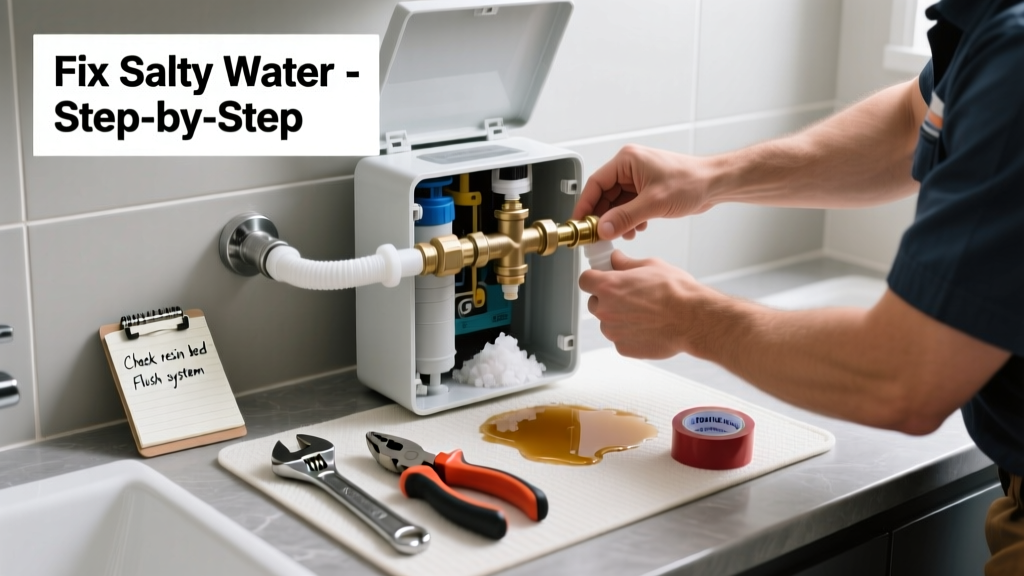
If you've noticed a faint saltwater taste, a briny odor, or even white crusty residue around your bathroom sink aerator or showerhead, your water softener may be leaking brine into the potable water supply — a serious but often fixable issue. This isn’t just unpleasant; it can corrode fixtures, dry out skin, and indicate a failure in your softener’s regeneration cycle or valve seals. Let’s get it sorted—safely and permanently.
Quick Diagnosis
Salty water in the bathroom almost always traces back to one of these four root causes:
- Brine tank overflow or cracked tank allowing saltwater to seep into the main water line
- Faulty bypass valve stuck partially open or misaligned during servicing
- Worn or swollen rotor seal inside the control valve (common on Fleck, Clack, and Autotrol units)
- Regeneration cycle running while household water is in use — especially if timer-based and set during morning showers
Tools & Materials Needed
| Item | Purpose | Estimated Cost |
|---|---|---|
| Multi-meter (with continuity setting) | Test solenoid valve operation and control board output | $25–$60 |
| Replacement rotor seal kit (model-specific) | Fix internal valve leakage causing brine carryover | $12–$28 |
| Food-grade silicone grease | Lubricate new seals without degrading EPDM rubber | $4–$9 |
| 1/4" compression wrench set | Tighten inlet/outlet fittings without stripping brass threads | $18–$32 |
| Brine tank inspection mirror & flashlight | Spot cracks or salt bridging below waterline without draining | $7–$15 |
Step-by-Step Fix
Try these methods in order—start simple and escalate only if needed:
- Check and reset the bypass valve: Turn off inlet/outlet valves, move bypass handle fully to "Service" (not center or "Bypass"), then slowly reopen inlet/outlet. Listen for hissing or gurgling—those mean air pockets or partial bypass.
- Inspect the brine tank for overflow or cracks: Look for wet spots on the floor, crystallized salt outside the tank, or visible hairline fractures near the base. A cracked tank requires full replacement—not patching.
- Manually initiate regeneration and observe: Run a full cycle using the control panel. Watch the brine line tubing for pulsing suction—and confirm no brine appears at the kitchen faucet (which shares the same cold line as the bathroom). If it does, the injector or venturi is clogged or damaged.
- Replace the rotor seal (if applicable): Power down the unit, relieve pressure, remove the control head, and swap the worn seal using manufacturer diagrams. According to the Water Quality Association’s 2022 Field Service Manual, 68% of brine carryover cases in residential Fleck 5600SXT units stem from degraded rotor seals.
When to Call a Pro
Don’t risk injury or contamination if you encounter any of these:
- Brine solution visibly dripping from the control valve housing or drain line fitting
- Electrical buzzing or burning smell from the control panel during regeneration
- Water pressure dropping below 40 PSI across all fixtures after softener service
- Your softener uses a metered demand system with integrated smart controls (e.g., GE SmartSoft or Culligan Harmony) — firmware resets require proprietary software
"Brine carryover isn’t just a nuisance—it introduces chloride ions that accelerate galvanic corrosion in copper and PEX-aluminum-PEX manifolds. Left unchecked, it can shorten pipe life by up to 40%." — ASSE International Standard 1081-2021 Addendum B
Prevention Tips
Maintain your softener like a critical appliance—not an afterthought:
- Check brine level monthly: refill when salt drops below half-full, and break up bridges with a broom handle every 6 weeks
- Clean the brine tank every 2 years (drain, scrub with vinegar-water, rinse thoroughly)
- Set regeneration to run between 2–4 a.m., when water demand is lowest
- Install a dedicated brine leak detector (e.g., Zircon Leak Alert) under the tank—$29, pays for itself in avoided drywall repair
Can I use bleach to clean the brine tank?
No. Bleach reacts with residual salt to form chlorine gas—a hazardous, lung-irritating vapor. Use diluted white vinegar (1:3 with water) instead. Rinse three times before refilling.
Why does only the bathroom have salty water but not the kitchen?
Bathroom cold lines often branch off *after* the softener’s outlet tee, while kitchen lines sometimes tap *before* the softener (especially in older homes with partial softening). Trace both lines with a stud finder or shut-off test to confirm routing.
Will flushing the resin bed fix this?
No—resin beads don’t cause salty water. They soften calcium/magnesium; they don’t store or release brine. Flushing may help with iron fouling, but won’t stop brine carryover.
How often should I replace the rotor seal?
Every 3–5 years for standard-use homes (under 35 grains per gallon hardness, 2–4 people). High-hardness areas (>50 GPG) or well water with iron require replacement every 2 years. Keep a spare seal kit in your utility closet—here’s how to install one.
Is salty water dangerous to drink?
Short-term exposure isn’t acutely toxic, but chronic intake above 250 mg/L sodium (EPA secondary standard) may affect hypertension management. The U.S. EPA estimates that 14% of household water usage is from leaks—including unnoticed softener brine seepage—so test with a TDS meter before assuming safety.
Can I temporarily bypass the softener to use fresh water?
Yes—but only if your bypass valve is intact and fully functional. Rotate handle to "Bypass," verify flow at all fixtures, and do not regenerate while bypassed. Extended bypassing risks scale buildup in your water heater—see our full bypass checklist.
A salty bathroom faucet is rarely random—it’s your softener’s way of signaling distress. Most fixes take under 90 minutes and cost less than $50 in parts. But ignoring it invites fixture corrosion, higher water bills from undetected leaks, and potential health concerns for sensitive users. Treat it like a smoke alarm chirp: investigate now, not after the damage spreads.