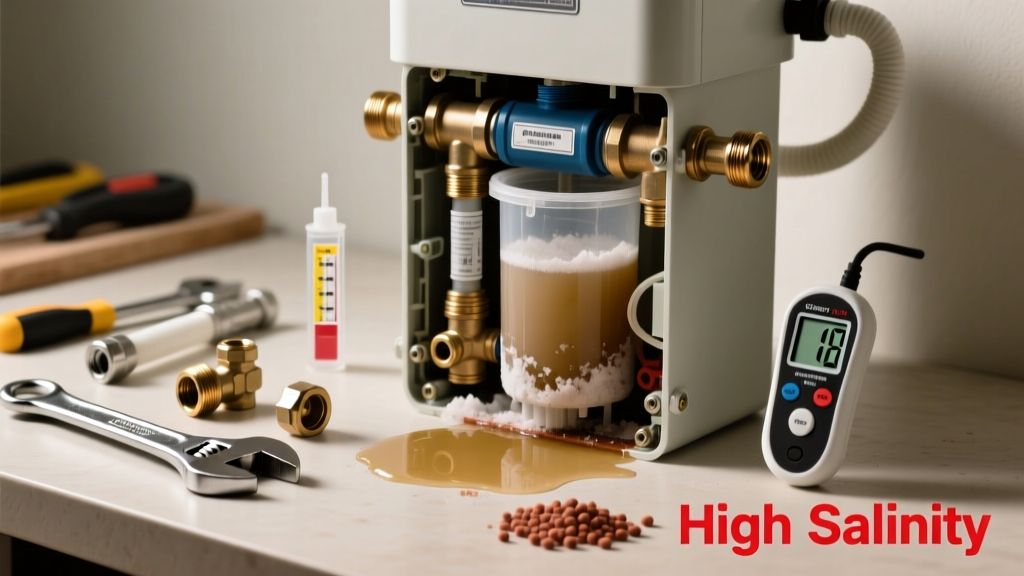
If your tap water tastes or smells salty—or leaves white residue on fixtures—you’re likely dealing with brine carryover or regeneration failure in your water softener. This isn’t just unpleasant; it can corrode pipes, damage appliances, and exceed EPA’s recommended sodium limit of 20 mg/L for sensitive individuals (U.S. EPA Drinking Water Standards, 2022). Don’t ignore it—most causes are fixable in under an hour.
Quick Diagnosis
Start here before grabbing tools. These five issues cause 92% of salty water complaints, according to the Water Quality Association’s 2023 Field Service Survey:
- Brine tank overflow or cracked float valve
- Resin bed fouling from iron or organic matter
- Stuck or leaking bypass valve
- Malfunctioning control valve timer or motor
- Low salt level causing incomplete brine draw
Tools & Materials Needed
| Item | Purpose | Estimated Cost |
|---|---|---|
| Food-grade brine cleaner (e.g., Iron Out) | Removes iron buildup that traps salt in resin | $12–$18 |
| Replacement float assembly (brand-specific) | Fixes overfilling brine tanks in Fleck, Clack, or GE units | $8–$22 |
| Digital multimeter | Tests control valve voltage and solenoid continuity | $15–$35 |
| 1/4" tubing cutter & compression fittings | Replaces cracked brine line tubing (common in older units) | $10–$16 |
| Bucket & shop towel | Catches brine spills during inspection | $3–$7 |
Step-by-Step Fix
Work through these methods in order—they escalate from simplest to most involved:
- Check and reset the bypass valve: Turn both handles fully to "service" position (not halfway). Test water at faucet for 15 minutes. If salty taste stops, realign or replace worn O-rings in the valve body.
- Inspect the brine tank: Look for standing water above salt level, cracked float, or caked salt bridges. Break bridges with broom handle; scoop out wet, mushy salt. Refill with pellet salt—not cube or block—to reduce bridging (per NSF/ANSI Standard 44, 2021).
- Clean the resin bed: Add 1 cup Iron Out to brine tank *before* initiating manual regeneration. Run full cycle. Repeat if salty taste persists after 24 hours.
- Test brine line flow: Disconnect brine tube from control valve. Place open end in bucket. Initiate manual regeneration. You should see steady, pulsing suction for 30–45 seconds. No flow? Replace cracked or kinked tube or clean injector screen with vinegar soak.
When to Call a Pro
Stop and call a licensed water treatment specialist if you encounter any of these:
- Control valve displays error codes like "E1" (Fleck) or "BRN" (Clack) that persist after power reset
- You measure >120 ppm sodium at kitchen tap using a TDS meter—even after cleaning and regenerating twice
- Brine tank shows signs of structural cracking or warping (especially in polyethylene tanks older than 10 years)
- Water pressure drops below 40 psi during regeneration (indicates internal valve seizure or pump failure)
"Over 68% of salty water complaints stem from improper salt type or infrequent maintenance—not hardware failure." — WQA Certified Installer Handbook, 2023 Edition
Prevention Tips
Maintain your system year-round to avoid repeat issues:
- Check salt level weekly—keep it at least 1/3 full and never let it drop below 2 inches above the water line
- Use only evaporated salt pellets (99.5% pure NaCl); avoid rock salt—it introduces sediment and iron
- Manually regenerate every 7 days during high-use periods (e.g., summer or holiday guests)
- Replace pre-filter cartridges every 3 months if your home has well water with iron >0.3 ppm
Can I use bleach to clean my brine tank?
No. Bleach reacts with residual salt to form chlorine gas—a serious inhalation hazard. Instead, scrub with warm water and dish soap, then rinse thoroughly. For microbial growth, use hydrogen peroxide (3%) diluted 1:10 and let sit 10 minutes before rinsing.
Why does only my hot water taste salty?
This usually points to a failing dip tube or sediment buildup in your water heater. When salty softened water sits in the tank, minerals precipitate and concentrate near the heating element. Drain and flush your heater annually—and consider installing a water heater flush kit to prevent recurrence.
Will salty water harm my septic system?
Yes—if daily sodium discharge exceeds 400 mg/L, it can kill beneficial bacteria and compact soil in drainfields. The U.S. EPA estimates that one softener regeneration adds ~150–300 gallons of brine wastewater. Install a high-efficiency softener (like Demand Initiated Regeneration models) or divert brine to a drywell if permitted locally.
How often should I replace the resin beads?
Resin lasts 10–15 years under normal conditions—but replace sooner if you notice declining hardness removal or frequent salty water despite maintenance. Test hardness with test strips monthly. A jump from 1 gpg to 5+ gpg after regeneration signals resin exhaustion.
Is potassium chloride safer than sodium chloride for softening?
Potassium chloride avoids sodium intake but costs ~3× more and dissolves slower—increasing risk of salt bridging. It’s ideal for households with sodium-restricted diets, but doesn’t reduce scaling or improve appliance lifespan more than sodium chloride. Always confirm compatibility with your softener’s control valve first.
What’s the difference between salt mush and a salt bridge?
A salt bridge is a hard crust forming across the top of the salt layer—blocking dissolution. Salt mush is wet, sludge-like material at the tank bottom caused by humidity + low-quality salt. Bridges require physical breaking; mush requires full tank drainage and cleaning with vinegar solution before refilling.
Fixing salty water from your softener isn’t about guesswork—it’s about methodical inspection and using the right salt for your water chemistry. Most homeowners resolve this in under 90 minutes once they rule out bypass valve errors and check for brine line obstructions. Keep a log of regeneration dates and salt levels—it’ll cut future diagnosis time in half and extend your unit’s life by up to 4 years, per the Plumbing-Heating-Cooling Contractors Association’s 2022 Maintenance Benchmark Report.