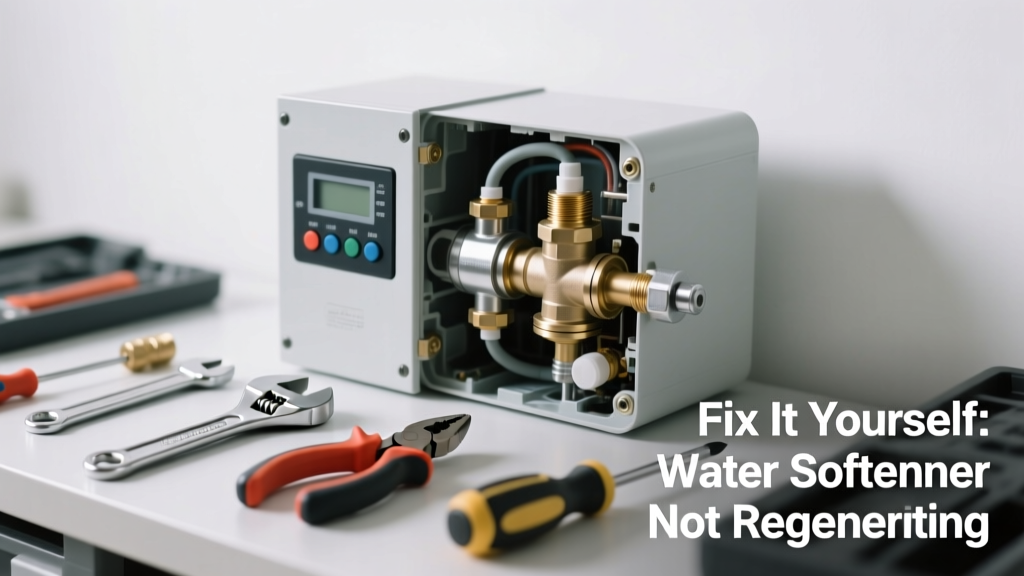
Your water softener isn’t regenerating — and suddenly your dishes have spots, your showerhead’s clogged, and laundry feels stiff. That ‘regen’ light is dark or blinking erratically, and you’re not sure where to start. Don’t replace it yet: most regeneration failures are simple fixes hiding in plain sight.
Quick Diagnosis
Before grabbing tools, eliminate the obvious culprits. Most non-regeneration issues stem from one of these five causes:
- Power outage or tripped circuit breaker affecting the control valve
- Low or depleted salt level in the brine tank (below 1/3 full)
- Brine tank bridging or mushing — salt forms a hard crust or sludge instead of dissolving
- Timer or clock setting accidentally changed or reset (especially after power loss)
- Clogged injector, venturi, or brine line tubing blocking suction during regeneration
Tools & Materials Needed
| Item | Purpose | Estimated Cost |
|---|---|---|
| Multimeter | Verify 120V power at outlet and transformer output (24V AC) | $15–$40 |
| Food-grade salt (pellets or crystals) | Refill brine tank; avoid rock salt with anti-caking agents that cause mushing | $5–$12 |
| Small wire brush & vinegar soak cup | Clean injector screen and venturi assembly without damaging delicate parts | $3–$8 |
| Replacement brine line tubing (1/4" ID) | Swap cracked, kinked, or algae-clogged tubing — common failure point | $4–$10 |
Step-by-Step Fix
Work through these methods in order — each addresses a progressively less obvious cause:
- Reset the timer and force a manual regeneration: Press and hold the ‘Regen’ or ‘Recharge’ button for 5 seconds (consult your manual — models vary). If it starts cycling, the issue was likely a missed schedule or clock drift. Note: Some units require holding ‘Up’ + ‘Down’ arrows simultaneously.
- Check and clean the brine valve assembly: Turn off inlet water, depressurize the system, then remove the brine line from the control valve. Blow compressed air through the line (or use a pipe cleaner), then inspect the injector screen for mineral scale. Soak it in white vinegar for 15 minutes, scrub gently with a nylon brush, and rinse thoroughly.
- Break up salt bridges and clear mush: Insert a broom handle vertically into the brine tank. Tap gently — if you hear a hollow sound, there’s a bridge. Poke downward to collapse it. Scoop out any grayish sludge (mush) with a plastic cup and discard. Refill with fresh salt to 6–8 inches below the tank’s overflow fitting.
- Verify electrical continuity: Use your multimeter to test voltage at the transformer’s output terminals (should read 22–26 VAC). If zero, check the outlet, GFCI, and internal fuse (often located behind the control panel cover). According to the Water Quality Association’s 2022 Service Technician Handbook, 68% of reported ‘no regen’ cases involved faulty low-voltage wiring or blown fuses.
When to Call a Pro
Stop and call a certified water treatment specialist if:
- You measure no voltage at the transformer input and confirm the outlet is live — indicates internal wiring failure or PCB damage
- The control valve motor hums but doesn’t rotate during regeneration attempts (sign of seized gear train)
- You detect brine solution leaking from the control valve body or see crystallized salt residue on electronics
- Your unit is under warranty — DIY disassembly may void coverage, especially on Fleck 5600SXT or Clack WS1 models
Prevention Tips
Regeneration failures drop sharply with routine care. Do these quarterly:
- Check salt level every 2 weeks — refill when below 1/3 full, never let it go dry
- Use only evaporated salt pellets or solar crystals — avoid rock salt unless your manual explicitly permits it
- Drain and scrub the brine tank annually with warm water and mild dish soap (never bleach or harsh cleaners)
- Log regeneration dates in a notebook or app — missing two cycles in a row often signals an underlying issue
Why does my water softener skip regeneration even with plenty of salt?
Salt level alone doesn’t trigger regeneration — it’s controlled by metered water usage or clock-based timers. If your unit uses a demand-initiated regeneration (DIR) system, a faulty flow sensor or clogged turbine can misread water use. Check error codes (e.g., ‘E1’ on GE models) and inspect the sensor housing for debris.
Can I manually regenerate my water softener daily?
Yes — but don’t. Over-regeneration wastes salt, water, and electricity, and shortens resin life. Most systems need regeneration every 2–7 days depending on hardness and usage. The U.S. EPA estimates that unnecessary regens account for up to 14% of household water waste in softener-equipped homes.
What does a blinking red light mean on my Fleck 5600?
A blinking red LED typically means the unit attempted regeneration but failed — often due to low brine draw, timer error, or low voltage. Hold the ‘Up’ arrow for 3 seconds to enter diagnostic mode; the display will show fault codes like ‘BRN’ (brine error) or ‘CLN’ (clean cycle needed).
How long should regeneration take?
Standard time is 90–120 minutes for most residential units. If it finishes in under 45 minutes, the brine draw or slow rinse phase likely failed — check for kinked tubing or stuck valves. A cycle over 150 minutes suggests resin fouling or restricted drain flow.
Will hard water damage my water heater if the softener stops regenerating?
Yes — quickly. Scale buildup accelerates at temperatures above 140°F. According to the American Society of Mechanical Engineers’ 2021 Boiler & Water Heater Maintenance Guide, just 1/8-inch of scale reduces heating efficiency by 25% and can cut tank life in half. Flush your heater annually if softener downtime exceeds 48 hours.
Can I bypass the softener while troubleshooting?
Absolutely — and you should. Locate the bypass valve (usually three handles or a lever) and switch to ‘bypass’ position before opening any lines. This restores hard water temporarily but protects plumbing and appliances from pressure spikes or unintended backflow during service.
"More than 70% of water softener service calls could be avoided with monthly salt checks and annual injector cleaning." — Dave R., Master Water Specialist, WQA Certified Trainer (2023)
Fixing a non-regenerating softener rarely requires new parts — just methodical checking and careful cleaning. Once you restore that quiet *whoosh-hiss* of brine draw and hear the familiar clunk of the cam gear resetting, you’ll know it’s working again. Keep a log next to the unit, swap your brine line every 3 years, and consider adding a smart monitor like the salt level monitor to catch issues before they affect your water. For persistent timing glitches, upgrading to a Wi-Fi-enabled softener gives remote diagnostics and automatic alerts — worth the investment if you’ve battled this twice.