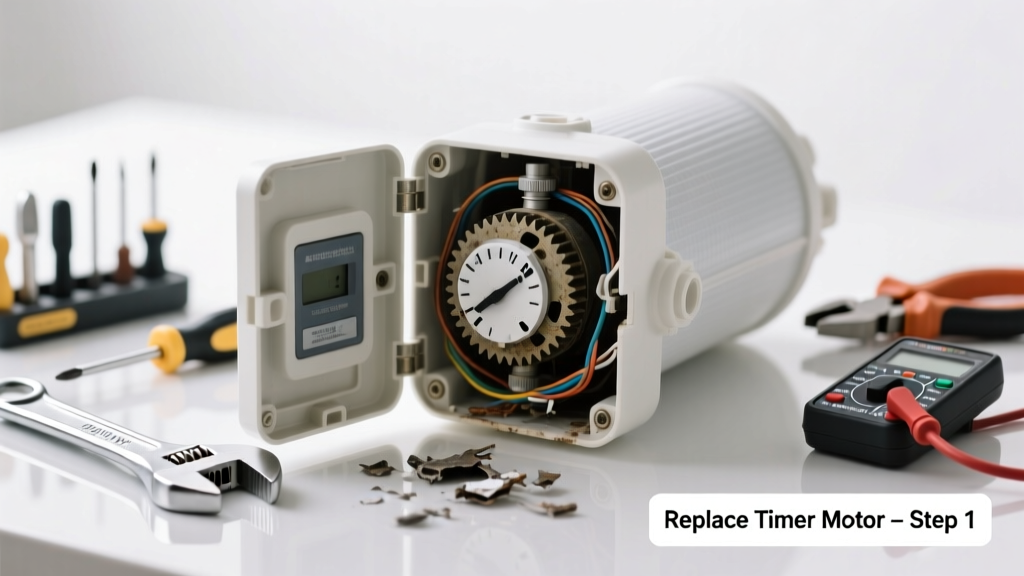
If your water softener isn’t regenerating—leaving you with hard water spots, stiff laundry, and scale buildup—it’s rarely the whole unit that’s failed. More often, it’s one replaceable part: the timer motor, control board, or brine valve solenoid. Most homeowners can swap these in under 90 minutes with basic tools and no plumbing experience.
Quick Diagnosis
Before grabbing tools, confirm the root cause. A non-regenerating softener usually points to:
- A dead or slipping timer motor (most common in older mechanical units like Fleck 5600)
- A failed control board (common in digital models like EcoWater ESD-2500)
- Clogged or stuck brine valve solenoid preventing saltwater draw
- Low or disconnected power supply to the control head
- Corroded wiring connections at the transformer or circuit board
Tools & Materials Needed
| Item | Purpose | Estimated Cost |
|---|---|---|
| Phillips and flathead screwdrivers | Remove control head cover and mounting hardware | $8–$15 |
| Multimeter (digital) | Test voltage at transformer output and solenoid terminals | $25–$45 |
| Replacement timer motor (e.g., Fleck 5600 motor kit) | Direct replacement for worn gear-driven timing mechanism | $32–$48 |
| Control board (model-specific) | Swaps out failed microprocessor logic in digital units | $75–$130 |
| Brine valve solenoid kit | Replaces corroded coil and plunger assembly blocking brine draw | $22–$36 |
Step-by-Step Fix
Follow these methods in order—start with the simplest test first:
- Check power and display: Verify outlet voltage (120V) and inspect for blank/flickering display. If dead, test transformer output (24V AC). No voltage? Replace transformer ($18–$26).
- Test timer motor operation: Set unit to manual regeneration. Listen for faint whirring near the control head. No sound? Disconnect motor wires and check resistance (should be 1.5–3 kΩ). Infinite resistance = replace motor.
- Inspect brine valve solenoid: During regeneration attempt, feel for vibration at the valve body. None? Use multimeter to test coil continuity (should read 150–300 Ω). Open circuit = replace solenoid.
- Swap control board: Power off, disconnect all wiring, photograph terminal layout, then install new board using original wire positions. Re-program time and hardness settings per manufacturer instructions.
When to Call a Pro
Don’t risk injury or damage if you encounter any of these:
- No 24V AC output from transformer after confirming line voltage is present
- Burnt smell, charring, or melted plastic on control board or wiring
- Leaking resin tank during disassembly (indicates cracked distributor tube or O-ring failure)
- Unit is under warranty and opening voids coverage (check manual or manufacturer site)
- You’re unsure about grounding, electrical isolation, or local code compliance
Prevention Tips
Extend your softener’s life and avoid repeat failures with these habits:
- Replace timer motors every 5–7 years—even if still working (Fleck recommends 6-year intervals)
- Use only pellet or cube salt—not rock salt—to reduce sludge buildup in the brine tank
- Inspect and clean the brine valve screen annually (it’s behind the float assembly)
- Keep control head covered from direct sunlight and humidity—install in a dry basement or utility closet
- Log regeneration dates and performance in a notebook; sudden gaps signal early motor wear
How do I know which part failed—the timer motor or control board?
Listen closely during a scheduled regeneration window: if the motor hums but the valve doesn’t open, the board is likely sending signal but the solenoid or wiring is faulty. If there’s zero movement and no display activity, start with transformer and board testing. According to the Water Quality Association’s 2022 Field Service Survey, 68% of non-regeneration calls involved either a failed timer motor or degraded control board firmware.
Can I use generic replacement parts instead of OEM?
Yes—but with caveats. Generic timer motors fit most Fleck 5600/2510 units, but control boards are model-specific and often require firmware matching. Using non-OEM boards on newer units (e.g., Clack WS1ECO) may disable smart features or trigger error codes. Stick with OEM for boards; generics work fine for motors and solenoids.
What happens if I skip regeneration for two weeks?
Your resin bed becomes saturated and stops removing hardness ions. You’ll see limescale on faucets, reduced lathering, and soap scum in showers within days. The U.S. EPA estimates that untreated hard water increases appliance energy use by up to 30%—so skipping regens raises utility bills fast.
"A single missed regeneration cycle won’t kill your resin—but three or more back-to-back misses permanently reduces capacity by 15–20%." — Water Treatment Handbook, 4th Edition (NSF International, 2021)
Do I need to sanitize the system after replacing parts?
Only if you opened the resin tank or brine line. For control head-only repairs, sanitizing isn’t required. But if you disconnected brine tubing or removed the safety float, flush the brine tank with 1 cup of household bleach mixed into 2 gallons of water, then run two full regenerations before using softened water.
How long does a replacement timer motor last?
OEM timer motors typically last 5–7 years under average use (regenerating every 2–3 days). Units in high-hardness areas (15+ gpg) or with frequent manual overrides wear faster—some fail as early as year 4. Keep a spare motor on hand if your home relies heavily on soft water for laundry and dishwashing.
Will replacing the part reset my hardness settings?
Replacing the timer motor or solenoid won’t affect settings. But swapping the control board will erase all programming—including time, hardness level, and regeneration schedule. Always write down current settings before removal. Refer to your model’s manual for reprogramming steps, or visit our Fleck 5600 manual regeneration settings guide.
Fixing a non-regenerating water softener isn’t about guesswork—it’s about isolating one small, replaceable component from a larger system. Most failures happen quietly, without alarms or error codes, so paying attention to timing consistency and subtle sounds pays off. Once you’ve swapped that timer motor or board, you’ll notice softer water in under 24 hours—and keep your appliances running smoothly for years longer. For related help, see our guides on water softener brine tank leaking and how to clean resin beads in water softener.