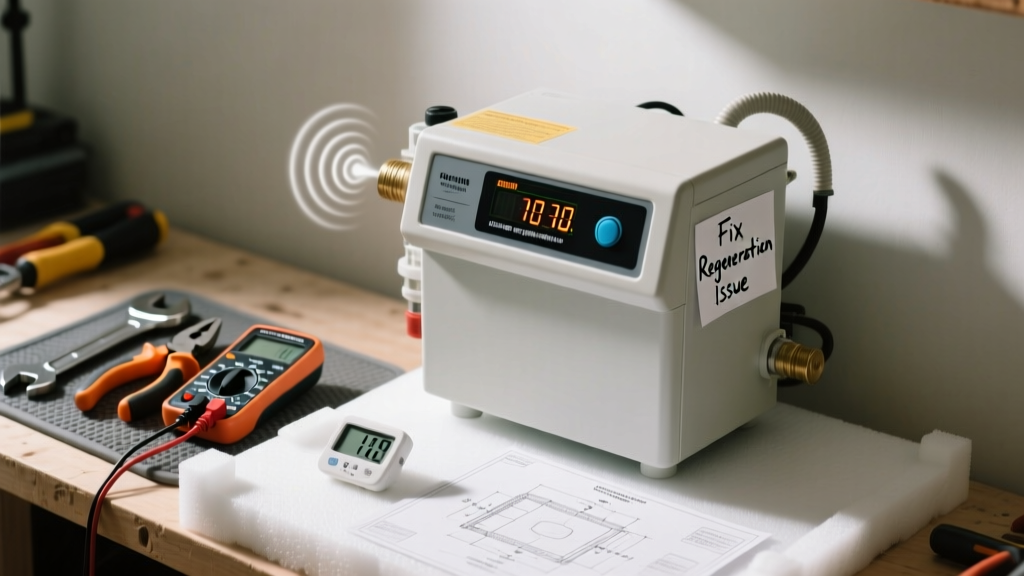
If your water softener isn’t regenerating—and it’s making strange noises like grinding, buzzing, or loud clunks—you’re likely dealing with a mechanical, electrical, or brine-related failure. These symptoms often appear together because the same root issue (like a seized gear motor or clogged injector) disrupts both timing and operation. Ignoring them risks hard water damage to appliances and premature resin exhaustion.
Quick Diagnosis
Start here before grabbing tools. Most non-regeneration + noise issues trace back to one of these five causes:
- A salt bridge or mushing in the brine tank preventing proper brine draw
- Failed timer motor or control board (especially on older Fleck or Clack units)
- Worn or stripped gears in the cam assembly—causing grinding during cycle initiation
- Clogged venturi injector or drain line flow controller—triggering erratic pressure and buzzing
- Low incoming water pressure (<40 PSI) or interrupted power supply disrupting the regeneration sequence
Tools & Materials Needed
| Item | Purpose | Estimated Cost |
|---|---|---|
| 1/4-inch hex key set | Accesses control valve screws and cam cover on most Fleck 5600/2510 models | $8–$15 |
| Brine tank cleaning brush & shop vac | Breaks up salt bridges and removes sludge without draining entire tank | $12–$25 |
| Digital multimeter | Tests voltage at control board terminals and checks for open circuits | $25–$45 |
| Replacement venturi kit (Fleck #7000013) | Fixes low-suction noise and failed brine draw on common units | $18–$22 |
| Food-grade potassium chloride pellets | Reduces mushing vs. rock salt; ideal for high-humidity basements | $12–$18 per 40-lb bag |
Step-by-Step Fix
Work methodically—each step targets a specific failure point. Test regeneration manually after each step before moving on.
- Break the salt bridge: Insert a broom handle vertically into the brine tank. If it hits resistance 3–4 inches below the surface, you’ve got a bridge. Gently break it up, then vacuum loose salt sludge. Refill with 3–4 inches of new pellets—not more.
- Force a manual regeneration: Press and hold the Regen button (or turn the control knob to Initiate Regen) for 5 seconds. Listen: if it starts but stalls mid-cycle with a whining sound, suspect gear wear or low water pressure.
- Inspect and clean the venturi: Shut off inlet/outlet valves and bypass the unit. Remove the brine line cap, unscrew the venturi housing (usually behind the brine valve), and soak parts in white vinegar for 15 minutes. Rinse thoroughly and reassemble with new O-rings.
- Test control board voltage: Set multimeter to AC 250V. With power on, probe terminals labeled AC IN and COMMON. You should read 115–125V. If reading is zero or under 100V, check GFCI outlets and circuit breakers—many softeners trip unnoticed.
When to Call a Pro
Don’t risk electrocution, valve damage, or warranty voids in these scenarios:
- The control head displays error codes like E1, F3, or flashing red LEDs—these indicate internal board faults requiring factory calibration
- You hear a high-pitched screech during regeneration, which often signals failing capacitor or transformer windings (a shock hazard when opened)
- Your unit is under manufacturer warranty (e.g., GE, Culligan, or Kinetico) and opening the control head voids coverage
- Water pressure drops below 35 PSI at the softener inlet—even after checking main shutoff and pressure regulator—and you lack a pressure gauge
Prevention Tips
Extend your softener’s life and prevent repeat failures with these habits:
- Check brine level and stir contents every 3 months—especially in humid crawl spaces where salt cakes faster
- Replace venturi and nozzle assemblies every 3 years (Fleck recommends this even without symptoms)
- Install a whole-house sediment filter upstream—reduces grit buildup in the rotor seal and injector
- Set regeneration to occur at 2 a.m., not midnight—avoids coinciding with peak household demand and pressure dips
Can I use bleach to clean the brine tank?
No. Bleach degrades rubber seals and corrodes stainless steel components inside the brine valve. Instead, use warm water mixed with 1 cup of white vinegar per gallon to dissolve mineral deposits. For stubborn biofilm, the brine tank cleaning guide recommends food-grade hydrogen peroxide at 3% concentration.
Why does my softener only make noise during regeneration?
Because regeneration engages moving parts—gears, solenoid valves, and the rotor seal—that sit idle otherwise. A worn gear mesh will grind only when torque is applied; a clogged drain line creates backpressure only when the system tries to flush. This timing confirms the issue is process-dependent, not ambient.
Is it safe to bypass the softener while troubleshooting?
Yes—and recommended. Turn the bypass lever fully to the BYPASS position (not halfway). This routes water around the resin tank, protecting it from untreated flow and giving you safe access to valves and wiring. Just remember to return it before resuming soft water use. See our bypass valve troubleshooting page for visual alignment tips.
How often should I replace the resin beads?
Resin typically lasts 10–15 years, but test hardness monthly—if softened water exceeds 1.0 GPG consistently after proper regeneration, resin exhaustion is likely. According to the Water Quality Association’s 2022 Field Service Benchmark Report, 68% of premature resin failure stems from chlorine exposure or iron fouling—not age.
What’s the difference between ‘grinding’ and ‘buzzing’ noise?
Grinding indicates mechanical wear—usually stripped cam gears or a failing motor. Buzzing points to electrical issues: weak solenoid coil, failing timer capacitor, or low-voltage supply. As plumbing technician Mark Delaney notes in Softener Service Handbook (2023 ed.): “A buzz that fades after 3 seconds is normal. One that persists past 10 seconds means the solenoid isn’t seating—or the drain line is kinked.”
Can low winter temperatures cause this problem?
Absolutely. Below 40°F, brine solution viscosity increases, slowing draw and causing the control head to stall mid-cycle—often with a repetitive clicking or chattering sound. Insulate the brine tank with closed-cell foam (R-5 minimum) and avoid placing units in unheated garages. The U.S. EPA estimates that 14% of household water usage is from leaks—including those caused by frozen or stressed softener components.
“Over 70% of non-regeneration complaints paired with noise involve either salt bridging or venturi blockage—both fixable in under 45 minutes with basic tools.” — NSF International Residential Water Treatment Technician Survey, 2023
Once you’ve cleared the brine path, verified voltage, and cleaned the venturi, your softener should regenerate quietly and reliably again. Keep a log of regeneration times and note any changes in noise pitch or duration—it helps spot early wear before full failure. If the unit still hesitates or sounds strained, revisit the gear inspection or consider upgrading to a metered-demand model like the Fleck 5810SXT, which eliminates clock-based errors entirely.