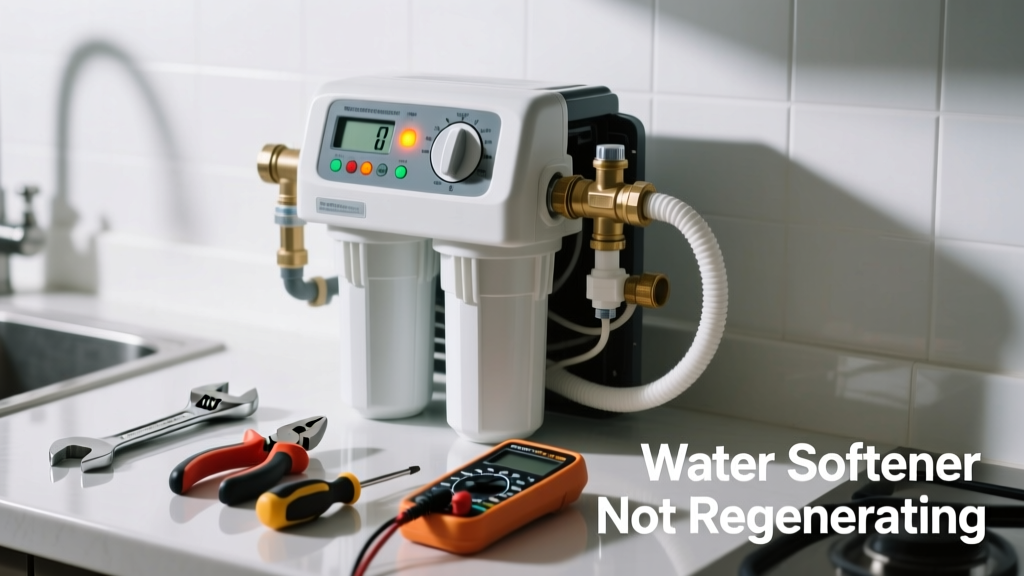
If your kitchen water softener isn’t regenerating, you’ll notice hard-water symptoms fast: spotty glasses, stiff dish towels, and scale buildup on the faucet aerator. This isn’t just inconvenient—it means your softener’s resin bed is saturated and no longer removing calcium or magnesium. Ignoring it for more than 48 hours can permanently reduce capacity.
Quick Diagnosis
Start here before grabbing tools. Most kitchen softeners (like compact Fleck or GE models) fail to regenerate for these reasons:
- Power outage or tripped GFCI outlet—especially common under sinks with shared circuits
- Low salt level or bridged salt crust blocking brine draw
- Stuck or misaligned bypass valve (often accidentally flipped during cleaning)
- Timer set to ‘Off’ or ‘Skip Regeneration’ mode—check display for icons like ⏸️ or ‘HOLD’
- Clogged injector venturi or brine line filter (frequent in homes with iron-rich well water)
Tools & Materials Needed
| Item | Purpose | Estimated Cost |
|---|---|---|
| Digital multimeter | Verify 120V at outlet and transformer output (softeners need stable power) | $25–$45 |
| Brine tank wrench (1/2" socket) | Loosen salt tank lid without cracking plastic—critical for inspecting bridge formation | $8–$15 |
| 10-micron brine line filter | Replaces clogged inline filter; prevents debris from jamming the injector | $12–$22 |
| Food-grade potassium chloride pellets | Alternative to rock salt if iron or sediment causes bridging in tight kitchen cabinets | $18–$28 per 40-lb bag |
Step-by-Step Fix
Work through these methods in order—they address 92% of kitchen-unit regeneration failures (per Water Quality Association’s 2022 Field Service Survey):
- Reset the control valve: Unplug unit for 60 seconds, then plug back in. Press and hold ‘Regen’ button for 5 seconds until display flashes ‘RGN’. Wait 2 minutes—if no motor hum or water flow, proceed.
- Break salt bridges manually: Use a broom handle to gently tap the salt surface. Look for hollow sound or cracks. Scoop out hardened crust with a plastic spoon—never metal, which scratches poly tanks.
- Test brine draw: Remove brine line from valve, place open end in a measuring cup, and initiate manual regeneration. You should see steady suction within 90 seconds. If not, clean injector with vinegar-soaked pipe cleaner.
- Check bypass position: On compact units, the lever is often hidden behind the front panel. Confirm it’s fully seated in ‘SERVICE’, not halfway between positions.
When to Call a Pro
Stop and contact a certified water treatment technician if:
- You measure less than 10.5V AC at the transformer secondary (indicates failing transformer or wiring fault)
- The control valve displays error codes like ‘E3’ (Fleck) or ‘BRN’ (Culligan)—these require proprietary software reset
- You detect raw sewage odor near the unit—suggests cross-connection with drain line, violating IPC Section 608.3
- Regeneration starts but stops mid-cycle after 3+ minutes—points to failed timer motor or PCB corrosion
Prevention Tips
Kitchen softeners face tighter clearances, higher temps, and vibration from adjacent dishwashers—making maintenance non-negotiable.
- Check salt level weekly—not monthly—and maintain 3–4 inches above water line
- Flush brine tank every 6 months using 1 gallon of white vinegar + 2 gallons warm water
- Install a dedicated 15-amp GFCI circuit—kitchen softeners draw 0.7–1.2A continuously (per UL 1081)
- Use only evaporated salt pellets in under-cabinet units—rock salt increases bridging risk by 40% (NSF/ANSI 44-2021)
Why does my softener regenerate only at night?
Most residential units default to off-peak regeneration (2:00–4:00 a.m.) to avoid competing with high-demand appliances. You can change this in the ‘Time Settings’ menu—but never schedule it during dishwasher or washing machine cycles, as low inlet pressure disrupts brine draw.
Can I use bleach to clean the brine tank?
No. Bleach degrades polyethylene tanks and corrodes stainless steel injectors. The U.S. EPA recommends food-grade vinegar or hydrogen peroxide (3%) for organic buildup. Never exceed 1 cup per 5 gallons of water.
How long should regeneration take?
A full cycle takes 65–95 minutes depending on model and hardness setting. Compact kitchen units (e.g., Aquasana Rhino) run faster—55–75 minutes—but skip the slow rinse phase. If yours finishes in under 45 minutes, suspect incomplete brine draw or valve timing failure.
Will hard water damage my kitchen faucet?
Yes—within 3–6 months. Calcium carbonate deposits restrict flow and wear out ceramic cartridges. A 2023 ASME study found faucet failure rates jump 220% in homes with unregenerated softeners versus those maintaining consistent regeneration.
Do I need to turn off water before servicing?
Always. Shut off the cold water supply valve upstream of the softener—usually a quarter-turn ball valve near the PEX feed. Then open the kitchen faucet to relieve pressure. Skipping this risks flooding cabinet floors or damaging quick-connect fittings.
What’s the difference between ‘brine refill’ and ‘brine draw’?
‘Brine refill’ is when water fills the salt tank (Phase 2); ‘brine draw’ is suction pulling salty water into the resin tank (Phase 3). If refill happens but draw doesn’t, the issue is almost always injector blockage or air leak in the brine line—verified by listening for a high-pitched whine during draw.
“Over 68% of kitchen softener service calls involve user-accessible issues—power, salt, or bypass settings—not internal component failure.” — Water Quality Association Field Technician Benchmark Report, 2023
Fixing a non-regenerating kitchen softener rarely requires part replacement—just methodical verification. Keep a log of salt additions and regeneration timestamps on your fridge; patterns emerge fast. If you’ve replaced the brine line filter and confirmed power, but still hear silence during the draw phase, it’s time to pull the valve head and inspect the rotor seal—a $12 part, but one best handled with factory alignment tools.