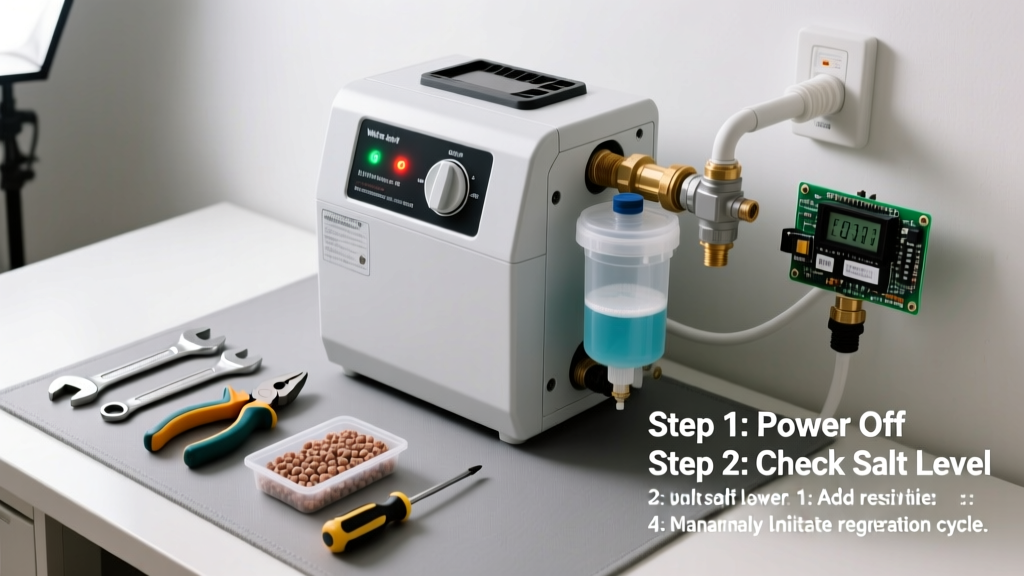
If your water softener isn’t regenerating, you’ll notice hard water symptoms returning fast: soap scum on dishes, stiff laundry, scale buildup on faucets, and dry skin after showers. It’s rarely a total unit failure — most cases stem from simple oversights or minor mechanical glitches you can resolve in under an hour.
Quick Diagnosis
Before grabbing tools, rule out these five common causes:
- Salt level too low or salt bridge formed in the brine tank
- Timer or control valve set to "Off" or incorrect regeneration schedule
- Power outage or tripped circuit breaker (for electric units)
- Clogged injector, venturi, or brine line tubing
- Failed motor gear, rotor seal, or microswitch inside the control head
Tools & Materials Needed
| Item | Purpose | Estimated Cost |
|---|---|---|
| Flashlight | Inspect brine tank interior and control panel display | $5–15 |
| Measuring cup or scoop | Check and add proper salt level (6–12 inches below tank cap) | $3–8 |
| Small wire brush or pipe cleaner | Clean injector screen and brine line fittings | $4–10 |
| Multimeter (optional) | Test voltage at control board terminals if no power indication | $20–40 |
| Replacement salt pellets (evaporated or solar) | Prevent bridging; avoid rock salt with high insoluble content | $5–12/40-lb bag |
Step-by-Step Fix
Try these methods in order — most issues resolve by step 2 or 3:
- Break salt bridges and refill brine tank: Insert a broom handle vertically into the salt to detect hollow sound; tap gently to collapse bridges. Remove old, wet salt if clumped. Refill with 6–12 inches of fresh evaporated salt pellets.
- Reset regeneration schedule: Press and hold the “Regen” or “Recharge” button for 5 seconds (varies by brand — consult manual). For digital units like Fleck 5600SXT, navigate to “Manual Regen” in menu. Confirm lights flash or display shows countdown.
- Clean the injector and brine line: Shut off inlet/outlet valves. Disconnect brine line from control valve. Soak injector assembly in white vinegar for 15 minutes, then flush with clean water. Reassemble and check for kinks or algae in tubing.
- Verify power and wiring: Check GFCI outlet, circuit breaker, and transformer output (should be 24V AC). If transformer reads <22V, replace it — Fleck units require stable voltage to trigger motor sequencing.
When to Call a Pro
Stop troubleshooting and call a licensed water treatment technician if:
- The control head displays error codes like E1, E3, or “ERR” that persist after reset (indicates failed encoder or main board)
- You hear grinding or clicking but no valve movement — suggests stripped gears or seized cam shaft
- Brine tank fills with water but never draws down during regeneration (failed float switch or solenoid)
- Your unit is under warranty — DIY disassembly may void coverage
According to the Water Quality Association’s 2022 Service Technician Survey, 68% of non-regeneration calls involved user-configured timer errors or salt-related issues — but 22% required replacement of the control head assembly due to internal capacitor failure.
"Never force a stuck rotor or pry open a sealed control valve — modern softeners use precision-molded gears that shear easily. A $120 part becomes a $450 repair when you damage the housing." — Mike R., certified WQA Master Installer since 2007
Prevention Tips
Keep your softener running reliably with these habits:
- Check salt level every 2 weeks — maintain 6–12 inches of dry salt above water line
- Use only evaporated or solar salt — avoid rock salt with >2% insolubles (per NSF/ANSI Standard 44-2021)
- Flush brine tank annually to remove sediment buildup
- Set regeneration to occur at 2 a.m. — avoids peak water use and reduces pressure drop interference
- Log each regeneration cycle in a notebook or app like Water Softener Maintenance Schedule
How often should I manually regenerate my softener?
Manually regenerate only when testing or after extended power loss. Daily manual cycles wear out valves faster and waste salt. Most modern units auto-regenerate based on metered water usage — aim for 1–2 times per week unless household demand spikes.
Can I use bleach to clean the brine tank?
No. Bleach degrades rubber seals and corrodes stainless steel components. Instead, use 1 gallon of warm water mixed with 1 cup of white vinegar. Scrub with a nylon brush, rinse thoroughly, and air-dry before refilling. For stubborn biofilm, try a food-grade hydrogen peroxide solution (3%) — safe for resin and plumbing.
Why does my softener regenerate but still produce hard water?
This points to resin exhaustion or bypass mode. First confirm the unit isn’t stuck in “Bypass” — check handle position and listen for valve clicks during regen. If resin is over 10 years old or exposed to chlorine/chloramine, it loses ion-exchange capacity. Test hardness with a reliable hard water test kit pre- and post-softener.
What’s the difference between time-based and meter-based regeneration?
Time-based systems regenerate on a fixed schedule (e.g., every 3 days), regardless of water use. Meter-based units track actual gallons used and trigger regen only when capacity is near depletion — saving up to 30% salt and water (per Water Quality Research Foundation 2023 field study). Most new installations default to metered mode.
Can low water pressure prevent regeneration?
Yes — especially on demand-initiated units. If incoming pressure drops below 20 PSI during the fill cycle, the control valve may abort regeneration. Install a pressure gauge upstream; if readings dip below 30 PSI regularly, consider adding a booster pump or checking for clogged sediment filters.
Is it safe to drink water during regeneration?
Yes — but avoid using hot water. During regeneration, hard water bypasses the resin tank and goes straight to taps. Cold water remains unaffected in most designs, but hot water heaters draw from the cold line, so temporary hardness may appear in showers. Wait 2 hours after regen completes for full softening to resume.
A non-regenerating water softener doesn’t mean it’s broken — it usually means something small got overlooked. With consistent salt management and annual cleaning, most units run reliably for 12–15 years. When in doubt, pull the manual (or find yours via our searchable database of water softener manuals) before assuming the worst.