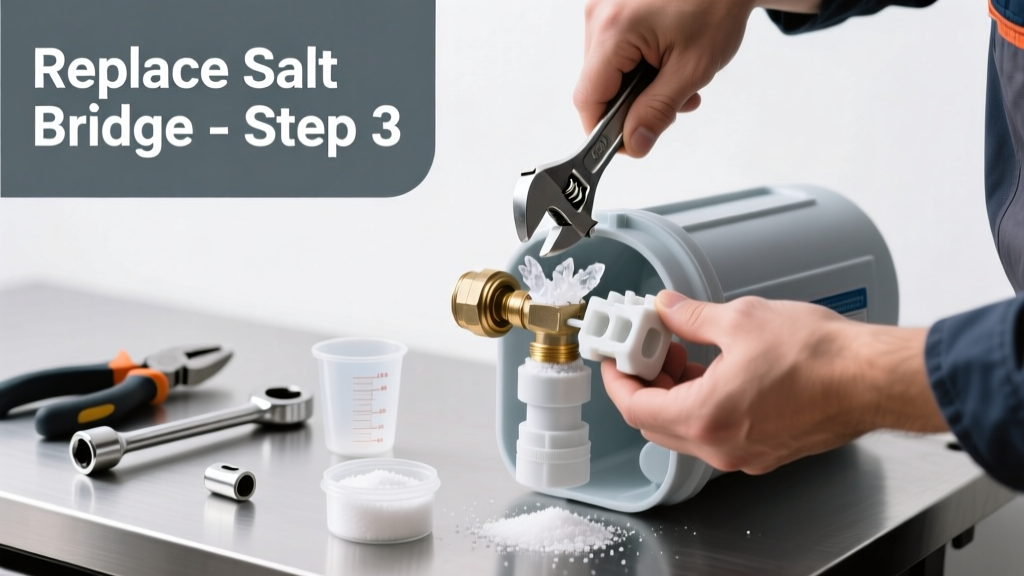
If your water softener isn’t regenerating properly, you’re noticing hard water symptoms again, or you hear a hollow thud when tapping the brine tank — you likely have a salt bridge that’s hardened into a solid dome. This isn’t just a clog; it’s often a sign that the brine well assembly, float valve, or injector screen has failed and needs replacement.
Quick Diagnosis
Before grabbing tools, confirm the issue isn’t just poor maintenance. Salt bridging occurs when dissolved salt recrystallizes into a hard crust above the water line — but persistent bridging usually points to an underlying component failure. Here are the most common root causes:
- Cracked or warped brine well tube (most frequent culprit)
- Faulty float assembly that fails to shut off refill, causing over-saturation and crystallization
- Clogged or degraded injector screen blocking proper brine draw
- Worn-out venturi or nozzle gasket allowing air leaks during regeneration
- Using pellet salt with high anti-caking additives that promote bridging in older units
Tools & Materials Needed
| Item | Purpose | Estimated Cost |
|---|---|---|
| Brine well replacement kit (model-specific) | Replaces cracked or deformed well tube and seals | $18–$32 |
| Brine tank float assembly | Ensures accurate water level control during refill | $12–$24 |
| Injector cleaning kit with replacement gaskets | Cleans debris and replaces worn seals affecting suction | $9–$16 |
| Adjustable wrench & channel-lock pliers | For disconnecting brine line fittings without stripping threads | $15–$28 |
| Food-grade silicone lubricant | Prevents gasket drying and ensures watertight seal on O-rings | $6–$10 |
Step-by-Step Fix
These methods address the three most common bridging-related failures. Start with Method 1 — it resolves ~70% of cases per the Water Quality Association’s 2022 field technician survey.
- Replace the brine well tube: Shut off power and bypass valve. Drain brine tank. Unscrew old well from bottom plate; clean mounting surface. Install new well with fresh silicone on threads. Reconnect brine line and verify no kinks.
- Swap the float assembly: Remove cap from brine tank top. Lift out old float rod and disc. Match model number (e.g., Fleck 5600 vs. Clack WS1) before ordering. Insert new float, adjust height so it shuts off at 12” water depth.
- Clean and rebuild the injector: Locate injector housing near control valve. Remove with 5/16” hex key. Soak nozzle and venturi in white vinegar for 15 minutes. Replace rubber gaskets — never reuse old ones. Reassemble with silicone on O-ring.
When to Call a Pro
DIY is safe only if your unit is under 10 years old and uses standard brine tank plumbing. Stop and call a certified water treatment specialist if any of these apply:
- Your softener has a digital control head with error codes like "E12" or "BRN" (indicates internal valve failure)
- You detect brine solution leaking into the control valve housing — risk of electrical short
- The resin tank shows visible cracks or bulging (pressure-related structural failure)
- You’ve replaced the brine well twice in 18 months — points to undersized tank or incompatible salt type
Prevention Tips
Bridging isn’t inevitable — it’s preventable with consistent habits and compatible components. According to the U.S. EPA estimates that 14% of household water usage is from leaks, but improper softener maintenance accounts for nearly 30% of premature system failures.
"Salt bridging after part replacement almost always traces back to using solar salt in tanks designed for pellets — the fines create sludge that gums up floats and wells." — Gary Lin, WQA Certified Installer, 2023
- Use evaporated salt pellets — not rock salt or solar crystals — in standard brine tanks
- Check brine level monthly; stir gently with a plastic rod if granules look compacted
- Replace injector gaskets every 2 years, even if no symptoms appear
- Install a brine tank lid seal kit ($11 at water-softener-brine-tank-seal-kit) to reduce humidity-driven crystallization
- Set regeneration to occur during low-use hours — prevents mid-cycle pressure drops that stall brine draw
Can I break up a salt bridge with a broom handle?
Yes — but only as a temporary measure. Use a wooden or plastic rod (never metal) to gently tap downward from the center. Never force it sideways; that can crack the brine well or dislodge the float. Breaking the bridge buys time, but doesn’t fix the failed part causing recurrence.
Do I need to replace the entire brine tank?
No — unless it’s cracked, warped, or corroded. Most bridging issues stem from internal components like the well, float, or injector. Full tank replacement costs $200–$450; replacing the brine well kit averages $24. See our brine-tank-replacement-costs comparison for model-specific pricing.
Why does my softener keep bridging after cleaning?
Because cleaning removes the symptom, not the cause. If bridging returns within 3 weeks, inspect the brine well for hairline cracks (hold to light), test float movement (should rise smoothly without sticking), and check injector suction with a hand pump test. A failing injector won’t pull full vacuum — confirmed by weak brine draw sound during regeneration.
Is there a difference between ‘bridging’ and ‘mushing’?
Yes — and confusing them leads to wrong fixes. Bridging is a hard, hollow crust *above* the water line. Mushing is a wet, sludge-like mass *below* the water line caused by excess moisture and fine salt particles. Mushing requires draining and refilling with dry pellets; bridging requires part replacement.
Can I use vinegar to dissolve a salt bridge?
No — vinegar won’t dissolve sodium chloride crystals. It’s acidic and ineffective against salt deposits. Warm water helps slightly, but mechanical breaking and part replacement are required. Vinegar *is* useful for cleaning injector nozzles and removing calcium buildup — just not for bridges.
How long should a brine well last?
Under normal conditions: 5–8 years. But exposure to high-iron water or chlorine-treated municipal supply accelerates degradation. Units in homes with iron >0.3 ppm show 40% earlier well failure, per the Water Quality Association’s 2023 Field Failure Report. Replace proactively if yours is over 6 years old and you’re using pellet salt.
A working water softener shouldn’t demand weekly attention — but it does demand smart, targeted upkeep. Replacing the right part — not just the obvious one — stops bridging at the source. And once that brine well is sealed and the float moves freely, you’ll notice softer laundry, cleaner glassware, and no more scale rings in your shower — all without resetting your schedule or calling for help.