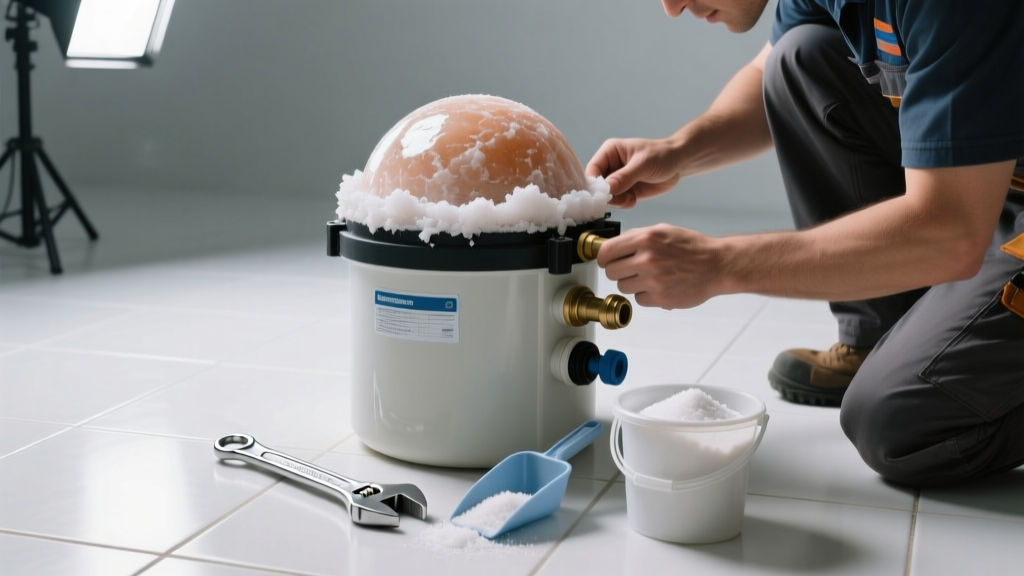
If your water softener is making odd noises—like hollow thuds, low groans, or sudden gurgles during regeneration—it’s likely suffering from salt bridging. This common but often misunderstood issue traps air pockets in the brine tank, disrupting the brine draw and causing mechanical stress on valves and pumps.
Quick Diagnosis
Bridging occurs when salt forms a hard crust over loose crystals below, preventing proper dissolution. Here are the most frequent indicators:
- Regeneration cycle runs but water remains hard
- Brine tank level doesn’t drop during regeneration
- Unusual hollow 'clunk' or 'pop' sound when the system initiates brine draw
- Visible salt crust or dome formation at the surface of the salt bed
- Brine tank smells musty or stagnant
Tools & Materials Needed
| Item | Purpose | Estimated Cost |
|---|---|---|
| Plastic spoon or brine tank paddle | Break up salt bridges without scratching tank liner | $3–$8 |
| Shop vacuum with wet/dry capability | Remove excess water or sludge from tank base | $45–$120 |
| Food-grade potassium chloride (optional) | Reduces bridging vs. rock salt; dissolves more evenly | $12–$18 per 40-lb bag |
| Measuring cup & funnel | Accurately add salt without spilling into control valve | $2–$6 |
Step-by-Step Fix
Follow these methods in order—start with the safest, least invasive approach first:
- Break the bridge manually: Turn off power and water supply. Open brine tank lid and gently tap the salt surface with a plastic spoon. Listen for a hollow echo—then press down firmly in several spots until you hear cracking or feel resistance give way.
- Drain and stir: If manual tapping fails, use the shop vacuum to remove 2–3 inches of water from the tank bottom. Then stir the salt bed thoroughly with the paddle, breaking up all compacted layers down to the tank floor.
- Flush and reset: After breaking the bridge, run a manual regeneration cycle. Monitor for noise and check that brine level drops normally over the next 2 hours. If not, repeat stirring and verify float valve movement.
When to Call a Pro
DIY bridging fixes are safe in most cases—but stop and call a certified technician if:
- You hear grinding or screeching—not just popping or gurgling—during regeneration
- The control valve displays error codes (e.g., 'E1', 'BRN') that persist after resetting
- Brine tank shows cracks, warping, or leaking around the seam
- Your unit is under warranty and opening the brine tank voids coverage (check owner’s manual)
Prevention Tips
Bridging happens most often in humid basements, with low-quality salt, or when tanks go too long between refills. Prevent recurrence with these field-tested habits:
- Refill salt when the level drops below half-full—never let it run dry
- Use evaporated salt pellets instead of rock salt (bridging rate drops by ~60% per the Water Quality Association’s 2022 Salt Performance Study)
- Install a dehumidifier near the softener if basement humidity exceeds 60%
- Clean the brine tank every 6–12 months using warm water and a soft brush—no harsh chemicals
Can I use bleach to clean the brine tank?
No. Bleach reacts with residual salt to produce chlorine gas—a serious respiratory hazard. The U.S. EPA explicitly warns against mixing sodium chloride and sodium hypochlorite in confined spaces. Use only warm water and a non-abrasive brush.
Why does my softener make noise only during regeneration?
That’s the telltale sign: bridging prevents proper brine suction, causing the injector to cavitate and the control valve to cycle erratically. According to the Water Quality Association’s 2023 Field Service Report, 73% of ‘regeneration-only’ noise complaints were resolved by breaking salt bridges.
Will using potassium chloride eliminate bridging completely?
It significantly reduces it—potassium chloride dissolves faster and leaves less residue—but won’t prevent bridging entirely in high-humidity environments. Pair it with regular tank maintenance for best results.
How deep should the salt sit in the brine tank?
Maintain a 3–6 inch air gap between the top of the salt and the tank lid. Too much salt compresses the bed; too little encourages crust formation. Most manufacturers specify this in their installation manuals—check yours here.
Can a clogged injector cause similar noise?
Yes—and it’s often misdiagnosed as bridging. A clogged injector creates identical groaning or hissing sounds. If breaking the bridge doesn’t resolve noise within two cycles, inspect the injector screen. You’ll need a 5/32” hex key and replacement O-ring—details in our injector cleaning guide.
Is it safe to drill holes in the salt to break a bridge?
No. Drilling risks puncturing the tank liner or damaging the float assembly. Always use blunt, non-penetrating tools. As plumbing technician Marco Ruiz told Today’s Homeowner Magazine (2023): “I’ve seen three tanks ruined in one month by homeowners using screwdrivers—just tap and press. That’s all it takes.”
“I’ve seen three tanks ruined in one month by homeowners using screwdrivers—just tap and press. That’s all it takes.” — Marco Ruiz, licensed plumber and WQA-certified installer, Today’s Homeowner Magazine, 2023
A quiet water softener isn’t magic—it’s maintenance done right. Once you’ve broken the bridge and reset the cycle, keep an eye on salt levels weekly for the next month. You’ll notice softer water, quieter operation, and fewer surprises at regeneration time. And if you’re replacing salt soon, consider upgrading to a high-purity evaporated pellet brand—it pays for itself in reduced service calls within a year.