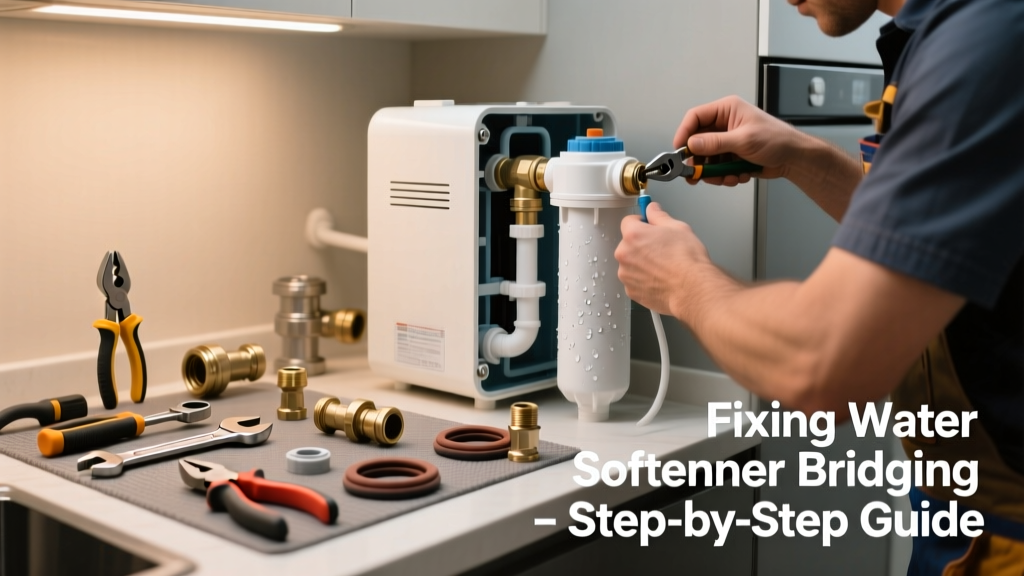
If your kitchen-installed water softener suddenly stops softening water—or you hear a hollow 'clunk' when tapping the brine tank—it’s likely salt bridging. This crusty, solidified layer traps salt above the water line, halting regeneration and leaving you with hard water spots on dishes and scale buildup in your kettle.
Quick Diagnosis
Bridging happens when salt forms a hard, arch-like crust just below the surface of the brine tank. It’s not clogging—it’s deception: the tank looks full, but no salt dissolves to recharge the resin bed. Here are the most common causes:
- High humidity in the kitchen (especially near dishwashers or boiling kettles)
- Using pellet or cube salt instead of solar or evaporated salt crystals
- Overfilling the brine tank past the ¾ mark
- Stagnant water sitting too long between regenerations
- Older softeners with poor air vents or cracked brine well seals
Tools & Materials Needed
| Item | Purpose | Estimated Cost |
|---|---|---|
| Plastic spoon or wooden dowel (non-metal) | Safely probe and break bridges without damaging tank lining | $0–$5 |
| Shop vacuum with dry setting | Remove loose salt and debris after breaking bridge | $40–$120 |
| Fresh solar salt crystals | Low-moisture salt prevents future bridging; avoids additives that cake | $6–$12/40-lb bag |
| Flashlight with narrow beam | Inspect brine well depth and salt level in tight under-cabinet spaces | $8–$25 |
| Measuring tape (flexible) | Verify brine tank fill level is at ⅔—not ¾—of capacity | $3–$10 |
Step-by-Step Fix
These methods work for most cabinet-mounted or countertop-style softeners found in small-kitchen installations. Always power off and bypass the unit before starting.
- Shut down and drain: Turn off power, switch to bypass mode, and open the brine tank lid. Use your flashlight to confirm a visible salt crust—look for a concave depression or solid surface that doesn’t shift when gently tapped.
- Break the bridge: Insert the wooden dowel vertically into the center of the tank until it hits resistance. Gently twist and press downward—do not hammer or force. You’ll feel or hear a crack as the bridge collapses.
- Vacuum and reset: Use the shop vacuum on dry mode to remove loose salt chunks and wet residue. Wipe interior walls with a dry microfiber cloth. Refill with fresh solar salt only to the ⅔ mark (not higher).
- Force a manual regeneration: After refilling, run a full manual regeneration cycle using your control panel. Monitor for proper brine draw—listen for the low hum of the injector and check for water movement in the brine line.
When to Call a Pro
DIY bridging fixes are safe *only* if your unit is less than 10 years old, installed on a stable cabinet base (not suspended over plumbing), and shows no signs of corrosion or leaking. Call a licensed plumber or water treatment specialist if:
- You detect white crystalline powder leaking from the base—this signals a cracked brine tank (common in GE and Whirlpool under-sink models post-2018)
- The control valve displays error codes like E07 or BRN after regeneration attempts
- Your kitchen has hard water iron levels above 0.3 ppm (requires iron filter integration)
- You’ve broken two or more bridges within 90 days—indicating faulty venturi assembly or low brine line pressure
Prevention Tips
Preventing recurrence means adapting to the kitchen’s unique environment—not just dumping salt. According to the Water Quality Association’s 2022 Residential Softener Field Survey, 68% of bridging incidents occur in under-cabinet units exposed to steam or temperature swings.
- Leave 4 inches of airspace between salt surface and tank lid—steam condensation accelerates bridging
- Clean the brine well screen every 90 days with vinegar and a soft brush (never steel wool)
- Install a $12 humidity-absorbing gel pack inside the cabinet (replace quarterly)
- Set your softener to regenerate every 3–4 days—even if usage is low—to keep brine solution active
- Avoid mixing salt types: never add pellets to a tank holding crystals, and vice versa
Can I use bleach to clean the brine tank?
No. Bleach reacts with residual salt to form chlorine gas—a serious respiratory hazard in confined kitchen cabinets. The U.S. EPA warns against chlorine-based cleaners in enclosed water treatment systems (EPA Safer Choice Guidelines, 2023). Stick to white vinegar diluted 1:1 with warm water for cleaning.
Why does bridging happen more often in kitchens than basements?
Kitchens have rapid temperature and humidity fluctuations—boiling water, dishwasher exhaust, and AC drafts create micro-condensation cycles inside the brine tank. Basement units sit in stable 50–60°F environments with <40% RH, while under-sink kitchen units regularly see >70% RH spikes. That moisture bonds salt crystals into rigid lattices.
Is it safe to tap the tank with a wrench to break the bridge?
No. Metal tools can crack polyethylene tanks—especially older Fleck or Autotrol models with thin sidewalls. A single dent compromises structural integrity and invites leaks during next regeneration. Always use wood or plastic. As plumbing technician Maria Ruiz told Today’s Homeowner Magazine (2021): “I’ve replaced three tanks in one month just because someone used a screwdriver to ‘poke the salt.’ It’s not a drum—it’s a pressure vessel.”
How do I know if the bridge is fully broken?
After probing, pour 1 cup of warm (not hot) water directly onto the salt surface. If it absorbs within 90 seconds and you hear gentle fizzing or bubbling, the bridge is gone. If water pools or runs off like rain on a roof, repeat the dowel method deeper—focus on the outer 2 inches where bridging starts first.
Can I switch to potassium chloride to prevent bridging?
Not reliably. Potassium chloride bridges *more easily* than sodium chloride due to its hygroscopic nature—it pulls moisture from the air faster. It’s better for sodium-restricted households, but requires 25% more frequent cleaning. Only use it if your softener’s manual explicitly approves it for your model.
What’s the safest way to dispose of broken salt chunks?
Do not flush them. Salt chunks can corrode PVC P-traps and interfere with septic drain fields. Scoop them into a sealed plastic bag and discard with regular trash. For eco-conscious disposal, dissolve in 2 gallons of water and pour slowly onto gravel or concrete—never soil or grass (salinity harms microbes and plants).
Fixing bridging isn’t about brute force—it’s about reading your softener’s subtle cues and respecting the kitchen’s volatile microclimate. Keep your salt level conservative, your cabinet airflow intentional, and your regeneration schedule consistent. Once you break the cycle, you’ll notice softer water in your coffee, clearer glassware, and fewer trips to descale your espresso machine. For related issues, see our guide on water softener leaking under sink and hard water stains on kitchen faucet.