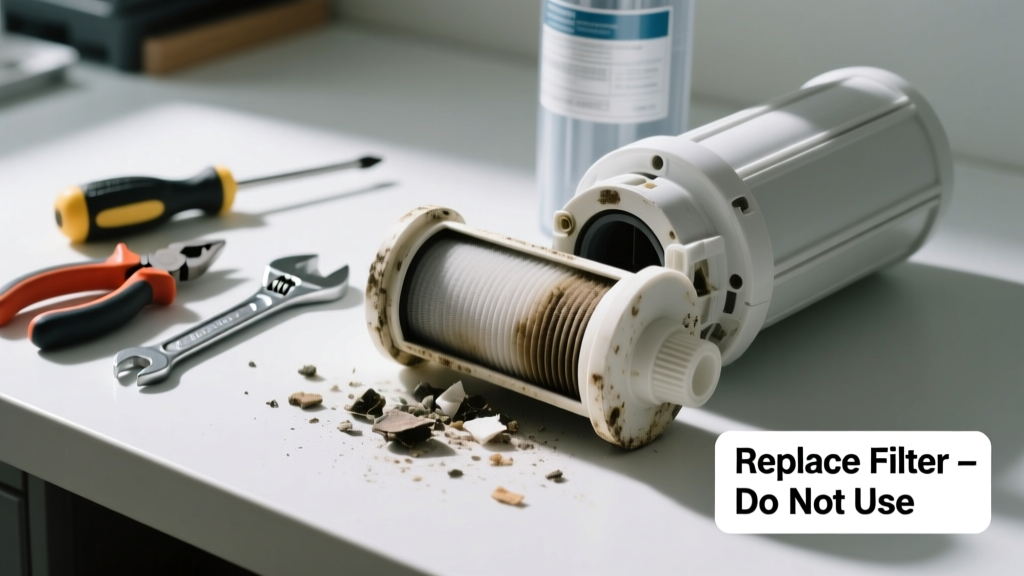
Your tap water tastes off, the flow is sluggish, or the TDS reading hasn’t budged in months — these are red flags your water purifier isn’t filtering properly. Most often, it’s not a total system failure but a single worn-out part begging for replacement. The good news? You can fix it yourself in under an hour.
Quick Diagnosis
Before grabbing tools, rule out simple causes:
- Expired or clogged RO membrane (most common cause of poor TDS reduction)
- Saturated sediment pre-filter blocking flow
- Failed carbon block filter allowing chlorine taste/odor
- Leaking or cracked housing causing bypass
- Low inlet water pressure (<40 PSI) starving the system
Tools & Materials Needed
| Item | Purpose | Estimated Cost |
|---|---|---|
| Replacement filter set (sediment + carbon + RO membrane) | Core components that restore filtration; match your model number exactly | $45–$85 |
| Wrench or filter housing key | Removes threaded housings without cracking plastic | $8–$15 |
| Food-grade silicone lubricant | Prevents O-ring damage during reassembly | $6–$12 |
| TDS meter (digital) | Verifies post-replacement performance (e.g., drops from 180 ppm to <10 ppm) | $22–$38 |
| Bucket and towels | Catches residual water and prevents floor damage | $0–$5 |
Step-by-Step Fix
Follow this sequence — skipping steps risks cross-contamination or housing cracks:
- Shut off feed water and open faucet to relieve pressure. Close the storage tank valve and unplug power if your unit has UV or pump features.
- Remove old filters in order: sediment (first), carbon block (second), then RO membrane (third). Note orientation — membranes have directional arrows; carbon blocks have flow direction stamps.
- Clean housings with warm water and soft brush — never use bleach or solvents. Inspect O-rings for nicks or flattening; replace if compressed >20%.
- Lubricate new O-rings with food-grade silicone, insert filters carefully, and hand-tighten housings (no wrench on final 1/4 turn — over-torquing cracks polycarbonate).
- Flush for 2–3 hours before use: run water continuously to purge air and carbon fines. Test TDS before drinking — wait until readings stabilize below 10 ppm.
When to Call a Pro
DIY ends where safety or complexity begins:
- Inlet pressure consistently below 35 PSI (requires booster pump installation)
- Cracked RO membrane housing or leaking stainless steel manifold
- No water output after replacement — points to faulty automatic shut-off valve or check valve
- Electrical issues: flickering UV lamp, pump humming but not cycling, or error codes you can’t clear
According to the Water Quality Association’s 2022 Service Technician Survey, 68% of misdiagnosed ‘filter failures’ were actually caused by undersized feed lines or frozen outdoor lines — problems best assessed onsite.
Prevention Tips
Extend your purifier’s life and avoid repeat failures:
- Replace sediment and carbon filters every 6 months — even if flow seems fine (they degrade chemically)
- Test TDS monthly; a rise >25% above baseline signals membrane fatigue
- Install a whole-house sediment filter upstream if your municipal supply is high in iron or silt
- Drain and sanitize the storage tank annually using NSF-certified sanitizer like RO tank sanitizer
How often should I replace the RO membrane?
Most manufacturers recommend every 2–3 years, but real-world lifespan depends on feed water quality. In hard water areas (TDS >300 ppm), expect 18–24 months. A TDS rejection rate below 85% means it’s time — calculate it: (Inlet TDS – Outlet TDS) ÷ Inlet TDS × 100. If it drops below 85%, replace immediately.
Can I reuse the old O-rings with new filters?
No. O-rings compress permanently after 6+ months of service and lose sealing integrity. Reusing them causes slow leaks or complete bypass — meaning unfiltered water enters your drinking line. Always install the new O-rings included with genuine replacement filters. Generic O-rings may swell or degrade with chlorine exposure.
Why does my water taste sweet after replacing filters?
A temporary sweet or ‘plastic’ taste is common for 1–2 days — it’s carbon fines leaching from the new carbon block. Flush for at least 2 hours before use. If it persists beyond 48 hours, the carbon wasn’t rinsed properly during manufacturing or the filter is counterfeit. Check batch numbers against the manufacturer’s genuine filter database.
Do I need to disinfect the system after filter replacement?
Yes — especially if filters sat dry for >24 hours or you live in a humid climate. Use a 1:100 dilution of NSF-certified sanitizer (e.g., Sani-System) in the first flush cycle. Let it sit in housings for 15 minutes, then flush 30 minutes minimum. Skipping this step invites biofilm regrowth in carbon pores — a leading cause of recurring odor issues.
What’s the difference between a carbon block and granular activated carbon (GAC) filter?
Carbon block filters compress powdered carbon into a solid matrix, removing smaller particles (down to 0.5 microns) and chloramines more effectively. GAC uses loose carbon granules — cheaper but less efficient at removing cysts or volatile organics. For whole-home or high-risk households (immunocompromised users), always choose carbon block. GAC is acceptable only as a pre-filter stage.
Can low water temperature affect filtration?
Absolutely. RO membranes operate at peak efficiency at 77°F (25°C). Below 50°F, permeate flow drops ~50% and rejection rates fall sharply. If your purifier lives in a garage or basement, consider adding a line heater or insulating the feed line — the U.S. EPA estimates 30% of residential RO systems underperform due to cold feed water alone.
Replacing a failed filter isn’t just about restoring clean water — it’s about reclaiming control over what goes into your glass. With the right parts, timing, and attention to detail, most filtration failures are resolved before lunchtime. Keep your TDS meter handy, track replacement dates on your fridge, and don’t ignore that faint chlorine hint — it’s your system’s quiet alarm.