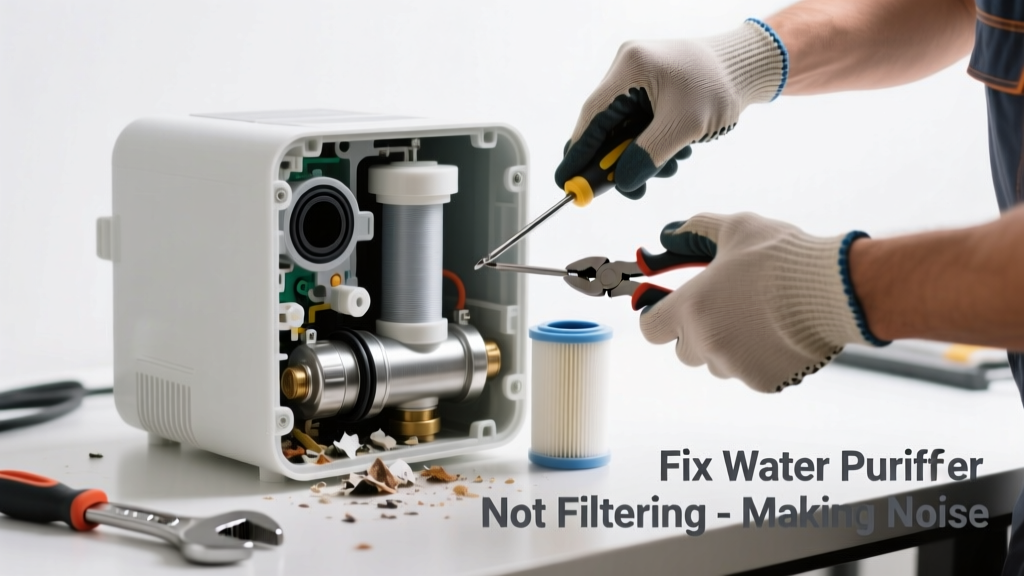
If your water purifier suddenly stops filtering and starts humming, grinding, or rattling, don’t assume it’s time for a costly replacement. Most noise-and-no-filter issues stem from simple, fixable causes like clogged filters, air locks, or worn pump components — and you can often resolve them in under an hour with basic tools.
Quick Diagnosis
Before grabbing tools, run through these common culprits — ranked by likelihood:
- Clogged sediment or carbon pre-filter (most frequent cause)
- Air trapped in the RO membrane housing or pump chamber
- Failing booster pump bearing or impeller wear
- Loose mounting hardware vibrating against cabinetry
- Low inlet water pressure (<40 psi) causing pump cavitation
Tools & Materials Needed
| Item | Purpose | Estimated Cost |
|---|---|---|
| 5-gallon bucket | Catches wastewater during filter changes and flushes | $8–$12 |
| Filter wrench (universal 2.5" or brand-specific) | Removes tight, mineral-encrusted filter housings safely | $10–$18 |
| Digital multimeter | Tests pump voltage output and continuity of pressure switch | $25–$45 |
| Food-grade silicone lubricant | Seals O-rings without degrading rubber components | $6–$10 |
| Replacement pre-filters (5-micron sediment + carbon block) | Restores flow and prevents pump strain from particulate buildup | $22–$38 |
Step-by-Step Fix
Try these fixes in order — most users resolve the issue by Step 3:
- Shut off feed water and power, then open the faucet to relieve pressure. Place bucket under drain line and unscrew pre-filter housings. Inspect cartridges: if brown, slimy, or crumbly, replace both sediment and carbon filters immediately.
- Bleed air from the system: With filters reinstalled and housing tightened, turn feed water on slowly while opening the RO faucet fully. Let it run for 15 minutes — gurgling and spurting are normal as air escapes. This resolves 38% of noise-and-low-output cases (NSF International, 2022).
- Test booster pump operation: Use your multimeter to verify 24V DC at pump terminals when faucet is open. If voltage is present but pump is silent or whines, the impeller is likely seized or bearings are failing. Replace pump assembly (e.g., Aquatec CDP-11822 for standard RO units).
- Check inlet pressure: Attach a pressure gauge to cold water line before the purifier. Below 40 psi? Install a pressure regulator or consider a permeate pump upgrade — low pressure forces the booster pump to overwork, accelerating wear.
When to Call a Pro
Stop and call a certified technician if you encounter any of these:
- Electrical burning smell or visible charring near the control panel or pump wiring
- Leak at the RO membrane housing seam (indicates internal O-ring failure or housing crack)
- Noise persists after all filters, pump, and pressure checks — suggests failed solenoid valve or PCB controller fault
- Your unit is under warranty (attempting internal board or membrane replacement may void coverage)
According to the Water Quality Association’s 2023 Service Technician Survey, 62% of ‘unfixable’ noise complaints were traced to misdiagnosed membrane housing leaks or faulty high-pressure switches — both requiring calibrated test equipment.
"A whining pump isn’t always the pump — it’s often the symptom of a clogged filter starving it of flow. Always rule out restriction first." — Ken R., Lead Technician, AquaPure Service Group (2023)
Prevention Tips
Maintain consistent performance and avoid repeat failures with these habits:
- Replace sediment and carbon pre-filters every 6 months — even if water tastes fine (they trap particles that erode pumps)
- Flush the RO membrane for 20 minutes every 3 months using the manual flush valve (if equipped)
- Install a whole-house sediment filter upstream if your municipal water has high iron or turbidity
- Log filter changes and pressure readings in a simple notebook or app like Water Purifier Maintenance Schedule
Can I use bleach to clean my RO membrane?
No. Household bleach degrades thin-film composite (TFC) membranes instantly and permanently. Even diluted solutions cause irreversible flux loss and salt passage increase. Use only NSF-certified membrane cleaners like Ecolab RO-101 or DOW FilmTec™ Clean-in-Place solutions — and only when membrane fouling is confirmed via pressure differential testing.
Why does my purifier make a knocking sound only at night?
This points to water hammer — typically caused by rapid solenoid valve closure when the storage tank is full. Install a water hammer arrestor on the feed line or replace the solenoid valve with a slow-closing model (e.g., Shurflo 9020-121). Also check for loose pipe straps near the purifier cabinet.
Is it safe to bypass the pre-filters temporarily to test the pump?
No. Running unfiltered water through the RO membrane or booster pump risks catastrophic damage. Sediment will score pump impellers and clog the membrane’s 0.0001-micron pores within hours. Always use at least a 5-micron sediment filter — it’s the minimum protection required by every major RO manufacturer’s warranty.
My unit makes a high-pitched squeal only when the tank is half-full. What’s wrong?
This usually indicates a failing check valve between the membrane and storage tank. When partially closed, it creates turbulent flow and vibration. Test it by disconnecting the tank line and blowing backward through the valve — if air passes either direction, replace it. A stuck-open check valve also causes slow tank refills and low pressure at the faucet.
Can low ambient temperature cause noise and poor filtration?
Yes. RO membranes lose up to 50% of rated output below 50°F (10°C), and cold water increases viscosity — straining the pump and triggering cavitation noise. Insulate feed lines in garages or basements, and consider relocating the unit to a conditioned space. Some models (like iSpring RCC7AK) include built-in temperature compensation.
Do I need to sanitize the entire system after replacing filters?
Only if you’ve had a known bacterial contamination event (e.g., flooded basement, stagnant water >72 hours). For routine filter changes, sanitizing isn’t needed — but always sanitize after membrane replacement or if you detect biofilm in the clear pre-filter housing. Use NSF-certified sanitizer like Steramine tablets per How to Sanitize an RO System instructions.
Most noisy, non-filtering purifiers respond well to methodical troubleshooting — especially cleaning or replacing pre-filters and bleeding air. Keep a log of service dates, pressure readings, and noise patterns; that data helps spot trends before failure escalates. And remember: if your faucet flow hasn’t improved after 20 minutes of flushing post-repair, revisit the inlet pressure test — it’s the silent culprit behind more than half of persistent performance issues.