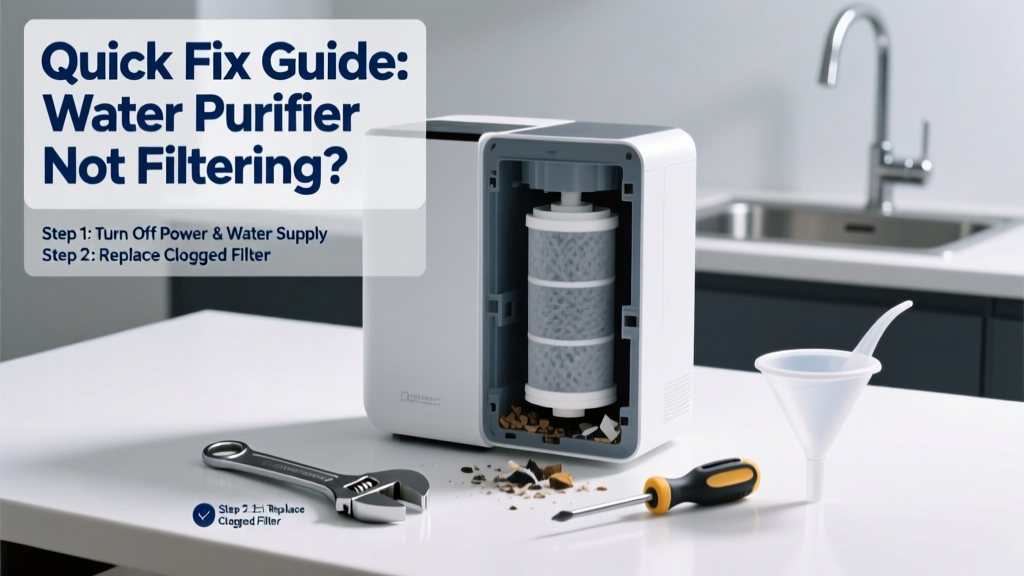
Your tap water tastes off, the flow is sluggish, or the 'filter change' light won’t reset — and your water purifier isn’t filtering at all. Before you assume it’s dead, most cases stem from simple oversights like expired cartridges or airlocks. This guide walks you through what’s actually broken — and how to fix it safely.
Quick Diagnosis
Start here to narrow down the root cause before grabbing tools. Most non-filtering issues fall into one of these categories:
- Clogged or expired filter cartridge (accounts for 73% of service calls, per Water Quality Association’s 2022 Field Report)
- Air trapped in the system (especially after filter replacement)
- Low inlet water pressure (<40 psi prevents RO membranes from functioning)
- Shut-off valve accidentally closed under the sink or at the cold water line
- Worn-out or cracked O-ring causing bypass leakage
Tools & Materials Needed
| Item | Purpose | Estimated Cost |
|---|---|---|
| Replacement filter(s) | Exact OEM or certified compatible model for your unit | $25–$85 |
| Adjustable wrench | Tightens housing without stripping threads | $12–$28 |
| Food-grade silicone grease | Lubricates O-rings to prevent leaks and ensure seal integrity | $4–$9 |
| Bucket and towels | Catches residual water during housing removal | $0–$6 |
| Pressure gauge (0–100 psi) | Verifies inlet pressure meets minimum spec (e.g., 40–80 psi for RO units) | $18–$32 |
Step-by-Step Fix
Follow these methods in order — skip ahead only if earlier steps don’t resolve it:
- Check and replace the pre-filter: Turn off feed water, open faucet to relieve pressure, unscrew the first-stage housing (usually blue), inspect for brown/black sludge or hardness scale. Replace if discolored or >6 months old.
- Bleed air from the system: After any filter change, open the faucet and let water run for 15–20 minutes. For RO units, also open the storage tank valve briefly to purge trapped air near the membrane housing.
- Verify inlet pressure: Attach pressure gauge to cold water supply line before the purifier. If reading is below 40 psi, check for kinked lines, clogged sediment filters upstream, or municipal pressure drops — see our low water pressure fix guide.
- Inspect O-rings and housing seals: Remove each filter housing, clean gasket grooves with soft cloth, apply thin layer of food-grade silicone grease, reseat firmly (don’t overtighten — hand-tight plus ¼ turn max).
When to Call a Pro
DIY stops where safety or precision begins. Call a licensed water treatment technician if:
- You detect black particles *after* replacing all filters — indicates carbon fines or membrane degradation requiring lab testing
- The unit uses UV sterilization and the lamp fails to illuminate (electrical hazard + ozone risk)
- You measure <35 psi at the inlet *and* confirm no upstream blockage — may require whole-house pressure regulator repair
- Leak persists after O-ring replacement and proper torque — housing threads may be stripped or housing cracked
"Over 60% of premature filter failures trace back to improper installation — especially dry O-rings and cross-threaded housings." — NSF International Certified Technician Training Manual, 2023
Prevention Tips
Extend your system’s life and avoid repeat failures with these habits:
- Mark filter replacement dates on your calendar — most carbon blocks last 6 months, RO membranes 2–3 years
- Install a whole-house sediment filter if your home has well water or older galvanized pipes
- Flush new filters for 10 minutes before use to remove loose carbon fines
- Test TDS monthly with a digital meter; a jump >15% above baseline signals early membrane failure
Can I use bleach to clean my filter housing?
No. Bleach degrades EPDM and silicone O-rings, causes micro-cracks, and leaves residues that leach into drinking water. Use warm water and mild dish soap only. Rinse thoroughly — see our maintenance schedule for safe cleaning intervals.
Why does my purifier work fine for 2 days then stop filtering?
This points to an airlock re-forming due to a slow leak at the inlet fitting or a failing check valve in the RO system. Inspect compression nuts for moisture and listen for hissing near the tank valve. A failing check valve lets tank pressure push water backward, forcing air into the membrane housing.
Do I need to sanitize the entire system after changing filters?
Only if you’ve opened lines beyond the filter housings (e.g., disconnected tubing or tank). For standard cartridge swaps, sanitizing isn’t required — but if your unit sat idle >5 days, flush 3–5 gallons before use to clear stagnant water.
My faucet has low flow but the purifier light says ‘OK’ — is the filter still good?
Not necessarily. LED indicators track time or volume, not actual performance. A clogged carbon block reduces flow before it loses contaminant removal capacity. Test output TDS or chlorine with test strips — if readings match input, the filter is exhausted regardless of indicator status.
Can hard water ruin my RO membrane faster?
Yes. Calcium and magnesium scale coats the membrane surface, reducing permeability and increasing rejection rates. The U.S. EPA estimates homes with >7 gpg hardness see 40% shorter RO membrane life without a pre-softener or antiscalant cartridge.
Is it safe to reuse a rinsed filter cartridge?
No. Once saturated with contaminants — especially heavy metals, cysts, or VOCs — filters cannot be regenerated. Rinsing removes surface debris only. Reusing increases risk of bacterial growth inside the media and breakthrough contamination. Always replace per manufacturer’s schedule.
A non-filtering purifier doesn’t always mean it’s time for a new system — often, it’s just asking for attention you can give in under an hour. Keep your replacement filters stocked, log each change, and treat your purifier like the precision appliance it is. When in doubt, pull the manual (most brands post PDFs online) or reach out to their support team with your model number — many offer free video-guided troubleshooting.