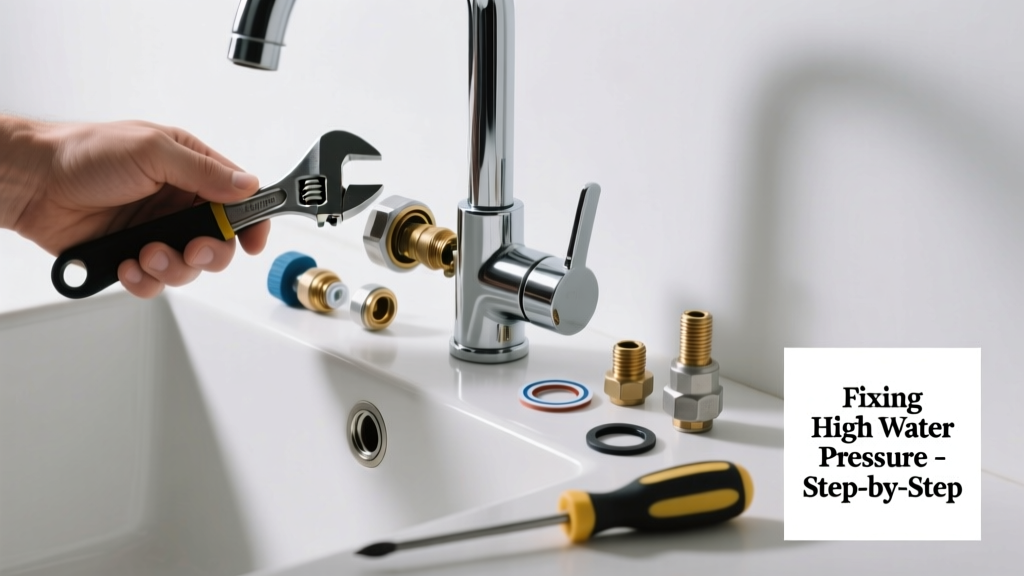
If your kitchen faucet sprays like a firehose, scalds you when you turn it on, or makes banging pipes every time you shut it off, you’re dealing with water pressure that’s too high — and it’s stressing your plumbing system. Left unchecked, this can crack valves, blow out seals, and shorten the life of your dishwasher and refrigerator water lines. The good news? Most cases are fixable with basic tools and under 30 minutes.
Quick Diagnosis
Before adjusting anything, confirm high pressure is the real issue — not just a worn aerator or clogged supply line. Here are the most common root causes:
- Housewide pressure over 80 psi (measured at an outdoor spigot or laundry valve)
- Faulty or missing pressure-reducing valve (PRV) on the main water line
- Thermal expansion in closed-loop systems with a backflow preventer and water heater
- Improperly adjusted or failed PRV downstream of the main valve (e.g., near a water softener)
- Kitchen-specific regulator installed incorrectly or set too high (common in homes with reverse osmosis or filtered systems)
Tools & Materials Needed
| Item | Purpose | Estimated Cost |
|---|---|---|
| Digital pressure gauge (0–160 psi) | Accurately measures static and dynamic water pressure at any faucet or valve | $24–$38 |
| Adjustable wrench | Tightens/loosens PRV locknuts and supply line fittings without marring metal | $12–$22 |
| Phillips and flat-head screwdrivers | Accesses adjustment screws on PRVs and removes faucet handles/aerators | $8–$15 |
| Replacement kitchen aerator (0.5–1.0 gpm) | Reduces flow without lowering system pressure; helps isolate faucet-specific issues | $3–$12 |
| Thermal expansion tank (2-gallon) | Required if high pressure spikes only after water heating cycles (prevents PRV failure) | $45–$75 |
Step-by-Step Fix
Start with the simplest, safest checks first — no pipe cutting required:
- Test pressure at the kitchen cold water line: Screw a digital pressure gauge onto the cold water supply valve (shut off hot/cold, open cold valve fully). Let it stabilize for 60 seconds. If reading exceeds 75 psi, proceed.
- Check your main PRV (if present): Located near the main shutoff, usually brass with an adjustment bolt and locknut. Loosen locknut, turn bolt counterclockwise ¼ turn, retighten, then retest. Repeat until pressure reads 50–65 psi. Don’t go below 45 psi — it’ll starve fixtures.
- Install a low-flow aerator: Remove existing aerator (use pliers wrapped in cloth), clean debris, and replace with a 0.75 gpm model. This won’t fix system pressure but reduces spray force and noise — a quick win while diagnosing.
- Add thermal expansion relief (if needed): If pressure climbs 20+ psi after 2 hours of water heater use, install a 2-gallon expansion tank on the cold inlet per manufacturer instructions. According to the Uniform Plumbing Code (2021), this is mandatory in closed systems with PRVs or backflow preventers.
When to Call a Pro
Don’t risk injury or code violations in these scenarios:
- No PRV exists on your main line and pressure consistently reads >80 psi — installing one requires soldering or press-fit connections and a permit in most jurisdictions
- You hear hammering (water hammer) that persists after installing a new expansion tank or air chamber — indicates undersized piping or failed arrestors
- Pressure fluctuates wildly (e.g., drops to 20 psi then spikes to 110 psi) — points to failing PRV diaphragm or municipal supply issues
- Your home has a well system with a pressure tank — adjusting cut-in/cut-out settings requires pump diagnostics and electrical safety knowledge
Prevention Tips
High pressure isn’t just inconvenient — it’s costly. The U.S. EPA estimates that 14% of household water usage is from leaks, many triggered by excessive pressure. Prevent recurrence with these habits:
- Test system pressure annually using your gauge — especially before winter (when thermal expansion worsens)
- Replace PRV every 7–10 years; they wear out silently (per Watts Manufacturing’s 2022 service bulletin)
- Install whole-house filtration after the PRV — upstream filters restrict flow and cause premature PRV failure
- Label your PRV’s adjustment screw and current setting with permanent marker — saves time during future tweaks
Can high kitchen water pressure damage my dishwasher?
Yes — sustained pressure above 80 psi accelerates wear on inlet valves and solenoids. Bosch service manuals specify a max of 65 psi; exceeding it voids the warranty on many models. A 2023 AHAM appliance reliability study found dishwashers in high-pressure homes failed inlet valves 3.2× faster than average.
Why does pressure spike only when I run hot water?
This points to thermal expansion in a closed system. When your water heater warms water, it expands — but with a backflow preventer or PRV, it has nowhere to go. Pressure builds until it finds relief: through the PRV, T&P valve, or even a leaking faucet seal. An expansion tank solves this — it absorbs the extra volume safely.
Will tightening the supply valve reduce pressure?
No — partially closing the valve creates turbulence and erosion inside the valve seat, leading to leaks and inconsistent flow. It also doesn’t lower system-wide pressure. Always adjust at the PRV or install flow restrictors at the fixture level instead.
Do all homes need a pressure-reducing valve?
No — but if your municipal supply exceeds 80 psi (common in hillside or newer developments), the International Residential Code (IRC R1003.3) requires one. Over 42% of homes built since 2015 in California and Colorado have mandated PRVs due to elevated street pressure.
Can I install a PRV myself?
You can — but only if you’re comfortable with copper sweating or using push-to-connect fittings, shutting off the main water, and draining the system. Permits and inspections are required in 37 states (ICC 2021 Plumbing Code Appendix A). For most homeowners, hiring a licensed plumber ensures compliance and avoids insurance exclusions.
How do I know if my PRV is failing?
Look for three telltale signs: pressure that creeps upward over days (even with no water use), inconsistent readings between faucets, or a constant drip from the PRV’s drain port. As Master Plumber Dan Riley notes in Modern Residential Plumbing (2020, p. 187): “A PRV that can’t hold its set point is like a brake pad with no friction — it’s not ‘getting old,’ it’s already failed.”
“A PRV that can’t hold its set point is like a brake pad with no friction — it’s not ‘getting old,’ it’s already failed.” — Dan Riley, Modern Residential Plumbing, 2020, p. 187
Fixing high kitchen water pressure isn’t about brute force — it’s about precision measurement and targeted intervention. Start with your gauge, respect the numbers, and remember: 60 psi is the sweet spot for longevity, safety, and comfort. Once dialed in, your faucet will pour smoothly, your pipes will stay quiet, and you’ll save hundreds in avoided repairs over the next decade. For related help, see our guides on fixing a leaking kitchen faucet and choosing the right kitchen aerator.