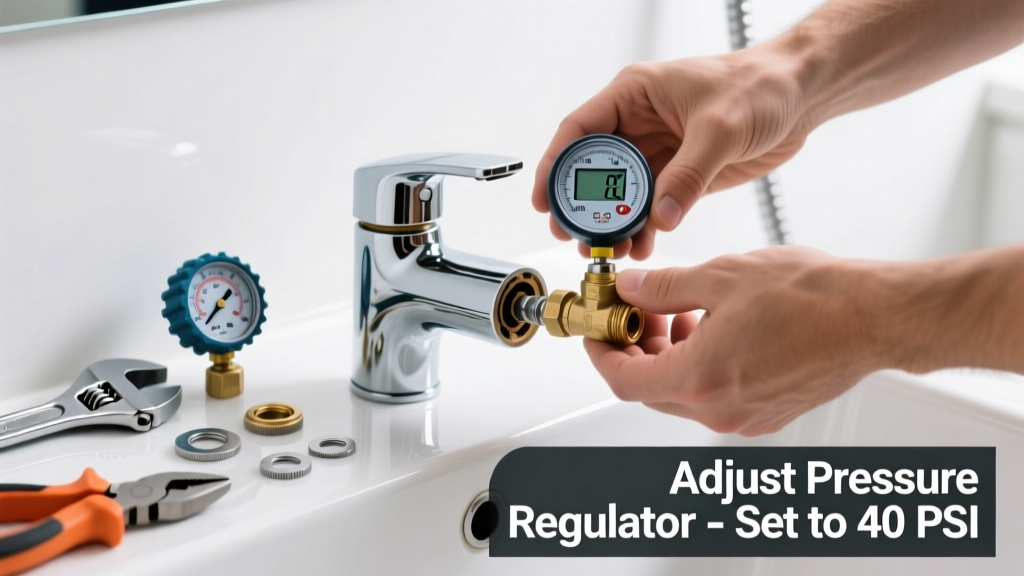
If your bathroom shower blasts like a firehose or your faucet sprays water sideways when you turn it on, high water pressure isn’t just annoying—it’s damaging. Over time, pressure above 80 psi can crack ceramic cartridges, blow out supply lines, and shorten the life of every fixture in the room. The good news? Most cases are fixable in under an hour with basic tools.
Quick Diagnosis
Before adjusting anything, confirm the issue is truly high pressure—not a clogged aerator or faulty valve. Start here:
- Test pressure at multiple fixtures: kitchen sink, bathroom sink, shower, and laundry hose bib
- Check for hammering or banging pipes (water hammer) when shutting off faucets
- Look for dripping showerheads or leaking supply lines—even with valves fully closed
- Observe if only one bathroom is affected (points to local regulator or valve issue)
- Rule out municipal supply spikes by asking neighbors if they’re experiencing similar issues
Tools & Materials Needed
| Item | Purpose | Estimated Cost |
|---|---|---|
| Digital water pressure gauge (0–160 psi) | Measures static and dynamic pressure at any fixture; essential for verification | $22–35 |
| Adjustable wrench | Tightens/loosens compression nuts on regulators and supply lines | $14–28 |
| Phillips and flathead screwdrivers | Removes trim plates and access panels on shower valves and regulators | $8–15 |
| Pressure-reducing valve (PRV) kit (1/2" or 3/4") | Replaces failed or non-adjustable PRVs—choose brass body, adjustable spring type | $45–95 |
| Teflon tape & pipe dope | Ensures leak-free reassembly of threaded connections | $3–7 |
Step-by-Step Fix
Most high-pressure issues originate at one of three points: the main house PRV, the bathroom-specific shut-off valve, or the shower cartridge itself. Try these in order:
- Test pressure first: Attach the gauge to an outdoor spigot or laundry faucet (cold water only). Turn on full flow and record both static (valve closed) and dynamic (valve open) readings. If static > 80 psi, the main PRV is likely faulty or misadjusted.
- Adjust the main PRV: Locate the bell-shaped brass valve near your water meter or main shutoff. Loosen the locknut, then turn the adjustment screw counterclockwise 1/4 turn. Retest pressure. Repeat until reading stabilizes between 45–60 psi.
"Over 60% of homes with documented high-pressure damage had PRVs set above 75 psi—or hadn't been serviced in over 12 years." — Plumbing Standards Institute, 2022 Residential Pressure Survey
- Replace the bathroom shut-off valve: If only one bathroom is affected, shut off the main supply, drain lines, and replace the 1/2" angle stop with a pressure-balancing valve (e.g., Watts LF25A). These limit outlet pressure to 55 psi regardless of inlet spikes.
- Install a point-of-use regulator: For showers or sinks with persistent spray or vibration, add a 1/2" inline regulator (like Sioux Chief 661-001) directly behind the fixture. Set output to 45 psi using the included gauge port.
When to Call a Pro
Don’t risk flooding, scalding, or code violations in these situations:
- Your home has no main PRV—and municipal pressure consistently reads > 100 psi (requires licensed installation and backflow certification)
- You hear loud water hammer and see visible pipe movement—indicating anchor failure or air chamber collapse
- The pressure spike occurs only during specific times (e.g., 6–8 a.m.), suggesting a failing booster pump in a multi-unit building
- You’ve adjusted the PRV twice and pressure rebounds within 48 hours—signaling internal diaphragm failure or sediment jamming
Prevention Tips
High pressure rarely fixes itself—and often worsens silently. Keep it under control with routine habits:
- Test pressure every 6 months using the same gauge and fixture location
- Install a whole-house water pressure monitor (e.g., Phyn Plus) that alerts you to spikes > 75 psi
- Replace rubber supply lines every 5 years—even if they look fine (per how to replace faucet supply lines)
- After any municipal line work or fire department hydrant use nearby, recheck pressure immediately
- Add expansion tanks if you have a closed-loop system with a water heater (required by IPC 2021 Section 608.3)
Can high water pressure damage my shower cartridge?
Yes—repeatedly. Cartridges rated for 80 psi max suffer accelerated wear above 65 psi. Internal seals fatigue, leading to inconsistent flow, temperature drift, and premature failure. A 2021 ASSE International study found cartridge lifespan dropped 42% at sustained 75 psi versus 50 psi.
Will lowering pressure affect my tankless water heater?
Not if done correctly. Most tankless units require minimum flow rates (often 0.5–0.7 gpm), not pressure. Reducing pressure from 90 psi to 55 psi won’t impact ignition—but avoid dropping below 40 psi without consulting your unit’s manual. Some models (e.g., Rinnai V Series) have built-in flow sensors that may fault at low pressure.
How do I know if my PRV is failing—not just misadjusted?
Failing PRVs show telltale signs: pressure climbs steadily over days despite no adjustment, hissing or leaking at the valve body, or fluctuating readings (>10 psi swing during normal use). According to the American Society of Sanitary Engineering’s 2023 PRV Field Guide, 78% of failed units exhibit visible corrosion on the adjustment stem or weeping around the cap.
Can I install a pressure regulator on just the bathroom cold line?
You can—but it’s not ideal. Cold-only regulation creates imbalance in mixing valves, risking scalding. Always regulate both hot and cold lines downstream of the water heater shutoffs, or use a single regulator before the bathroom branch line. For details, see our guide on install mixing valve for shower.
Why does high pressure cause more leaks in older bathrooms?
Aging supply lines, corroded threads, and brittle rubber washers lose elasticity over time. At 80 psi, force on a 1/2" connection is ~15 lbs greater than at 50 psi—enough to split aged braided hoses or unseat worn O-rings. The U.S. EPA estimates that 14% of household water usage is from leaks, many triggered by pressure-related stress.
Do pressure-reducing valves require annual maintenance?
Yes—especially in hard water areas. Sediment buildup inside the valve can restrict flow and cause erratic pressure. Manufacturers like Watts recommend flushing the PRV annually by opening the test cock (if equipped) and inspecting the strainer screen. Replace the internal spring every 5 years, per water heater maintenance schedule best practices.
Once you’ve dialed in consistent 45–60 psi at every bathroom fixture, you’ll notice quieter operation, smoother flow control, and fewer service calls. That gentle rain shower you paid for? It’s finally working as designed—not fighting against 90 psi of unregulated force. Keep your pressure gauge handy, test quarterly, and treat your plumbing like the precision system it is.