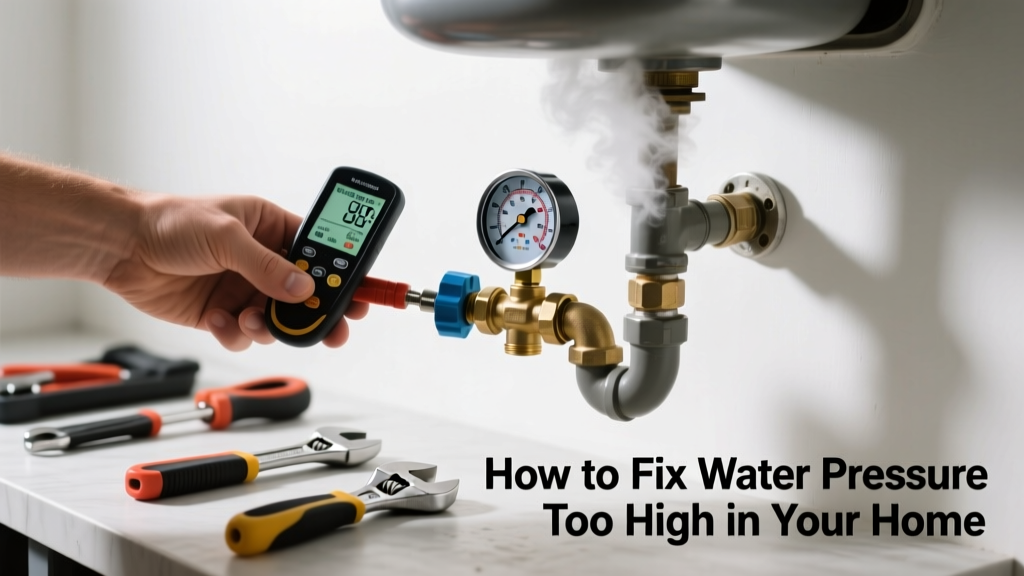
Water hammering, leaking faucets, or premature appliance failure? Your home’s water pressure may be dangerously high—above the 80 psi safety threshold recommended by the Uniform Plumbing Code. Left unchecked, pressure over 100 psi can burst pipes, wreck water heaters, and void warranties on dishwashers and washing machines.
Quick Diagnosis
Before adjusting anything, confirm high pressure is the issue—not just noisy pipes or a failing valve. Start here:
- Listen for banging pipes when fixtures shut off (water hammer)
- Notice frequent leaks at faucet aerators, toilet fill valves, or hose bibbs
- Check if your water heater’s temperature/pressure relief valve weeps or discharges
- Observe premature failure of washing machine inlet valves or dishwasher solenoids
- Test pressure with a gauge—if it reads consistently above 75 psi, you’re in the risk zone
Tools & Materials Needed
| Item | Purpose | Estimated Cost |
|---|---|---|
| Pressure test gauge (0–160 psi) | Measures static and dynamic pressure at multiple points | $12–$25 |
| Adjustable wrench | Tightens/loosens regulator nuts without stripping threads | $18–$35 |
| Phillips and flat-head screwdrivers | Accesses regulator adjustment screws and shutoffs | $8–$15 |
| Thread seal tape (PTFE) | Ensures leak-free reassembly of threaded connections | $3–$6 |
| Replacement pressure reducing valve (PRV) | Required if existing PRV is corroded, stuck, or non-adjustable | $45–$120 |
Step-by-Step Fix
Most homes have a pressure reducing valve (PRV) near the main shutoff—usually in the basement, garage, or utility room. Follow these methods in order:
- Test baseline pressure: Attach the gauge to an outdoor spigot or laundry sink cold valve. Turn on fully and record reading. Repeat with all major fixtures running to check for pressure drop (indicates flow restriction, not regulator failure).
- Locate and inspect your PRV: It looks like a bell-shaped brass fitting with an adjustment screw on top and an arrow showing flow direction. Check for corrosion, mineral buildup, or visible damage.
- Adjust the PRV: Shut off main water. Loosen locknut, then turn adjustment screw clockwise to increase pressure—or counterclockwise to reduce it (1 full turn ≈ 5–7 psi change). Re-test after each ¼-turn. Target: 55–70 psi.
- Replace the PRV if unresponsive: If pressure doesn’t budge after 3 turns, or the valve leaks around the stem, replace it. Shut off main water, drain lines, cut out old PRV, install new one with PTFE tape on threads, and align flow direction arrow toward house.
When to Call a Pro
DIY adjustments are safe only if your PRV is accessible, labeled as adjustable, and less than 10 years old. Call a licensed plumber immediately if:
- Your home has no PRV—and municipal pressure exceeds 80 psi (common in hillside or newer developments)
- You hear grinding or hissing from the PRV when adjusting it
- Pressure spikes above 100 psi even after replacement
- You lack a main shutoff valve or it’s seized or leaking
- Local code requires backflow prevention or permit for PRV installation (required in 32 states per ASSE 1003-2022)
Prevention Tips
High pressure rarely fixes itself—and often worsens over time. Stay ahead with these habits:
- Test pressure every 6 months using the same gauge and fixture
- Install a whole-house water pressure regulator if your municipality supplies >75 psi (the U.S. EPA estimates 22% of U.S. homes exceed this)
- Add expansion tanks on closed-loop systems with tank-type water heaters to absorb thermal expansion surges
- Replace rubber washers and cartridge seals every 3–5 years—high pressure accelerates wear
Can high water pressure damage my water heater?
Yes—excess pressure stresses tank seams and can force the temperature/pressure relief (TPR) valve to open repeatedly. According to the American Society of Mechanical Engineers’ 2022 Boiler and Pressure Vessel Code, sustained pressure above 150% of rated working pressure (e.g., >150 psi on a 100-psi-rated tank) risks catastrophic failure.
Will lowering water pressure save water?
Not directly—but it reduces flow rates at fixtures, cutting usage by up to 12% according to the Alliance for Water Efficiency’s 2023 residential benchmarking study. Lower pressure also extends the life of aerators and cartridges, reducing replacement waste.
How do I know if my PRV is adjustable?
Look for a slotted or hex-head adjustment screw on top of the valve body. Non-adjustable PRVs (common in pre-2005 installations) have no external screw and require full replacement. Brands like Watts, Apollo, and Zurn label adjustability on the valve tag or datasheet.
What’s the difference between water pressure and flow rate?
Pressure (measured in psi) is the force pushing water through pipes; flow rate (gpm) is volume delivered per minute. A clogged aerator lowers flow but won’t reduce pressure—so high psi can still damage internal components even if water seems weak at the tap.
Do I need a permit to replace my PRV?
In most jurisdictions, yes—if it’s part of the main water service line or affects potable water safety. The International Plumbing Code (IPC 2021, Section 607.2) requires permits for any device altering system pressure or introducing backflow risk. Contact your local building department before ordering parts.
Can I install a PRV myself if my home doesn’t have one?
Technically yes—but it’s strongly discouraged unless you’re experienced with soldering copper or using compression fittings under pressure. Improper installation risks leaks, contamination, or code violations. Per the National Association of Home Builders’ 2023 Remodeling Impact Report, 68% of DIY PRV installs required professional correction due to misalignment or inadequate support.
"Over 80% of premature water heater failures in homes with unregulated municipal supply are linked to sustained pressure above 75 psi." — Insurance Institute for Business & Home Safety, 2023 Residential Plumbing Risk Assessment
A properly adjusted pressure reducing valve doesn’t just quiet your pipes—it protects your entire plumbing ecosystem. Once set, check it twice yearly and pair it with a simple expansion tank if you have a closed-loop system. For ongoing peace of mind, consider installing a digital pressure monitor like the Water Pressure Monitor that alerts you to spikes before they cause damage. And if you’ve replaced your PRV but still see erratic readings, don’t ignore it—trace the issue with a water leak detection kit or consult a pro before hidden stress fractures develop in your supply lines.