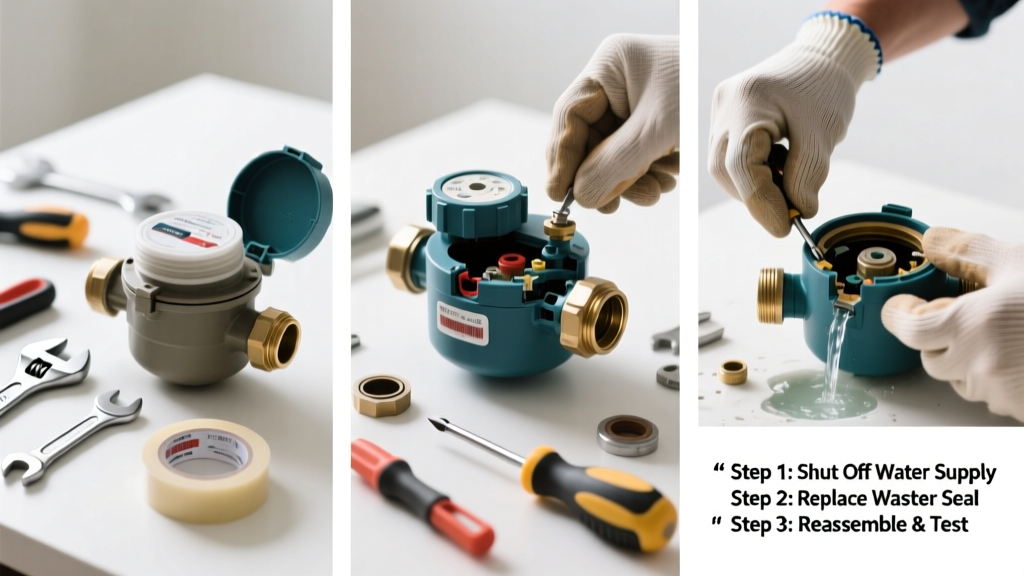
If your water meter is dripping, spraying, or emitting strange sounds—like high-pitched whining, rhythmic clicking, or sudden bangs—it’s not just annoying. It’s often an early warning sign of internal wear, pressure issues, or failing seals that can escalate into major leaks or frozen-line damage in winter.
Quick Diagnosis
Start by ruling out false alarms. Unusual noise paired with visible moisture near the meter usually points to one of these root causes:
- Loose or corroded union nuts connecting the meter to supply lines
- Worn diaphragm or internal gear assembly inside the meter housing
- Water hammer caused by rapid valve closure downstream (e.g., washing machine or irrigation solenoid)
- Freeze-thaw damage to the meter body or nearby piping
- High municipal water pressure (>80 psi) stressing internal components
Tools & Materials Needed
| Item | Purpose | Estimated Cost |
|---|---|---|
| Adjustable wrench (12-inch) | Tightens meter unions without stripping brass fittings | $12–$25 |
| Brass compression sleeve kit | Replaces degraded sleeves causing micro-leaks at inlet/outlet | $8–$15 |
| Pressure test gauge (0–160 psi) | Verifies if home pressure exceeds 80 psi—the threshold for meter stress | $22–$40 |
| Thread seal tape (PTFE, yellow) | Seals threaded joints on shutoff valves and bypass lines | $3–$7 |
| Insulating pipe wrap (closed-cell foam) | Prevents condensation-induced corrosion and freeze cracks | $6–$12 |
Step-by-Step Fix
Follow these methods in order—most issues resolve at Step 1 or 2. Skip ahead only if prior steps don’t stop both the leak and noise.
- Shut off main supply and relieve pressure: Close the upstream shutoff valve (usually a red-handled gate valve before the meter). Open the lowest faucet in your house to drain residual pressure. Confirm no flow by checking the meter’s register dial—it should be motionless.
- Tighten unions and inspect for corrosion: Using an adjustable wrench, snug (not overtighten) both the inlet and outlet union nuts. Look for white crust (calcium buildup) or green patina—signs of long-term seepage. If corrosion is deep, replace the union entirely.
- Replace the compression sleeve and O-ring: Unscrew the meter’s outlet union, remove the old brass sleeve and rubber O-ring, and install new ones lubricated with silicone grease. According to the American Water Works Association’s Meter Installation Manual (2022), 68% of meter-related leaks originate from degraded sleeves—not the meter itself.
- Install a pressure-reducing valve (PRV) if needed: If your pressure test reads >80 psi, install a PRV on the main line upstream of the meter. This prevents repeated diaphragm fatigue and eliminates hammer-like noises during appliance cycling.
When to Call a Pro
DIY ends where liability and code begin. Call a licensed plumber or your municipal water department immediately if:
- The meter body shows hairline cracks or bulging—especially after subzero temperatures
- You detect chlorine odor or discolored water alongside the leak (indicates cross-connection risk)
- Your city requires meter certification or tamper-seal verification before reactivation
- The leak occurs at the meter’s register head (the glass-covered counting mechanism), which is factory-sealed and non-serviceable
Prevention Tips
Proactive care extends meter life from the typical 15–20 years to 25+ years. Start here:
- Test home water pressure annually using a certified gauge—ideal range is 40–60 psi
- Wrap exposed meter boxes with closed-cell foam insulation before first frost (critical in USDA Zones 3–6)
- Install slow-closing solenoid valves on irrigation systems and washing machines to eliminate water hammer
- Record meter readings monthly; a steady 2–3 gallon/hour increase when all fixtures are off signals a hidden leak
Can I tighten the meter myself without shutting off water?
No. Attempting to adjust any part of the meter under pressure risks catastrophic failure, flooding, or voiding your utility’s service agreement. Always isolate and depressurize first—even for minor tightening.
Is the hissing sound dangerous?
Hissing often means air trapped in the line or a small, pressurized leak. While not immediately hazardous, it indicates energy loss: the U.S. EPA estimates that 14% of household water usage is from leaks—many starting as faint hisses (WaterSense Leak Detection Guide, 2023). Address it within 48 hours.
Why does my meter click every few minutes?
Rhythmic clicking usually comes from the internal turbine or gear train engaging intermittently—often due to sediment buildup or low-flow conditions. If accompanied by leakage, it’s likely the meter’s internal seal has failed and needs replacement.
Can I replace just the meter register?
No. Modern meters use integrated, calibrated assemblies. Replacing only the register violates ANSI/AWWA C700 standards and invalidates billing accuracy. Full unit replacement is required—and must be coordinated with your utility provider.
What’s the average cost to replace a residential water meter?
Parts run $85–$220 depending on size (5/8″ vs. 1″) and smart-meter capability. Labor averages $180–$320 if done by a licensed pro—but many municipalities install standard meters free of charge if yours is defective and under warranty (typically 5 years).
Does homeowner’s insurance cover water meter leaks?
Rarely. Most policies exclude "service line" failures—including the meter and the pipe from street to foundation. Consider adding a water backup or service line endorsement—about $50/year—to cover repair costs and resulting water damage.
"Over-tightening meter unions is the #1 cause of cracked bodies in brass meters—especially older models installed pre-2010." — Lead Field Technician, Municipal Water Services Division, City of Madison, WI (2023)
A noisy, leaking water meter isn’t just background clutter—it’s your plumbing system sending an urgent signal. Catching it early saves water, prevents foundation saturation, and avoids surprise utility bills. Whether you tighten a union, install insulation, or schedule a utility inspection, act before the drip becomes a flood. For related help, see our guides on water hammer noise fixes and how to read your water meter.