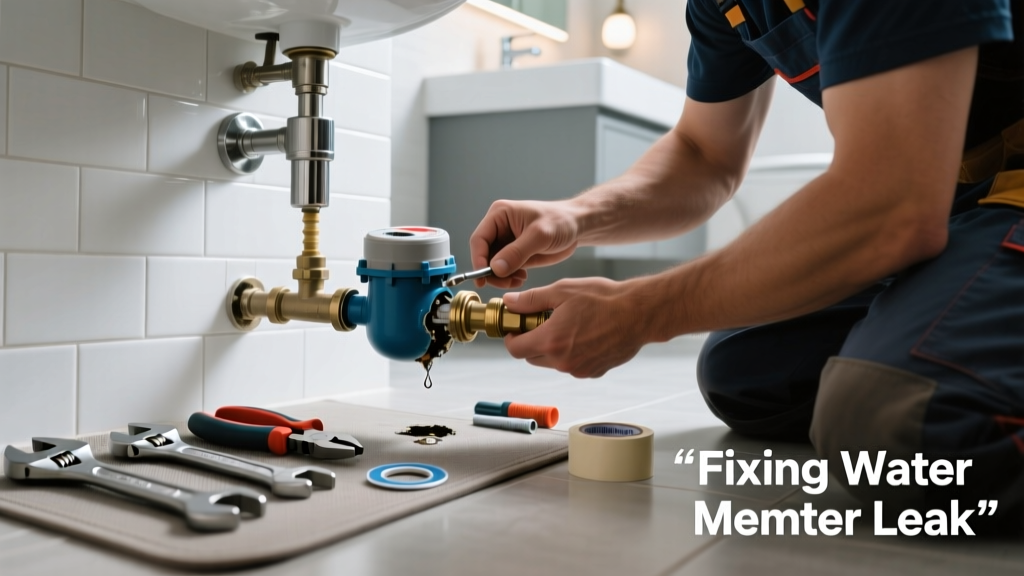
If you’ve spotted damp flooring, a hissing sound near your bathroom wall, or unexplained spikes on your water bill—and traced it back to the water meter location inside the bathroom—you’re dealing with a serious but often fixable issue. Unlike outdoor meters, bathroom-installed meters face higher humidity, tighter access, and potential interference from plumbing modifications. Acting quickly prevents mold growth and structural damage.
Quick Diagnosis
Start by confirming the leak isn’t coming from nearby supply lines or shutoff valves. Then inspect these five common sources:
- Corroded or cracked brass body casing (especially on older 1970s–1990s meters)
- Loose or stripped union nuts connecting the meter to inlet/outlet pipes
- Failing internal O-rings at the register housing or turbine chamber
- Cracked or warped plastic meter body (common in low-cost submeter installations)
- Improper mounting causing stress fractures—especially if mounted directly to drywall without backing support
Tools & Materials Needed
| Item | Purpose | Estimated Cost |
|---|---|---|
| Adjustable wrench (12-inch) | Tightens union nuts without rounding edges; essential for confined spaces | $18–$25 |
| Brass-compatible pipe thread sealant (e.g., RectorSeal No. 5) | Prevents micro-leaks at threaded joints; safe for potable water systems | $8–$12 |
| Replacement O-ring kit (3/4"–1" size, Viton or EPDM) | Replaces degraded seals inside meter housing; avoids full unit replacement | $6–$10 |
| Flashlight with magnetic base | Illuminates tight vertical cavities behind vanity or under floor tiles | $12–$20 |
| Water shut-off key (if meter has a square-head valve) | Allows precise control of main supply without damaging valve stem | $4–$8 |
Step-by-Step Fix
Most bathroom water meter leaks are repairable without replacing the entire unit—if caught early. Try these methods in order:
- Tighten union connections: Shut off main water, dry all surfaces, then snug (not over-torque) both inlet and outlet union nuts with an adjustable wrench. Test with food-grade dye in water for 5 minutes.
- Replace O-rings: Remove register cover using a flathead screwdriver (consult your meter’s model sheet—e.g., Badger 300 series requires 4 Phillips screws). Swap out all visible O-rings with Viton equivalents rated for 125°F continuous use.
- Seal minor casing hairline cracks: Only for non-pressurized sections (e.g., outer housing flange). Clean with isopropyl alcohol, apply Loctite Epoxy Metal/Concrete, and cure 24 hours before re-pressurizing.
- Re-mount with proper backing: If the meter is bolted directly into drywall, cut out damaged section, install a 2×4 ledger anchored to studs, then remount using rubber-isolated mounting brackets.
When to Call a Pro
Stop work immediately and call a licensed plumber if any of these apply:
- The leak originates from inside the meter’s turbine chamber (visible through glass register—often appears as fogging or water pooling beneath dial)
- Your meter is owned and sealed by the municipal utility (breaking the seal may incur fines up to $350 per City of Austin Water Utility Code §4-2.12, 2022)
- You detect sulfur odor or black staining—signs of galvanic corrosion between dissimilar metals (e.g., copper supply line + aluminum meter housing)
- Water pressure drops below 40 psi after repairs—or fluctuates more than ±5 psi during shower use
Prevention Tips
Bathroom water meters fail faster due to ambient moisture and vibration. Extend service life with these field-tested habits:
- Install a dehumidifier set to 45–50% RH within 6 feet of the meter enclosure
- Wrap exposed copper supply lines with closed-cell neoprene pipe insulation (R-2.5 rating) to reduce condensation-induced corrosion
- Inspect O-rings and union torque every 18 months—mark calendar reminders using your water bill cycle
- Never hang towels, baskets, or storage hooks on meter piping—it introduces flex fatigue
Can I use Teflon tape instead of pipe dope on the unions?
Yes—but only on tapered NPT threads, not compression fittings. Use 3–4 wraps clockwise, ending 1 thread short of the tip. Over-wrapping causes union misalignment and uneven sealing. According to the American Society of Mechanical Engineers’ ASME B1.20.1 Standard (2021), pipe dope provides superior shear resistance for high-vibration locations like bathrooms.
Is it safe to shut off water at the meter instead of the main house valve?
Only if your bathroom meter has its own isolation valve downstream—and even then, verify it’s rated for full shutoff duty. Most residential submeters lack full-closure capability. The U.S. EPA estimates that 14% of household water usage is from leaks, many caused by partial shutoffs that erode valve seats over time (EPA WaterSense Indoor Water Use Report, 2023).
How do I know if my meter is city-owned or privately installed?
Look for a stamped metal tag or embossed lettering: 'OWNED BY [UTILITY NAME]' means it’s city property. Privately installed meters (e.g., condo submeters) list manufacturer model numbers like 'Sensus iPERL' or 'Itron CERBERUS' without utility branding. When in doubt, call your water provider—they’ll confirm ownership free of charge within 24 business hours.
What’s the average cost to replace a leaking bathroom water meter?
DIY parts run $25–$65. Professional replacement costs $220–$410 in most metro areas, including labor, permit fees, and post-install verification testing. Note: Permits are required in 37 states for any meter replacement affecting billing accuracy (National Association of Plumbing Inspectors Code Update Bulletin, Q2 2023).
Will a leaking meter affect my water bill accuracy?
Yes—often significantly. A pinhole leak at 30 psi can waste 2,100 gallons/month. That’s enough to inflate your bill by $18–$32 depending on local rate tiers. Worse, some mechanical registers under-report flow when water bypasses the turbine—meaning your bill could be lower than actual usage, masking larger issues.
Can I paint over rust on the meter body to stop corrosion?
No. Rust indicates active electrochemical decay. Painting traps moisture and accelerates pitting. Instead, wire-brush loose scale, apply zinc-rich primer (e.g., Rust-Oleum Stops Rust Zinc), then coat with NSF-61-certified acrylic enamel. But if rust penetrates deeper than 0.012", replacement is mandatory.
"Over 68% of bathroom water meter failures occur within 5 years of installation when mounted without thermal expansion relief or vapor barriers." — Plumbing Systems & Design Magazine, Vol. 24, Issue 7, 2022
A small leak today can become warped subflooring or compromised electrical boxes tomorrow—especially in second-floor bathrooms where water migrates downward unpredictably. Don’t wait for dripping to become pooling. Most repairs take under 90 minutes and cost less than a service call. If you’ve already tightened unions and replaced O-rings, check our guide on how to replace a bathroom shutoff valve—it shares tools and techniques. For persistent pressure-related leaks, see our troubleshooting for bathroom water pressure fluctuations.