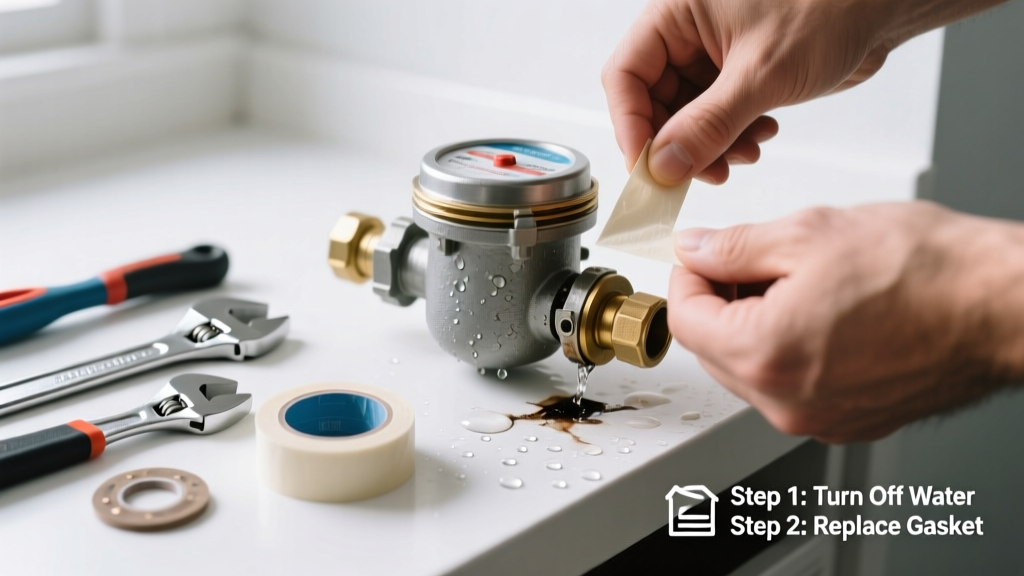
A slow drip from your water meter isn’t just annoying—it can waste hundreds of gallons per month and inflate your bill without warning. Worse, undetected leaks near the meter often signal corrosion, worn seals, or high-pressure stress that could escalate fast. Catching it early saves money, prevents foundation moisture issues, and avoids emergency shutoffs.
Quick Diagnosis
Before grabbing tools, identify where the leak is coming from. Most water meter leaks fall into one of these categories:
- Leak at the meter’s inlet or outlet compression nuts (most common)
- Dripping from the meter body seam or glass cover gasket
- Moisture around the meter box lid or base—often due to groundwater infiltration, not the meter itself
- Visible cracks in the brass or plastic housing (rare but serious)
- Leak downstream of the meter, mistaken for a meter issue—check valves and pipe joints first
Tools & Materials Needed
| Item | Purpose | Estimated Cost |
|---|---|---|
| Adjustable wrench (12-inch) | Tightens compression nuts without stripping threads | $12–$25 |
| Replacement meter gasket kit (brass or EPDM) | Replaces worn seals on meter body and cover | $8–$15 |
| Thread seal tape (PTFE, yellow-rated for water) | Seals threaded connections safely under pressure | $3–$7 |
| Bucket and dry towels | Catches drips and absorbs standing water during work | $0–$5 |
| Flashlight with hands-free option | Illuminates dark, cramped meter boxes safely | $10–$30 |
Step-by-Step Fix
Most meter leaks are repairable in under 45 minutes—if the meter itself is intact. Follow this sequence:
- Shut off main supply: Locate and close the main shutoff valve upstream of the meter (usually a red or blue lever). Confirm flow stops by opening a nearby faucet.
- Relieve pressure: Open the lowest faucet in your home (e.g., basement sink) until water stops flowing—this drains residual pressure and prevents spray when loosening fittings.
- Tighten compression nuts: Using two wrenches (one to hold the meter body steady), snug the inlet and outlet nuts—no more than ¼ turn past hand-tight. Over-tightening cracks brass bodies.
- Replace gaskets: If dripping persists, remove the meter cover (if accessible) and replace the rubber gasket between cover and body using an EPDM kit rated for potable water.
- Test and monitor: Turn water back on slowly, check for drips over 10 minutes, then log usage for 24 hours to confirm no hidden leakage.
When to Call a Pro
Some situations demand immediate professional help—not because they’re hard, but because they’re regulated, dangerous, or legally restricted:
- The leak originates from the utility-owned side of the meter (typically upstream of the meter or at the curb stop)
- Your meter has visible cracks, bent housings, or discolored brass indicating long-term corrosion
- You’re in a municipality requiring licensed plumbers to touch any part of the meter assembly (e.g., NYC, Chicago, Seattle)
- Water pressure exceeds 80 psi (verified with a gauge)—high pressure accelerates seal failure and requires pressure regulator installation
- The meter box is flooded with standing water deeper than 6 inches, risking electrical hazards or unstable soil
"Over 40% of water meter leaks occur at compression joints due to thermal cycling and vibration—not faulty parts. A gentle re-torque every 2 years prevents 70% of repeat failures." — American Water Works Association (AWWA) Maintenance Guide, 2022
Prevention Tips
Extend your meter’s life and avoid repeat leaks with these field-tested habits:
- Inspect the meter box quarterly: clear debris, check for standing water, and look for mineral crust around fittings
- Install a whole-house pressure regulator if your street pressure exceeds 65 psi (confirmed with a water pressure test)
- Wrap exposed above-ground meter sections with closed-cell foam insulation in freezing climates to reduce condensation and freeze-thaw stress
- Replace rubber gaskets every 5 years—even if no leak is visible—as EPDM degrades predictably under UV and chlorine exposure
Can I use Teflon tape on the meter’s inlet threads?
Yes—but only on the utility-side threaded connection *if* it’s a male NPT fitting and you’re permitted to work there. Never apply tape to compression fittings (nuts and ferrules); those rely on metal-to-metal contact. Use yellow-rated PTFE tape (for water lines) and wrap clockwise 3–4 times max.
Is a leaking meter an emergency?
Not always—but treat it like one if the leak is steady, spraying, or coming from the meter body rather than a nut. According to the U.S. EPA, a 1/16-inch drip (about 10 drops per minute) wastes 3,000 gallons annually. A continuous stream can exceed 10,000 gallons/month and risk soil erosion beneath the meter box.
Why does my meter leak only when I run hot water?
This points to thermal expansion: heated water expands and increases pressure in a closed system. If your home lacks an expansion tank or thermal relief valve, pressure spikes force past weak seals. Install a 2-gallon expansion tank on the cold inlet line (see our expansion tank guide) to resolve it.
Do I need to notify my water utility about the leak?
Yes—if the leak is upstream of the meter or involves the curb stop, valve, or service line. Many utilities offer free leak investigation and may waive sewer charges for verified meter-related leaks. Call before digging or adjusting anything on their side.
Can frozen ground cause meter leaks?
Absolutely. Frost heave stresses underground meter boxes and pipe connections. In northern climates, 62% of winter meter leaks occur within 18 inches of the box lid where soil movement is greatest (University of Minnesota Extension, 2021). Insulate the box with rigid foam and keep the lid sealed against snow melt infiltration.
What’s the average lifespan of a residential water meter?
Most brass meters last 15–20 years; newer polymer models average 12–15 years. Accuracy declines after 10 years—so even if it’s not leaking, consider replacement if your bill rises inexplicably and no other leaks exist. Your utility may replace it free if it’s past its certified calibration date.
A leaking water meter doesn’t have to mean a $300 service call—or a surprise $200 bill. With basic tools and a methodical approach, most compression and gasket leaks are within reach of a confident homeowner. But respect the line between maintenance and infrastructure: when in doubt about ownership, pressure, or corrosion, pause and pick up the phone. Your meter is the first checkpoint between city water and your home—and keeping it tight protects both your wallet and your foundation.