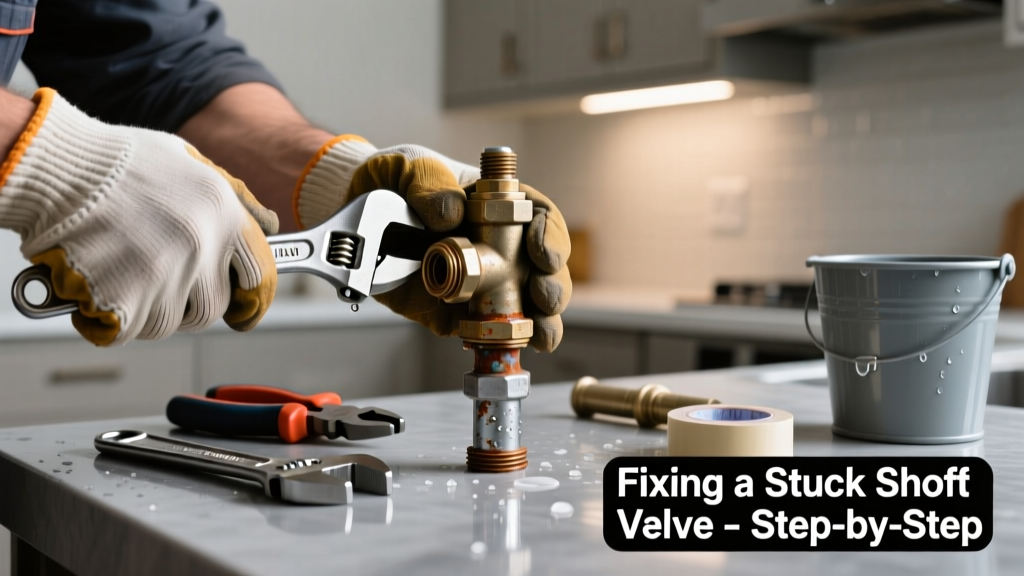
Your kitchen sink suddenly stops working—and the main shutoff under the sink won’t budge. No water flow, no response to turning, just stubborn resistance. This isn’t just inconvenient—it’s a potential flood risk if you can’t isolate the line during an emergency.
Quick Diagnosis
Before forcing anything, identify the root cause. A stuck shutoff is rarely random—it’s usually one of these:
- Mineral buildup (especially in homes with hard water over 10+ years)
- Rusted or corroded valve stem—common in galvanized steel or older brass valves
- Broken internal washer or seat causing binding
- Debris lodged between the handle and valve body (e.g., pipe thread tape fragments)
- Valve installed upside-down or misaligned during prior repair
Tools & Materials Needed
| Item | Purpose | Estimated Cost |
|---|---|---|
| Adjustable wrench (10-inch) | Provides torque without stripping hex flats on valve stems | $12–$22 |
| Penetrating oil (e.g., PB Blaster) | Dissolves rust and mineral bonds faster than WD-40 for plumbing applications | $8–$14 |
| Heat gun (not torch) | Gently expands metal to break corrosion bonds—safer than open flame near cabinets | $35–$65 |
| Replacement angle stop valve (1/2" compression) | Required if stem breaks or seat is damaged beyond repair | $9–$24 |
| Rubber mallet | Delivers controlled shock to loosen seized threads without cracking brass | $6–$15 |
Step-by-Step Fix
Try these methods in order—start gentle, escalate only if needed:
- Apply penetrating oil: Spray PB Blaster liberally around the valve stem and nut. Let sit 15 minutes, then tap lightly with rubber mallet. Repeat twice before attempting to turn.
- Use heat + torque: Heat the valve body (not the handle) with a heat gun for 45 seconds at 300°F. Immediately apply steady counterclockwise pressure with an adjustable wrench—do not jerk.
- Tap-and-turn technique: Hold wrench firmly, then strike the wrench handle *once* with the rubber mallet while applying light turning pressure. The micro-shock often breaks static friction.
- Replace the valve: If the stem spins freely but doesn’t shut off—or snaps—shut off the street-side main first, then replace the entire angle stop using this step-by-step replacement guide.
When to Call a Pro
Stop immediately and call a licensed plumber if any of these apply:
- The valve body cracks or leaks when pressure is applied
- You hear hissing or see water seeping from the valve packing nut
- Your home has polybutylene pipes (installed 1978–1995)—they’re prone to sudden failure under stress
- The main shutoff is located outside your property line (e.g., in the sidewalk or utility easement)
- You’ve tried all steps above and the valve remains immobile after 20 minutes of safe effort
According to the Insurance Institute for Business & Home Safety's 2023 report, 68% of water damage claims involving interior shutoffs stemmed from DIY attempts that worsened valve integrity or ruptured supply lines.
"Never use a pipe wrench on a brass angle stop—it deforms the body and guarantees future leaks. Use only smooth-jaw tools or wrap jaws with electrical tape." — Master Plumber Luis M., Chicago Plumbing Inspectors Guild, 2022
Prevention Tips
Maintain your kitchen shutoff annually to avoid recurrence:
- Turn the valve fully open and closed once every 6 months—even if you never use it
- After each use, wipe the stem clean and apply a pea-sized dab of silicone-based grease (never petroleum jelly)
- Install a labeled shutoff tag so others know its location and function
- If your home is over 25 years old, consider upgrading to a stainless steel or ceramic-disk angle stop—it resists corrosion far better than brass
Can I use vinegar instead of penetrating oil?
Vinegar works on light calcium deposits but lacks the solvent strength and creep action needed for iron oxide or hardened scale. It takes hours to show effect—and may corrode zinc-plated fittings. Stick with PB Blaster or Liquid Wrench for reliable results.
What if the handle breaks off completely?
Don’t panic. Use locking pliers on the exposed square stem—but grip only the very end to avoid rounding. If the stem itself is stripped, you’ll need to replace the valve. Shut off the upstream main first, then drain the line before removal.
Is it safe to use a cheater bar for extra leverage?
No. Adding a pipe extension to your wrench multiplies torque unpredictably and risks shearing the valve body or cracking nearby solder joints. If standard wrench pressure fails, move to heat or replacement—not brute force.
Why does my shutoff only turn halfway?
This usually means the internal gate is warped or the seat is eroded. Even partial movement can cause drip leaks or inconsistent flow. Replace the valve—don’t try to ‘adjust’ it. A partially functional shutoff gives false security during emergencies.
Can I shut off water at the meter instead?
Yes—if your municipal meter has a functional curb key valve (usually located in a round cast-iron box near the street). But be aware: many older meters lack internal shutoffs, and some municipalities fine homeowners for tampering. Always check local codes first—and keep a curb key in your garage.
How do I know if my valve is a quarter-turn ball type or a multi-turn compression type?
Look at the handle: ball valves have lever-style handles that move 90°; compression valves have round knobs that require 5–7 full turns to close. Ball valves rarely seize—but if they do, they almost always need full replacement. Compression types are more serviceable but prone to stem corrosion.
A stuck kitchen shutoff isn’t just a nuisance—it’s a warning sign about your home’s plumbing health. Fix it right the first time, protect your fixtures, and keep that critical emergency control functional. For related help, see our guides on kitchen leak detection and testing kitchen water pressure.