If your water heater isn’t heating, you smell gas or burnt plastic near the unit, or the pilot won’t stay lit, a disconnected vent pipe is a likely culprit—and a serious safety hazard. This isn’t just an efficiency issue; it’s a potential carbon monoxide trap. Let’s get it fixed right, safely, and for good.
Quick Diagnosis
Before grabbing tools, confirm the problem isn’t something else. A disconnected vent pipe often mimics other failures—but has telltale signs:
- Pilot light flickers or won’t relight after ignition
- Burning odor (like hot metal or sulfur) near the heater or ceiling vents
- Yellow or lazy flame instead of crisp blue on the burner
- Carbon monoxide detector alarm going off near the utility room
- Visible gap, rusted seam, or loose collar where the vent pipe meets the flue or roof jack
Tools & Materials Needed
| Item | Purpose | Estimated Cost |
|---|---|---|
| Combination wrench set (1/4"–3/4") | Tightens clamps and flue collars without stripping threads | $12–$28 |
| High-temp silicone sealant (UL 1738 rated) | Seals minor gaps in Class B venting—safe up to 400°F | $8–$14 |
| Stainless steel hose clamps (2"–3") | Re-secures loose pipe sections; resists corrosion better than galvanized | $3–$7 per pack of 3 |
| Flashlight with magnetic base | Illuminates tight attic or crawl space vent runs | $10–$22 |
| CO detector (if you don’t own one) | Verifies safe operation post-repair; required by NFPA 54 (2023) | $25–$45 |
Step-by-Step Fix
Work only when the heater is cold and power/gas is OFF. Confirm gas valve is in "OFF" position and circuit breaker is tripped for electric models.
- Shut off fuel and power: Turn gas valve to "OFF" and verify no hissing. For electric units, switch off the double-pole breaker at the panel.
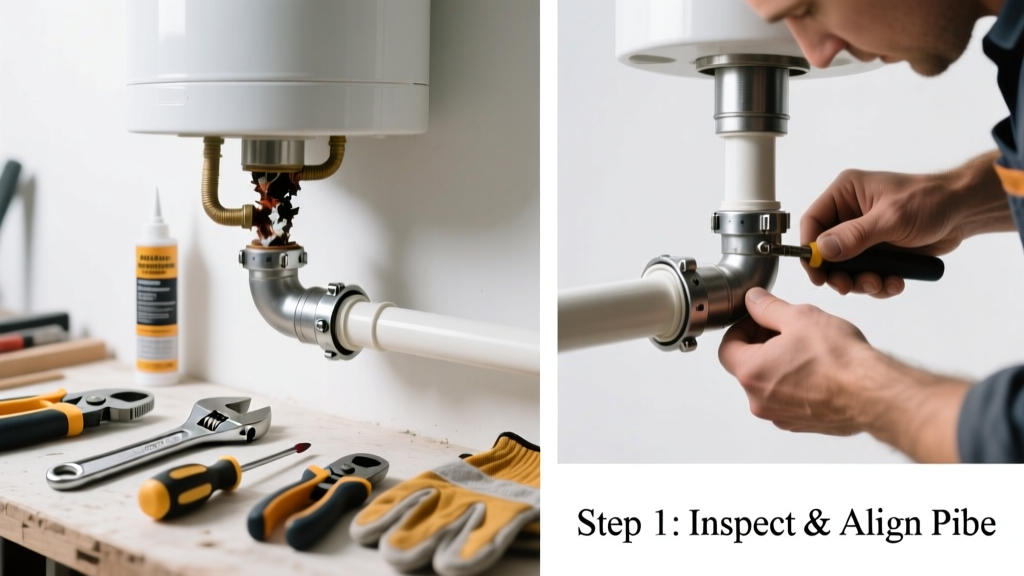
- Inspect the entire vent path: Start at the draft hood, follow pipe through attic or wall chase, checking every joint, elbow, and roof penetration. Look for corrosion, dents, or missing screws—especially at the roof jack boot.
- Reconnect and secure: Slide pipe sections fully into collars. Tighten all clamps evenly—don’t overtighten. Use two clamps per joint if pipe is over 6 ft long or subject to vibration.
- Seal small gaps: Apply UL 1738-rated high-temp silicone only to exterior seams—not inside the flue. Let cure 24 hours before restarting.
- Test for CO and draft: Light the heater, wait 10 minutes, then hold a lit match near the draft hood. Flame should be drawn steadily upward—not fluttering or blowing out.
When to Call a Pro
Don’t risk your life trying these fixes yourself:
- The vent pipe shows visible corrosion holes or thinning walls (especially in older aluminum or single-wall pipe)
- You’re dealing with a direct-vent system requiring sealed combustion air intake and exhaust lines
- The disconnect occurred at the roof penetration, and roofing material is damaged or flashing is compromised
- Your CO detector alarms during or after reconnection—even once
According to the U.S. Consumer Product Safety Commission, improperly vented gas water heaters contribute to over 400 unintentional CO poisoning deaths annually (CPSC 2022 report).
Prevention Tips
Vent pipe disconnections often stem from thermal expansion, vibration, or poor initial installation. Prevent recurrence with these habits:
- Inspect vent connections every 6 months—especially after winter freeze-thaw cycles
- Use insulated hangers every 4 ft for horizontal runs to reduce stress on joints
- Replace galvanized clamps with stainless steel every 5 years (galvanized corrodes faster in humid attics)
- Install a carbon monoxide detector within 10 feet of the heater—and test monthly
Can I use duct tape to temporarily fix the vent pipe?
No—duct tape melts at low temperatures and releases toxic fumes when exposed to flue gases. It also fails under thermal cycling and offers zero structural integrity. Even short-term use violates the International Fuel Gas Code (IFGC 2021 Section 503.4). Use only UL-listed high-temp sealant or approved mechanical clamps.
Why does my vent pipe keep coming loose near the roof jack?
This usually points to improper flashing installation or missing roof-to-pipe transition hardware. Wind uplift and thermal movement cause repeated loosening. The fix requires removing the boot, installing a new UL-listed roof jack with integrated compression gasket, and sealing with roofing-grade butyl tape—not caulk.
Is it safe to run the heater with the vent pipe disconnected for just 10 minutes?
No. Even brief operation without proper venting can produce lethal CO concentrations in under 5 minutes. The American Lung Association warns that CO is odorless and colorless—and symptoms like headache or nausea may not appear until dangerous levels are already present.
Do tankless water heaters have the same venting risks?
Yes—and higher stakes. Tankless units operate at much higher flue gas temperatures and require precise vent sizing and slope. A disconnected section can trigger immediate lockout mode or, worse, allow condensate to back up into the heat exchanger. Always refer to the manufacturer’s venting manual (e.g., Navien NPE-A Series Manual, 2023) for specific clearance and support requirements.
How do I know if my vent pipe is the right size?
Most standard 40–50-gallon atmospheric vented heaters require 3" or 4" diameter Class B double-wall vent pipe. Undersized pipe causes poor draft and sooting; oversized pipe cools flue gases too quickly, leading to condensation and corrosion. Check your heater’s data plate—it lists required vent diameter and maximum length. For help interpreting specs, see our vent sizing chart guide.
What’s the difference between a draft hood and a draft diverter?
A draft hood (on older atmospheric heaters) is a sheet-metal funnel above the burner that stabilizes draft and prevents backdrafting. A draft diverter (common on mid-efficiency units) is a T-shaped fitting that mixes room air with flue gases to lower exhaust temps. Both rely on intact, rigid venting—any disconnect compromises their function and creates spillage risk.
A properly secured vent pipe doesn’t just restore hot water—it protects your family’s health and your home’s structural integrity. Reconnect it right, test thoroughly, and add that semiannual inspection to your maintenance calendar. If you’ve replaced clamps and sealed joints but still notice soot buildup or inconsistent heating, it’s time to check your flue baffle or consider a venting upgrade to a power-vented system.