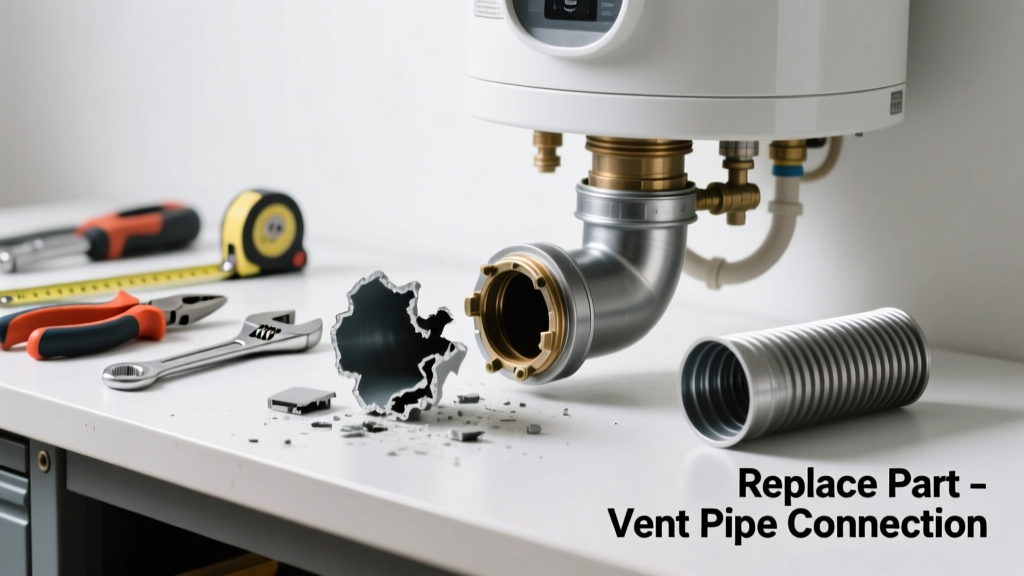
A disconnected water heater vent pipe isn’t just an annoyance—it’s a serious safety hazard. Carbon monoxide can backdraft into your home if exhaust gases aren’t properly expelled, and many local codes require immediate repair. This guide walks you through diagnosing the failure point, sourcing the correct replacement part, and reinstalling it safely.
Quick Diagnosis
Before buying parts, confirm the exact failure mode. Most disconnections stem from one of these causes:
- Cracked or corroded aluminum or galvanized steel vent pipe sections (especially near elbows or roof penetrations)
- Loose or missing sheet metal screws securing pipe joints
- Deteriorated high-temperature silicone sealant or deteriorated gasket at the draft hood or flue collar
- Thermal expansion stress causing separation at rigid connections
- Improperly sized or mismatched pipe diameters (e.g., 3-inch heater outlet connected to 4-inch pipe without adapter)
Tools & Materials Needed
| Item | Purpose | Estimated Cost |
|---|---|---|
| Replacement vent pipe section (aluminum or Type B double-wall) | Matches existing diameter and wall thickness; must be rated for gas water heater exhaust | $18–$45 |
| High-temp RTV silicone (UL 1738 listed) | Seals joints where tape alone won’t hold under thermal cycling | $8–$12 |
| Sheet metal screws (1/2" stainless steel) | Secures pipe sections without rusting or stripping | $4–$7 |
| Combination square & torpedo level | Ensures vertical alignment and proper slope (1/4" per foot minimum) | $12–$22 |
| Stainless steel vent pipe tape (not duct tape!) | Reinforces seams and prevents air leaks in Class A or Type B systems | $6–$10 |
Step-by-Step Fix
- Shut off gas and power: Turn the gas valve to "OFF" and switch off the circuit breaker if your unit has electric ignition or controls. Confirm no flame is visible at the burner.
- Inspect and measure: Trace the vent path from draft hood to termination. Note pipe diameter (common: 3", 4", or 5"), wall type (single-wall vs. double-wall Type B), and exact location of gap or break. Measure length needed—add 1/8" for expansion clearance.
- Remove damaged section: Loosen screws at both ends using a Phillips #2 driver. Gently twist and pull apart—don’t force if corroded. Clean old sealant residue with a wire brush and acetone wipe.
- Install replacement: Apply a 1/8" bead of UL 1738-rated RTV silicone to both mating surfaces. Slide new section into place, align with adjacent pipes, and secure with three evenly spaced stainless screws per joint. Wrap seam with stainless vent tape, overlapping 50%.
- Test for leaks: Turn gas back on and ignite per manufacturer instructions. Hold incense or smoke pencil near all joints—if smoke gets drawn inward, you have a dangerous negative pressure leak. Test CO levels with a detector before closing up.
When to Call a Pro
Don’t risk DIY if any of these apply:
- Your water heater uses a direct-vent or power-vented system (requires manometer testing and combustion analysis)
- The disconnect occurs inside a wall cavity or attic space requiring drywall removal or insulation disturbance
- You observe soot buildup, rust stains on ceiling joists, or a sulfur odor—signs of chronic incomplete combustion
- Local code requires licensed HVAC or plumbing inspection for vent modifications (required in 37 states per 2023 ICC amendments)
Prevention Tips
Vent pipe failures often repeat without proactive maintenance. Here’s what works:
- Inspect venting annually—look for dents, corrosion, or loose screws, especially after storms
- Ensure roof jacks and wall thimbles are sealed with non-hardening, high-temp caulk—not standard silicone
- Verify proper draft hood clearance: maintain at least 6" vertical rise before first elbow per 2024 IRC Section G2427.7
- Replace single-wall vent pipe older than 10 years—even if intact—since aluminum fatigue accelerates after that point
Can I use regular duct tape on the vent pipe?
No. Standard duct tape fails above 140°F and releases toxic fumes when exposed to exhaust heat. Only UL-listed stainless steel vent tape or high-temp fiberglass tape rated for 1200°F+ is acceptable. The U.S. Consumer Product Safety Commission reports over 200 incidents annually tied to improper vent sealing materials.
How do I know if my vent pipe is Type B or single-wall?
Type B double-wall pipe has an inner and outer metal layer with an air gap—feels lighter and warmer to the touch during operation. Single-wall is thin, rigid, and conducts heat aggressively. Check for embossed labeling like "UL 1738" or "Type B" stamped every 18 inches. If unmarked and installed post-1980, assume Type B is required for indoor runs.
Is it safe to run the water heater while the vent is disconnected?
No—never operate a gas water heater with a compromised vent. Even brief use risks lethal carbon monoxide accumulation. According to the CDC, unintentional CO poisoning causes over 400 U.S. deaths annually, and improperly vented water heaters are among the top five sources.
What’s the difference between a draft hood and a flue collar?
The flue collar is the round metal outlet at the top of the heater where vent pipe attaches. The draft hood is a separate, bell-shaped device (often chrome) mounted directly above the collar—it stabilizes draft and prevents backdrafting during wind gusts. Both must be intact and sealed; a missing draft hood voids most manufacturer warranties.
Can I replace just the elbow instead of the whole pipe section?
Yes—if only the elbow is cracked or warped and adjacent straight sections are sound. Match radius (short-radius vs. long-radius), diameter, and material exactly. Use two screws per side plus RTV sealant. But avoid mixing brands—some elbows have proprietary locking tabs that won’t mate with generic pipe.
Do I need a permit to replace vent pipe?
In most jurisdictions, yes—especially if replacing more than 2 feet of pipe or altering the termination point. Permits ensure compliance with NFPA 54 and local amendments. Unpermitted work may void insurance coverage after a CO incident, as noted in the Insurance Institute for Business & Home Safety’s 2023 Residential Venting Compliance Report.
"Every inch of vent pipe must maintain positive draft under worst-case conditions—wind, cold air infiltration, and simultaneous appliance operation. That’s why visual inspection alone isn’t enough; pressure testing is non-negotiable for repairs." — John R. D’Agostino, Certified Master HVAC Technician, NATE, 2022
Replacing a disconnected vent pipe section takes under two hours for most homeowners with basic tools—but never skip verification. After reassembly, watch the burner flame for 10 minutes: it should stay steady and blue, not lift or yellow at the tips. If it does, stop and call a technician. Your family’s safety depends on consistent, code-compliant venting—not just getting the pipe back together.