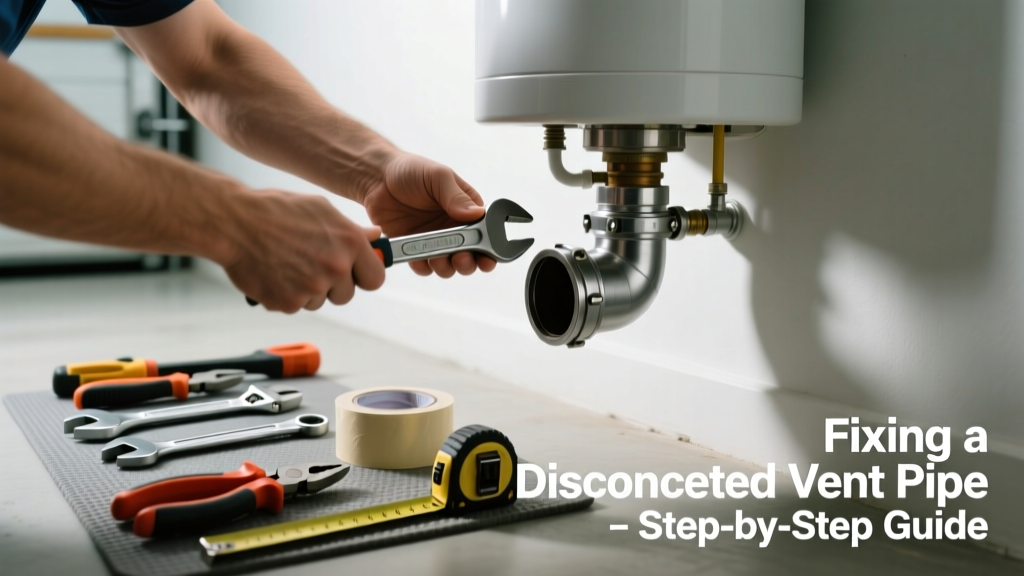
If you smell burnt metal or sulfur near your gas water heater—or notice soot around the draft hood or ceiling—you may have a disconnected vent pipe. This isn’t just an efficiency issue: a broken vent path can allow deadly carbon monoxide to backdraft into your home. Immediate attention is non-negotiable.
Quick Diagnosis
Before grabbing tools, confirm the issue isn’t something else. A disconnected vent pipe often presents with these telltale signs:
- Visible gap or separation between the draft hood outlet and the first vent section
- Soot staining on the top of the water heater, vent pipe, or nearby drywall
- Yellow or flickering burner flame (instead of steady blue)
- Carbon monoxide detector alarm—evacuate immediately if this occurs
- Cold spot or condensation pooling inside the vent pipe during operation
Tools & Materials Needed
| Item | Purpose | Estimated Cost |
|---|---|---|
| Adjustable wrench | Tightens clamps and secures connectors without stripping threads | $12–$25 |
| Aluminum foil tape (UL 181 rated) | Seals seams on Class B double-wall vent pipe; withstands >300°F | $8–$14 |
| Replacement vent pipe sections (6" or 8" diameter) | Replaces corroded, dented, or warped sections that won’t seal properly | $22–$48 per 2-ft section |
| Stainless steel hose clamps (2–3) | Secures loose connections where original clamps failed or rusted out | $3–$7 each |
| Flashlight & mirror | Inspects hard-to-see joints above the draft hood or in tight attic spaces | $5–$18 |
Step-by-Step Fix
Work only after shutting off gas and power (if electric ignition) and letting the unit cool for at least 30 minutes. Never attempt reconnection while the heater is hot or running.
- Shut down and inspect: Turn gas valve to OFF and unplug/switch off power. Remove access panels. Use flashlight and mirror to trace entire vent path from draft hood to roof or sidewall termination.
- Identify failure point: Look for corrosion, crushed sections, missing clamps, or gaps >1/8". Note whether it’s single-wall (rare, unsafe in modern installs) or Class B double-wall pipe—the latter requires UL 181 tape and proper clearance.
- Clean and prep: Wipe mating surfaces with dry rag. Lightly sand corrosion spots with 120-grit paper. Discard any pipe section with pitting deeper than 0.015" (about thickness of a credit card).
- Reconnect and seal: Slide pipes fully together—Class B pipe must engage at least 1.5" deep. Tighten clamps evenly with adjustable wrench. Seal all joints with two overlapping layers of UL 181 aluminum tape—no duct tape or HVAC mastic.
- Test for draft: Relight pilot or restart unit. Hold a lit incense stick 2" from draft hood inlet—if smoke draws steadily upward, venting is working. If smoke wafts sideways or downward, stop use and call a pro.
When to Call a Pro
Some disconnects signal deeper system failures—not just loose hardware. Stop and contact a licensed HVAC technician or plumber if you encounter any of these:
- The vent pipe shows severe rust-through, warping, or heat discoloration beyond localized corrosion
- You’re dealing with a direct-vent or power-vented unit (requires manometer testing and combustion analysis)
- The disconnection occurred after recent roof work, suggesting improper reattachment or missing roof jack
- Your home has a high-efficiency (condensing) water heater—its PVC venting requires precise slope, trap placement, and air intake coordination
- You detect CO levels above 35 ppm using a calibrated detector (the U.S. EPA recommends immediate evacuation above 70 ppm)
"A single improperly sealed joint in a gas water heater vent system can elevate indoor CO concentrations to life-threatening levels within 90 minutes of operation." — National Fuel Gas Code (NFPA 54), 2023 Edition, Section 12.9.2
Prevention Tips
Annual inspection prevents repeat failures. Add these habits to your maintenance routine:
- Check vent connections every 6 months—especially after seasonal temperature swings that cause expansion/contraction
- Install a battery-powered CO detector within 10 feet of the water heater and test monthly
- Keep attic vents clear; moisture buildup accelerates galvanic corrosion on steel pipe
- Replace single-wall vent pipe with UL-listed Class B double-wall pipe if still present—it’s required by code in most jurisdictions since 2003
- Document repairs: snap photos of joints before/after and log dates in your water heater maintenance schedule
Can I use duct tape to seal the vent pipe?
No—duct tape melts, degrades, and fails under sustained heat. It’s not rated for flue gas temperatures and violates NFPA 54 and IRC M1802. Only UL 181–listed aluminum foil tape or high-temp silicone caulk (for non-moving joints) is acceptable. Using duct tape risks fire and CO poisoning.
How far can the vent pipe run horizontally?
Per the International Residential Code (IRC M1802.4), Class B gas vent horizontal runs must not exceed 75% of the total vertical height of the system—and never more than 30 feet total. Slope must be ≥1/4" per foot upward toward the chimney or exterior termination. Longer runs require professional sizing and draft testing.
Why does my vent pipe keep coming loose near the draft hood?
This usually points to thermal cycling stress or undersized clamps. Draft hoods expand significantly when heated; factory clamps often loosen after 3–5 years. Replace with stainless steel clamps rated for 1200°F and tighten to 25–30 in-lbs using a torque screwdriver. Also check for warped or cracked draft hood flanges—common in units over 12 years old. See our guide on draft hood replacement for details.
Is it safe to run the water heater with a temporarily taped vent?
No. Even short-term operation with a compromised vent risks carbon monoxide exposure. The CDC reports that unintentional CO poisoning causes over 400 U.S. deaths annually—and water heaters are among the top three sources (CDC, 2022). Shut it down until properly repaired or replaced.
Do I need a permit to replace vent pipe sections?
In most municipalities, yes—especially if altering vent size, length, or termination location. Permits ensure compliance with local amendments to the IRC and NFPA 54. Unpermitted work may void homeowner’s insurance and fail resale inspections. Contact your local building department before starting; many offer free pre-submission consultations.
What’s the difference between a draft hood and a draft diverter?
A draft hood (standard on atmospheric vent water heaters) is a sheet-metal chamber above the burner that stabilizes draft and prevents backdrafting during wind gusts. A draft diverter is found on older, non-vented space heaters and some obsolete water heaters—it’s less reliable and not code-compliant for new installations. Modern units require draft hoods meeting ANSI Z21.10.1 standards.
A disconnected vent pipe is never a ‘minor’ repair—it’s a potential safety emergency disguised as a simple hardware issue. When done right, reconnection takes under an hour and costs less than $50 in parts. But cutting corners risks health, code violations, and costly remediation later. Stay vigilant, stay safe, and don’t hesitate to reach out to a licensed pro when in doubt—your family’s air quality depends on it. For related help, see our guides on what your flame color means and how to clean soot safely.