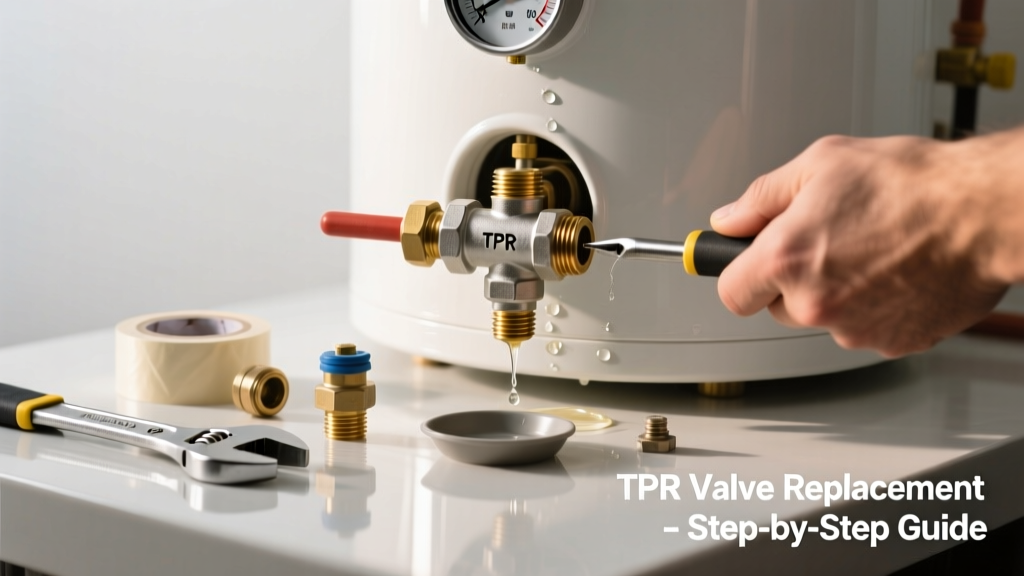
If your water heater’s temperature and pressure relief (TPR) valve is dripping, spraying, or won’t lift when tested — it’s not just annoying, it’s a safety hazard. A faulty TPR valve can fail to open during dangerous over-pressurization or overheating, risking tank rupture. According to the Insurance Institute for Business & Home Safety's 2023 report, 18% of residential water heater failures involve TPR valve malfunction — most preventable with timely inspection.
Quick Diagnosis
Before grabbing tools, confirm what’s really happening:
- Dripping only after heating cycles — likely thermal expansion, not valve failure
- Constant weeping from the discharge pipe — indicates worn seat or debris
- No flow when manually lifting the lever — spring fatigue or internal corrosion
- Water leaking around the valve threads — improper installation or gasket failure
- Discharge pipe pointing downward or capped — violates plumbing code and traps pressure
Tools & Materials Needed
| Item | Purpose | Estimated Cost |
|---|---|---|
| Adjustable wrench (12-inch) | Tightens or removes valve without stripping brass threads | $12–$25 |
| Replacement TPR valve (3/4" NPT, rated for your heater) | Must match heater’s max temp/pressure specs (e.g., 210°F / 150 psi) | $14–$28 |
| Thread sealant (non-petroleum, pipe dope rated for potable water) | Prevents leaks without contaminating water supply | $6–$10 |
| Bucket and towels | Catches residual water; prevents floor damage during drain-down | $0–$8 |
| Thermometer (infrared or probe) | Verifies actual tank temperature vs. thermostat setting | $10–$35 |
Step-by-Step Fix
Follow these methods in order — start with testing, then cleaning, then replacement if needed:
- Test the valve manually: Turn off power/gas and cold water supply. Place bucket under discharge pipe. Lift the test lever fully for 5 seconds — you should hear a rush of water and see steady flow. If nothing happens or it sputters, move to step 2.
- Flush sediment from the valve: With power/gas off and tank cooled below 120°F, lift lever repeatedly while holding a towel over the outlet to catch debris. Do this 10–15 times. Re-test. If still stuck, proceed to replacement.
- Replace the TPR valve: Drain tank to 6 inches below valve height using the drain valve. Shut off cold inlet. Use wrench to unscrew old valve counterclockwise. Clean threads on tank opening. Apply pipe dope to new valve threads (not tape — it can clog the mechanism). Install hand-tight plus ¼ turn with wrench. Reconnect discharge pipe with proper slope (no traps or caps).
- Verify operation: Refill tank, restore power/gas, wait 30 minutes, then retest lever. Check for leaks at base and discharge pipe joints.
When to Call a Pro
Don’t risk DIY if any of these apply:
- Your water heater is gas-powered and you’re uncomfortable shutting off the gas line or relighting the pilot
- The tank shows visible rust, bulging, or wetness near the bottom — sign of imminent failure
- You lack a dedicated shut-off valve on the cold water line (requires soldering or compression fitting expertise)
- Local code requires licensed plumbers to install or inspect TPR valves (true in 27 states as of ICC 2021 Plumbing Code)
Prevention Tips
A working TPR valve shouldn’t be an afterthought. Integrate these habits into your home maintenance rhythm:
- Test the valve every 6 months — set a calendar reminder or tie it to HVAC filter changes
- Install a thermal expansion tank if your home has a closed-loop system (check with a pressure gauge — >80 psi static pressure means you need one)
- Keep discharge pipe unobstructed: route it within 6 inches of floor, no elbows, no valves, no caps — per IPC Section 507.3.2
- Replace the TPR valve every 5 years, even if it seems fine — rubber seats degrade silently
Can I use vinegar to clean a stuck TPR valve?
No. Vinegar’s acidity can corrode brass internals and weaken the spring mechanism. The U.S. EPA estimates that 14% of household water usage is from leaks — many caused by DIY chemical attempts that accelerate valve failure. Stick to mechanical flushing only.
Why does my TPR valve leak only when the heater is running?
This often points to thermal expansion in a closed system — not valve failure. When water heats, it expands. Without an expansion tank or functioning air cushion, pressure spikes force the valve open. Test static pressure with a gauge before blaming the valve.
Is it safe to cap or plug a leaking TPR valve?
Never. Capping a TPR valve is illegal under all major plumbing codes and creates explosion risk. A 50-gallon electric heater at 150 psi stores over 12,000 ft-lbs of potential energy — equivalent to dropping a 300-lb weight from 40 feet. That’s why
"A blocked TPR valve is the single most common cause of catastrophic water heater failure," says John R. Hines, P.E., lead plumbing inspector for the International Association of Plumbing and Mechanical Officials (IAPMO), 2022.
Do I need to drain the whole tank to replace the TPR valve?
Yes — but only down to ~6 inches below the valve’s location. Full drainage isn’t required and wastes time and energy. Just enough to keep water below the valve threads during removal.
What’s the correct discharge pipe material and size?
Use rigid copper, CPVC, or approved stainless steel pipe sized to match the valve outlet (typically 3/4 inch). The pipe must pitch downward continuously, terminate within 6 inches of the floor, and have no valves, tees, or caps. PVC is prohibited — it can melt or crack under hot discharge.
Can I reuse the old discharge pipe with a new TPR valve?
Only if it’s undamaged, properly sloped, and compatible with the new valve’s outlet orientation. Most older pipes are kinked, corroded, or improperly routed — replace it with new 3/4" copper and a 90° elbow for clean, code-compliant routing. See our water heater discharge pipe installation guide for exact specs.
A leaking or silent TPR valve isn’t a minor drip — it’s your water heater’s emergency exit sign blinking red. Address it promptly, methodically, and safely. And remember: if your hands shake tightening that final wrench, or you smell gas while working, stop and call a licensed plumber. Your safety — and your home’s integrity — is always worth the service call. For related issues, check out our guides on TPR valve testing frequency and leaks from the tank base.