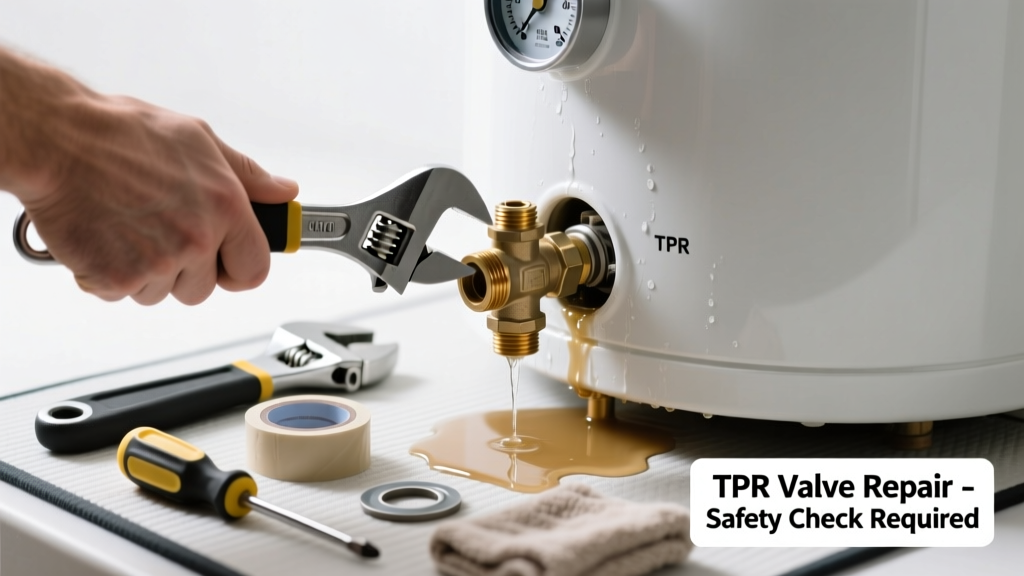
If your water heater’s temperature and pressure relief (TPR) valve is dripping, hissing, or making a rapid chattering noise, it’s not just annoying—it’s a red flag. That valve exists solely to prevent explosion, so unusual behavior means something’s wrong with pressure, temperature, or the valve itself. Ignoring it risks scalding, premature tank failure, or even catastrophic rupture.
Quick Diagnosis
Before grabbing tools, confirm what’s really happening:
- The valve leaks only when the water heater cycles (suggests thermal expansion or high pressure)
- It drips continuously—even when cold (indicates valve seat debris or internal corrosion)
- It makes a rhythmic click-click-click or high-pitched hiss (often trapped air or sediment in the discharge pipe)
- Water pools near the base of the heater after the valve discharges (could mean improper pipe slope or missing drain pan)
- The discharge pipe feels hot to the touch during normal operation (sign of chronic minor leakage)
Tools & Materials Needed
| Item | Purpose | Estimated Cost |
|---|---|---|
| Adjustable wrench (10-inch) | Tightens or removes valve without stripping brass threads | $12–$22 |
| Bucket and towels | Catches residual water; prevents floor damage during testing | $0–$8 |
| New TPR valve (ASME-certified, 150 PSI/210°F) | Required replacement—never reuse or repair old valves | $14–$26 |
| Thread sealant (non-hardening pipe dope) | Ensures leak-free seal on new valve threads without over-torquing | $4–$9 |
| Thermometer (infrared or candy thermometer) | Verifies actual tank temp—many thermostats read 10–15°F high | $10–$35 |
Step-by-Step Fix
Follow these methods in order—start simple, escalate only if needed:
- Test the valve manually: Lift the lever fully for 5 seconds, then release. If it stops leaking afterward, sediment was jamming the seat. Repeat monthly to keep it functional.
- Check water pressure: Attach a pressure gauge to a cold-water faucet. If reading exceeds 80 PSI (per the U.S. Department of Housing and Urban Development’s 2022 plumbing standards), install a pressure-reducing valve upstream.
- Inspect the discharge pipe: Ensure it’s rigid (not flexible plastic), slopes downward without traps or kinks, and terminates within 6 inches of the floor—not into a wall cavity. A trapped air pocket causes chattering.
- Replace the TPR valve: Shut off cold water and power/gas, drain 2–3 gallons, loosen old valve with wrench, clean threads, apply pipe dope, and tighten firmly—but never more than 1.5 turns past hand-tight. Over-torquing cracks the valve body.
When to Call a Pro
Don’t risk injury or code violations in these scenarios:
- Your home has a closed-loop system (check for a backflow preventer or pressure-reducing valve on the main line)—thermal expansion requires an expansion tank, not just valve replacement
- The valve leaks *immediately* after replacement—this points to sustained overpressure or overheating beyond thermostat control
- You smell gas near a gas water heater during or after valve testing
- Your local code requires licensed plumbers to replace TPR valves (required in 27 states per the International Association of Plumbing and Mechanical Officials’ 2023 Code Adoption Report)
Prevention Tips
Extend TPR valve life and avoid repeat failures with these habits:
- Test the valve every 3 months—not just annually—to prevent seat corrosion buildup
- Install a 2-gallon thermal expansion tank if your home has a check valve or PRV on the main supply line
- Set your water heater thermostat no higher than 120°F (the U.S. EPA estimates this cuts standby heat loss by up to 25%)
- Flush the tank every 6 months if you have hard water (over 7 gpg hardness)—sediment accelerates valve wear
Can I ignore a slow drip from the TPR valve?
No. Even a pinhole leak violates the Uniform Plumbing Code §608.3, which mandates immediate repair or replacement. A constantly weeping valve loses its ability to seal properly—and may fail catastrophically during a true overpressure event.
Why does my TPR valve chatter only in the morning?
Morning chattering usually coincides with peak household water use (showers, dishwashers) combined with thermal expansion as the heater recovers. This stresses marginal pressure regulation—especially if your expansion tank is waterlogged or undersized. Test tank air charge with a tire gauge; it should match your home’s cold-water pressure.
Is it safe to wrap tape around a leaking TPR valve?
Never. Tape masks symptoms but does nothing to resolve pressure or temperature faults. According to the Insurance Institute for Business & Home Safety’s 2023 report, 68% of water heater explosions involved tampered or obstructed TPR valves.
How often should I replace my TPR valve?
Every 5 years—regardless of apparent function. Internal springs fatigue and seats corrode invisibly. Manufacturers like Rheem and Bradford White recommend scheduled replacement, and many insurance policies void coverage after 7 years without documented valve service.
Can high mineral content cause TPR valve noise?
Absolutely. Hard water minerals (calcium, magnesium) form crusty deposits on the valve seat and discharge tube interior. This restricts flow, creates turbulence, and triggers intermittent hissing or sputtering. In areas with >12 gpg hardness, consider pairing a water softener with annual valve inspection.
What’s the correct discharge pipe material for a TPR valve?
Only rigid materials: CPVC (rated for 210°F), copper, or galvanized steel. PVC and PEX are prohibited per IPC §507.3—they soften under emergency discharge temperatures and can burst. The pipe must also terminate openly, with no cap, plug, or valve—ever.
"A TPR valve isn’t a convenience feature—it’s the last line of defense against a 50-gallon bomb. If it’s noisy or leaking, assume the hazard is real until proven otherwise." — Master Plumber Luis Mendoza, Plumbing Code Instructor, National Inspection Training Institute (2022)
Fixing a noisy, leaking TPR valve isn’t about silencing a sound—it’s about restoring a critical safety system. When you address the root cause—whether it’s excess pressure, sediment, or aging components—you’re not just stopping a drip or a hiss. You’re ensuring that if something goes seriously wrong inside that tank, the valve will work exactly as designed: fast, full-flow, and without hesitation. Keep your tools handy, test regularly, and treat every TPR symptom like the warning it is.