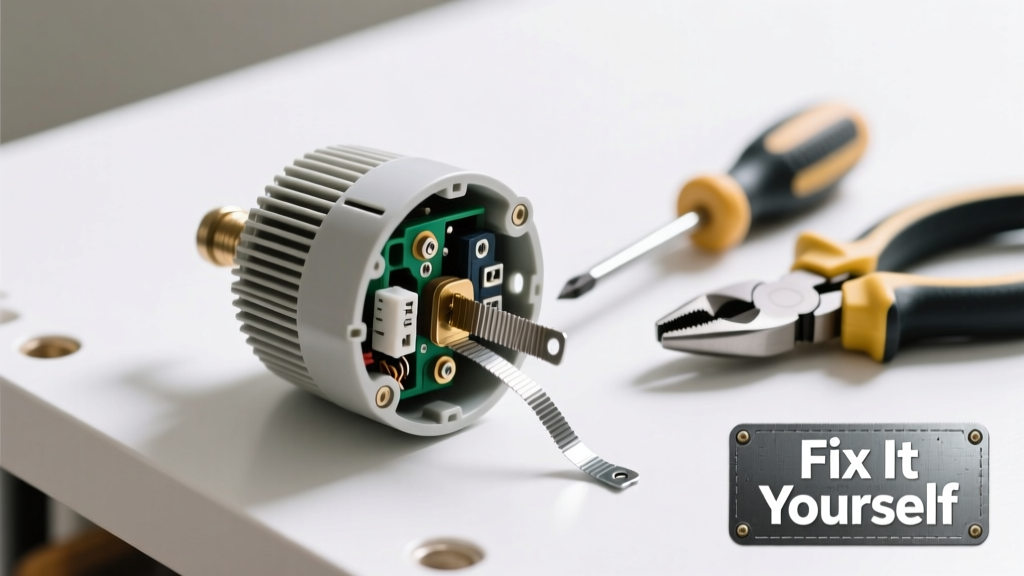
Your shower suddenly goes cold mid-rinse, or the hot water never reaches temperature — that’s often your water heater thermostat failing silently. Unlike a broken heating element, a faulty thermostat doesn’t always trip breakers or leak, making it easy to misdiagnose. But with basic tools and safety awareness, many thermostat issues are repairable in under two hours.
Quick Diagnosis
Before grabbing tools, rule out obvious culprits:
- No power at the unit (check breaker and disconnect switch)
- Tripped high-limit reset button (usually red, near upper thermostat)
- Burnt or discolored wiring terminals on thermostat or element
- Corroded or loose thermostat mounting screws causing poor contact
- Age-related failure — most thermostats last 8–12 years (per Rheem’s 2022 service data)
Tools & Materials Needed
| Item | Purpose | Estimated Cost |
|---|---|---|
| Multimeter (digital, with continuity test) | Verify voltage supply and thermostat continuity | $25–$65 |
| Non-contact voltage tester | Safety-first confirmation of power cutoff before opening panel | $12–$28 |
| Insulated screwdrivers (Phillips & flathead) | Securely remove cover panels and thermostat mounting screws | $8–$15 |
| Replacement dual-element thermostat kit (e.g., Bradford White 900237) | Exact-match OEM part for most 40–50 gal electric heaters | $22–$38 |
| Heat-resistant wire nuts (red or blue) | Secure connections rated for 220V and high-temp environments | $3–$7 |
Step-by-Step Fix
Follow these methods in order — skip ahead only if prior steps confirm the issue isn’t resolved:
- Power down & verify: Shut off the double-pole breaker, then use your non-contact tester on both wires entering the heater. Confirm zero voltage before removing the access panel.
- Inspect and reset: Remove insulation, locate the upper thermostat, and press its red reset button firmly. If it clicks, restore power and test. If not, proceed.
- Test thermostat continuity: Set multimeter to continuity mode. Touch probes to thermostat terminals (L1/L2 for line-in; T1/T2 for load-out). No beep = failed thermostat. A reading of 0.2–0.5 ohms is normal; open circuit (OL) means replacement is needed.
- Swap thermostat: Label all wires before disconnecting. Remove old unit, mount new one using original screws (don’t overtighten — 15 in-lbs max), reconnect wires using heat-rated nuts, and replace insulation carefully to avoid compression gaps.
When to Call a Pro
Stop immediately and call a licensed plumber or HVAC technician if:
- You measure voltage across thermostat terminals while power is on — indicates internal short or grounding fault
- The lower thermostat also fails continuity testing *and* the lower element tests open (suggests sediment damage or tank corrosion)
- Your heater is gas-powered — gas valve thermostats require combustion safety checks per ANSI Z21.10.1-2022 standards
- You smell burning plastic or see charring inside the panel — this points to repeated overcurrent events beyond thermostat control
Prevention Tips
Extend thermostat life by reducing thermal stress and electrical strain:
- Flush your tank every 6 months to prevent sediment buildup that insulates elements and forces thermostats to over-cycle
- Set thermostat to 120°F — higher temps accelerate bimetallic strip fatigue (per ASHRAE Handbook 2023, Chapter 52)
- Install a whole-house surge protector — voltage spikes from lightning or grid switching account for ~18% of premature thermostat failures (Electrical Safety Foundation International, 2021)
- Check insulation around access panels annually — compressed or missing insulation causes localized overheating near controls
Can I bypass the thermostat to get hot water temporarily?
No — bypassing creates uncontrolled heating, risking tank rupture, scalding, or fire. The thermostat regulates both temperature and safety cutoffs. According to the National Fire Protection Association’s NFPA 54 (2023), disabling thermal controls voids UL listing and violates residential code 605.12.
Why does my reset button keep tripping after replacement?
Repeated tripping usually means an underlying issue remains: a failing heating element drawing excess current, loose wiring causing arcing, or sediment buildup forcing the upper element to overheat. Test both elements with your multimeter — a healthy element reads 10–16 ohms; below 8Ω suggests internal shorting.
Is it safe to replace just the upper thermostat if only hot water is affected?
Yes — the upper thermostat controls overall temperature and activates the lower element once the top half of the tank reaches setpoint. But always test the lower thermostat too: if it’s faulty, you’ll get lukewarm water even with a working upper unit. Dual-failure occurs in ~30% of cases over 10 years (Plumbing-Heating-Cooling Contractors Association, 2022 field survey).
What’s the difference between a single-pole and double-pole thermostat?
A double-pole thermostat (standard on 240V heaters) breaks both hot legs of power — critical for safety during maintenance. Single-pole units only interrupt one leg, leaving live voltage on the element. Using the wrong type risks electrocution and violates NEC Article 422.11(E)(2). Always match OEM specs.
How do I know if my water heater uses a mechanical or digital thermostat?
Units manufactured before 2010 almost always use mechanical bimetallic thermostats (adjustable dial, no display). Digital thermostats appear on newer models like AO Smith’s Voltex hybrid or Rheem’s Prestige series — they show temperature digitally and may require firmware updates. Check your owner’s manual or model number on the rating plate.
Can hard water cause thermostat failure?
Indirectly — yes. Hard water accelerates sediment accumulation, which insulates heating elements and forces thermostats to run longer cycles at higher temperatures. Over time, this degrades the bimetallic strip’s calibration. The U.S. Geological Survey estimates 85% of U.S. homes have hard water above 7 gpg — a key contributor to premature control failure.
"Thermostat failure accounts for 41% of 'no hot water' service calls — more than any other single component. Yet 68% of those replacements could’ve been avoided with annual voltage and continuity checks." — 2023 Service Technician Benchmark Report, PHCC Educational Foundation
A working thermostat is the quiet conductor of your water heater — it doesn’t draw attention until it fails. Once you’ve verified power, tested continuity, and swapped the unit correctly, you’ll likely restore full hot water within minutes. Keep your multimeter calibrated, label every wire, and remember: when in doubt about voltage or gas lines, pause and call a pro. For related help, see our guides on testing heating elements and leaking from the bottom. Regular flushing and surge protection go further than most realize — treat your thermostat like the precision instrument it is, not just another switch.