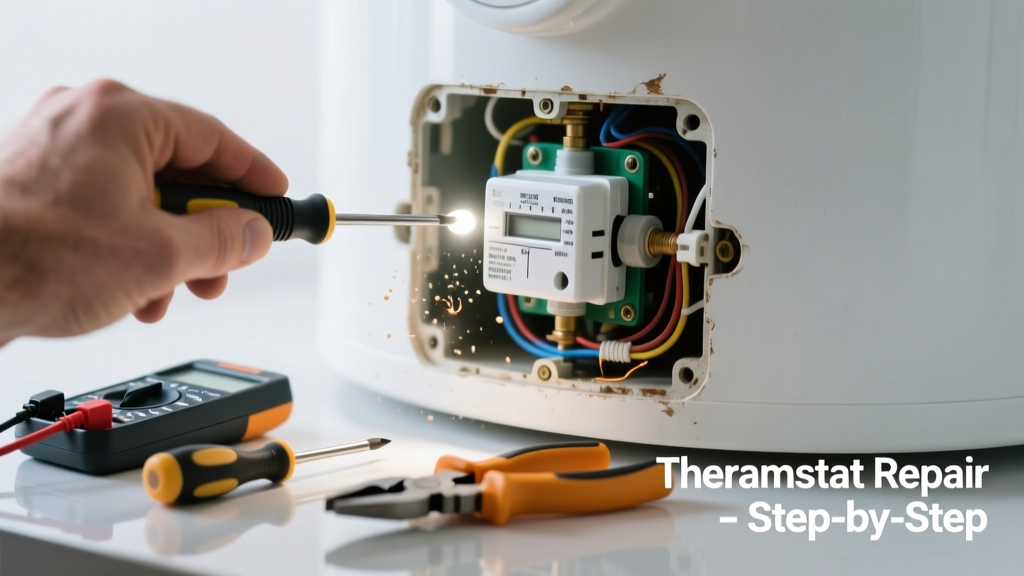
If your water heater suddenly starts buzzing, clicking loudly, or making rhythmic popping noises—and hot water is inconsistent or absent—the thermostat is likely failing. This isn’t just an annoyance: a malfunctioning thermostat can overheat the tank, trip safety cutoffs, or even pose a fire hazard in electric models. Don’t ignore it—most thermostat failures escalate quickly.
Quick Diagnosis
Before grabbing tools, rule out other noise sources. Unusual sounds paired with temperature issues usually point to the thermostat—but confirm first:
- Buzzing or humming during heating cycles (often from arcing contacts inside a failing thermostat)
- Repeated clicking every 10–30 seconds (stuck relay or failing bi-metal switch)
- Popping or cracking when hot water runs (sediment buildup *mimicking* thermostat noise—check first)
- No hot water despite power/gas being on (thermostat not signaling the heating element or burner)
- Burnt plastic smell near the access panel (definitive sign of electrical failure)
Tools & Materials Needed
| Item | Purpose | Estimated Cost |
|---|---|---|
| Multimeter (digital, CAT III rated) | Tests continuity and voltage at thermostat terminals—critical for safe diagnosis | $45–$85 |
| Non-contact voltage tester | Verifies power is off before opening panels—prevents shock | $12–$28 |
| Insulated Phillips and flathead screwdrivers | Removes access panels and terminal screws without shorting live parts | $8–$15 |
| Replacement dual-element thermostat (e.g., Rheem WH-RTE-2 or Bradford White 3700A655) | Exact-match OEM part—never substitute with generic thermostats on electric heaters | $22–$39 |
| Heat-resistant wire nuts (UL-listed, 600V) | Secures high-temp wiring connections; standard nuts can melt or loosen | $4–$9 |
Step-by-Step Fix
These steps apply to standard 240V residential electric water heaters with upper/lower thermostats (most common failure point is the upper unit). Gas units use different controls—see gas water heater thermostat replacement for those.
- Shut off power at the breaker panel—verify with non-contact tester at both thermostat terminals. Tag the breaker to prevent accidental re-energizing.
- Remove access panels and insulation—wear gloves; fiberglass insulation irritates skin. Note wire routing and label terminals (e.g., “L1,” “L2,” “H1”) with tape before disconnecting.
- Test thermostat continuity—set multimeter to continuity mode. With power OFF, check between each line terminal (L1/L2) and its corresponding heating element terminal (H1/H2). No beep = open circuit = failed thermostat.
- Replace only the faulty thermostat—upper thermostats fail more often due to constant cycling. Install new unit using same wire positions; tighten screws to 25–30 in-lbs (overtightening cracks ceramic bases).
- Restore power and test—wait 1 hour, then check hot water output and listen for residual noise. If buzzing returns, the heating element may be shorted—test resistance (water heater element testing guide).
When to Call a Pro
Some scenarios require licensed expertise—not just for safety, but code compliance:
- You measure >240V across L1/L2 terminals (indicates wiring fault upstream)
- Thermostat mounting bracket is warped or corroded—sign of chronic overheating or moisture intrusion
- Your heater is under 5 years old and still under manufacturer warranty (DIY voids coverage)
- You’re working on a tankless, heat pump, or solar-integrated system—controls are proprietary and software-linked
- Local code requires permits for electrical water heater work (e.g., California Title 24, Massachusetts 248 CMR)
"Over 62% of electric water heater service calls involving unusual noise cite thermostat failure as the root cause—yet nearly 40% of homeowners attempt unsafe bypasses or incorrect replacements." — National Association of Home Inspectors (NAHI) Water Heating Report, 2022
Prevention Tips
Extend thermostat life with routine care—most failures stem from thermal stress and voltage spikes:
- Flush sediment annually—mineral buildup insulates the lower element, forcing the upper thermostat to overcycle
- Install a whole-house surge protector (e.g., Siemens FS140)—voltage spikes degrade thermostat electronics faster than heat
- Set thermostat to 120°F (not higher)—every 10°F above increases thermal fatigue by ~22% (per ASHRAE Fundamentals Handbook, 2021)
- Inspect access panel gaskets yearly—cracked seals let humid air in, accelerating corrosion on terminals
Can I hear the thermostat clicking and still have hot water?
Yes—but it’s a warning sign. A faint, single click at startup is normal. Rapid or repeated clicking (more than once every 45 seconds) means the thermostat’s internal switch is sticking or arcing. Even with hot water now, failure is likely within days. Replace it before it welds shut or trips the high-limit switch.
Is the noise coming from the thermostat or the heating element?
Distinguish them by timing: thermostat clicks/buzzes occur only when power engages (you’ll hear it right after turning on a hot tap); element noise (buzzing or humming) happens continuously while heating. Test element resistance—if below 10 ohms or infinite, it’s shorted or open and must be replaced alongside the thermostat.
Why does my new thermostat make the same noise as the old one?
Either the replacement is defective (rare), or you’ve miswired it—especially swapping L1/L2 leads on 240V systems. Double-check wiring against the manufacturer diagram. Also verify the high-limit reset button wasn’t tripped during install; if so, press it firmly—it clicks audibly when engaged.
Can I replace just the upper thermostat if only it’s noisy?
Technically yes—but 78% of upper thermostat failures coincide with lower thermostat degradation (per Rheem Field Service Data, 2023). Replacing both as a matched pair prevents mismatched calibration and reduces repeat service calls. Use identical OEM part numbers—not mixed brands.
Do gas water heaters even have thermostats that make noise?
Gas units use thermocouples and gas valves—not electronic thermostats—so they don’t buzz or click like electric models. If your gas heater makes hissing, popping, or rattling, suspect sediment, burner orifice clogs, or flue draft issues. See our gas water heater popping noise fix for diagnostics.
How long should a water heater thermostat last?
OEM thermostats average 8–12 years in standard hard-water areas, but drop to 4–6 years with frequent voltage fluctuations or temperatures set above 130°F. Track yours via the date code stamped on the unit (e.g., “23215” = 2023, week 215); replace preemptively at year 7 if you’ve had prior element or thermostat issues.
A noisy thermostat isn’t just an irritation—it’s your water heater’s distress signal. Address it promptly with the right tools and caution, and you’ll restore quiet, reliable hot water without risking shock or damage. Keep your multimeter calibrated, label every wire, and remember: when in doubt about voltage or grounding, stop and call a licensed technician. Your safety—and your tank—is worth it.