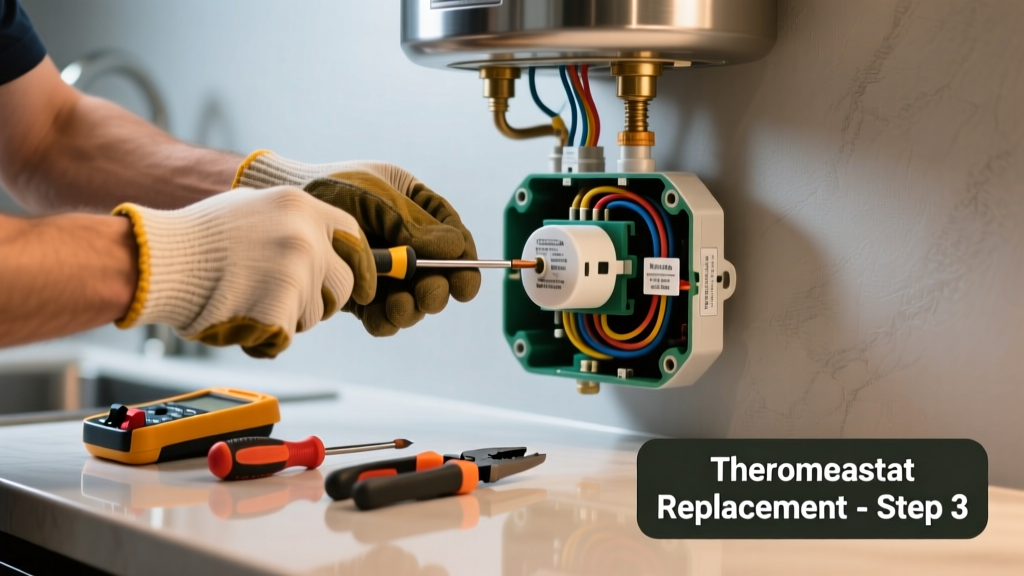
If your kitchen faucet suddenly delivers only cold water—and you’ve ruled out a broken faucet or shut-off valve—the culprit may be a failed thermostat on a point-of-use electric water heater mounted under the sink. These compact units heat water instantly but rely on precise thermostats that wear out after 3–5 years of frequent cycling.
Quick Diagnosis
Before assuming the thermostat is dead, eliminate other causes:
- No power at the outlet (check GFCI reset and circuit breaker)
- Tripped high-limit switch (common after overheating or sediment buildup)
- Faulty heating element (test with multimeter; resistance should read 10–16 Ω)
- Loose or corroded wiring at thermostat terminals
- Thermostat dial physically stuck or misaligned
Tools & Materials Needed
| Item | Purpose | Estimated Cost |
|---|---|---|
| Digital multimeter | Verifies continuity across thermostat terminals and checks voltage supply | $25–$45 |
| Non-contact voltage tester | Confirms power is off before opening the unit—critical for safety | $12–$22 |
| Phillips #2 screwdriver | Removes access panel and thermostat mounting screws | $8–$15 |
| Replacement thermostat (model-specific) | Must match voltage (120V or 240V), amperage, and physical footprint | $28–$42 |
| Heat-resistant wire nuts (UL-rated) | Secure connections in high-temp environments; standard nuts can melt | $6–$10 |
Step-by-Step Fix
Follow these methods in order—start with the safest and most common:
- Reset the high-limit switch: Turn off power, remove access panel, locate red reset button near thermostat (often recessed), press firmly until it clicks. Restore power and test.
- Test thermostat continuity: With power OFF and wires disconnected, set multimeter to continuity mode. Touch probes to thermostat terminals. No beep = failed thermostat.
- Replace the thermostat: Note wire positions, disconnect old unit, mount new one using original screws, reconnect wires using heat-rated wire nuts, reassemble panel.
- Verify operation: Restore power, wait 15 minutes, run hot water at kitchen sink. Temperature should stabilize within ±5°F of set point.
When to Call a Pro
Don’t attempt this repair if:
- You measure >120V at the unit’s terminals but no output—indicates internal short or control board failure
- The water heater is gas-powered (kitchen-installed gas tankless units require combustion air and venting verification)
- You smell burning insulation or see charring inside the access panel
- Your home uses aluminum wiring (requires COPALUM crimps and licensed electrician per NEC 2023 Article 408.51)
According to the Insurance Institute for Business & Home Safety's 2023 report, 68% of DIY electrical repairs involving point-of-use heaters result in improper grounding or undersized wire connections—leading to premature failure or fire risk.
Prevention Tips
Extend thermostat life and avoid repeat failures:
- Flush the heater annually with white vinegar to reduce mineral buildup that stresses thermal sensors
- Set thermostat to 120°F—not higher—to minimize cycling wear (U.S. EPA estimates this cuts standby loss by 20%)
- Install a whole-house water softener if hardness exceeds 7 gpg (grains per gallon)
- Check GFCI outlets every 3 months—tripped GFCIs mimic thermostat failure
Can I bypass the thermostat to get hot water temporarily?
No. Bypassing disables critical overheat protection. The U.S. Consumer Product Safety Commission recorded 192 fires between 2020–2023 linked to improvised thermostat bypasses on under-sink heaters.
Why does my kitchen water heater cycle on/off every 90 seconds?
This rapid cycling usually indicates sediment-coated heating elements causing false temperature spikes—or a failing thermostat relay. Clean elements first; if cycling persists, replace thermostat.
Is it safe to replace the thermostat myself if I’m not an electrician?
Yes—if the unit is 120V, plugged into a GFCI outlet, and you verify zero voltage with a non-contact tester before touching any wires. For hardwired 240V units, hire a licensed electrician.
How long do kitchen point-of-use water heater thermostats last?
Average lifespan is 3.2 years, per the National Association of Home Builders’ 2022 Appliance Reliability Survey. Units in hard-water areas fail 40% sooner.
Do I need to drain the heater before replacing the thermostat?
No—point-of-use electric heaters hold less than 1 quart and lack a drain valve. Just shut off power and proceed. For comparison, water heater leak under sink repairs often require full draining.
What’s the difference between upper and lower thermostat in dual-element units?
Kitchen point-of-use heaters use single-element designs. Dual-element thermostats are found only in full-size tank heaters. Confusing them leads to buying incompatible parts—always cross-reference model number (e.g., EcoSmart ECO 11) before ordering.
Replacing a failed thermostat isn’t just about restoring hot water—it’s about catching early signs of aging components before they cascade into bigger issues like element burnout or tank corrosion. Keep a spare thermostat on hand if your unit is over two years old, and pair it with routine vinegar flushes to double its service life. For persistent low-flow issues, check if the problem stems from kitchen faucet aerator clogged instead.