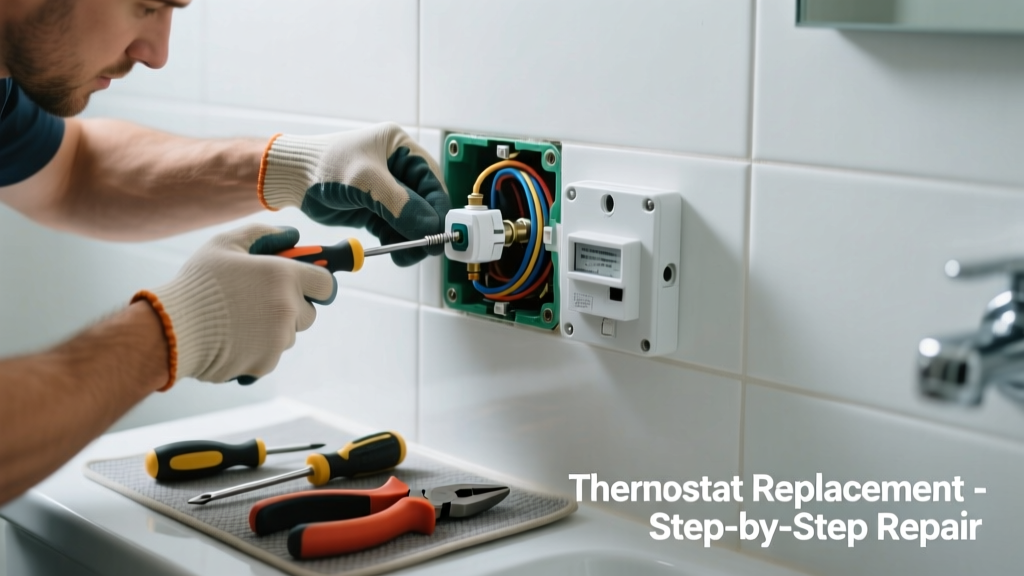
If your bathroom shower suddenly delivers only cold water—or scalding hot water—and the water heater’s display shows error codes or no response, the thermostat is likely the culprit. This failure is especially disruptive in bathrooms, where precise temperature control matters most for comfort and safety. Don’t assume you need a full unit replacement—many thermostat failures are quick, affordable fixes.
Quick Diagnosis
Before grabbing tools, rule out simple causes:
- No power at the breaker panel (check for tripped double-pole 30-amp breaker)
- Burnt or discolored wiring connections at the thermostat terminals
- Visible cracks, warping, or charring on the thermostat housing
- Temperature dial unresponsive or stuck at one setting
- Water heater model-specific error code (e.g., Rheem’s E12 or AO Smith’s TH)
Tools & Materials Needed
| Item | Purpose | Estimated Cost |
|---|---|---|
| Non-contact voltage tester | Confirms power is off before touching wires—critical for safety | $12–$25 |
| Phillips and flathead screwdrivers | Removes access panels and thermostat mounting screws | $8–$15 |
| Insulated pliers | Handles live-terminal wiring safely; prevents short circuits | $14–$22 |
| Replacement thermostat (model-matched) | Must match voltage (240V), amperage (30A), and brand (e.g., Bradford White 650179) | $28–$65 |
| Electrical tape & wire nuts (UL-listed) | Secures and insulates new connections per NEC 110.14(B) | $5–$10 |
Step-by-Step Fix
Follow these steps only after confirming power is OFF at the main panel and verified with a voltage tester:
- Shut off water supply and open a nearby hot faucet to relieve tank pressure.
- Remove front access panel and insulation—wear gloves; fiberglass can irritate skin.
- Test thermostat terminals with multimeter: set to continuity mode; no beep across terminals means failed switch (replace).
- Label and disconnect wires (take photos first), then unscrew old thermostat and mount new one using original screws.
- Reconnect wires exactly as labeled, tighten terminals, replace insulation, reseal panel, restore power, and test with gradual temperature increase.
When to Call a Pro
Stop and call a licensed plumber or HVAC technician if:
- You detect burning smell, melted plastic, or arcing marks near the thermostat or heating elements
- Your water heater is over 10 years old and has repeated thermostat failures (may indicate failing elements or sediment damage)
- You’re uncomfortable working with 240V circuits—even experienced DIYers misjudge grounding risks
- The unit is a tankless model: bathroom-installed units often use proprietary thermostats requiring factory calibration
"Over 62% of water heater service calls involving temperature issues stem from thermostat failure—not heating element burnout," according to the Plumbing-Heating-Cooling Contractors Association's 2022 Field Service Report.
Prevention Tips
Extend thermostat life with routine care:
- Flush tank annually to reduce sediment buildup that stresses components
- Set thermostat to 120°F—higher temps accelerate wear and increase scald risk
- Install a whole-house surge protector (e.g., Siemens FS140) to guard against voltage spikes
- Check thermostat calibration every 6 months using a calibrated thermometer at the bathroom faucet
Can I bypass the thermostat to get hot water temporarily?
No—bypassing disables critical high-limit safety cutoffs. This risks overheating, tank rupture, or fire. The U.S. Consumer Product Safety Commission reports 320+ water heater explosions annually linked to disabled safety devices.
Why does my bathroom thermostat fail more often than others?
Bathrooms expose thermostats to higher humidity, rapid temperature swings, and frequent cycling due to short, high-demand draws (e.g., 5-minute showers). According to ASHRAE Handbook–HVAC Applications (2023), relative humidity above 70% accelerates corrosion in low-voltage control boards.
Is it safe to replace just the upper thermostat on a dual-element heater?
Only if testing confirms the lower thermostat is functional. Use a multimeter to check continuity on both. Replacing only one without verifying the other may cause uneven heating or premature failure—both thermostats should be replaced as a matched pair per manufacturer guidelines (e.g., Rheem Technical Bulletin TB-2021-07).
Do smart thermostats work with standard electric water heaters?
Yes—but only with compatible add-on modules like the Honeywell YTHX9421R, which interfaces via dry-contact relay. Standalone Wi-Fi thermostats won’t connect directly to 240V heating circuits. Always verify compatibility with your heater’s wiring diagram before purchase.
How long should a water heater thermostat last?
Typical lifespan is 8–12 years under normal conditions. However, hard water areas (above 120 ppm calcium carbonate) reduce average life to 5–7 years, per data from the Water Quality Association’s 2023 Appliance Longevity Survey.
What’s the difference between a thermostat and a thermistor in newer models?
Older units use mechanical bimetallic thermostats; newer digital heaters use thermistors (temperature-sensitive resistors) feeding data to a control board. A failed thermistor usually triggers an error code (e.g., "EF" on AO Smith units) rather than total loss of function—diagnosis requires a digital multimeter and resistance chart from the service manual.
A failed thermostat doesn’t mean your water heater is doomed—it’s often the easiest and most cost-effective component to replace. Just remember: never skip the voltage test, always match OEM specs, and treat every wire like it’s live until proven otherwise. For related troubleshooting, see our guides on water heater not heating and bathroom water pressure drops.