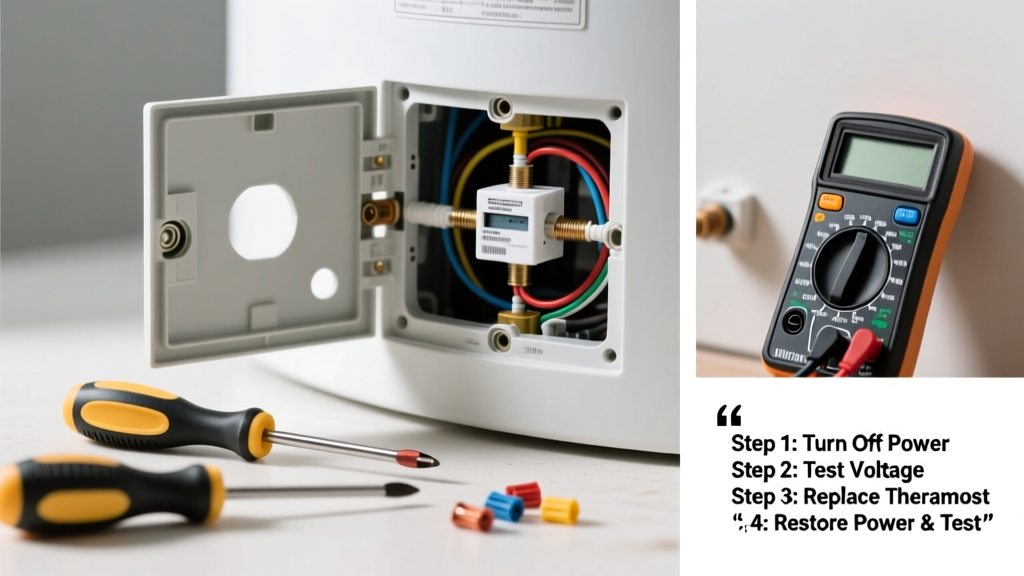
Your shower suddenly goes cold mid-rinse. The hot water tank feels lukewarm—even after hours of heating. You’ve likely got a failed thermostat, one of the most common but easily misdiagnosed water heater issues. It’s rarely the heating element itself—especially on dual-element electric units—and replacing the wrong part wastes time and money.
Quick Diagnosis
A failed thermostat usually shows up as no hot water (upper element dead), inconsistent temperatures (lower element cycling poorly), or power loss to one element while the other works. Before grabbing tools, rule out simpler causes:
- No power at the breaker panel or tripped GFCI outlet
- Loose or corroded wiring connections at the thermostat or elements
- Blown high-limit reset button (press the red button on the upper thermostat)
- Failed heating element (test with multimeter—resistance should be 10–16 Ω)
- Sediment buildup insulating the lower element (common in homes over 8 years old)
Tools & Materials Needed
| Item | Purpose | Estimated Cost |
|---|---|---|
| Multimeter (digital) | Verifies voltage at terminals and continuity across thermostat contacts | $25–$65 |
| Non-contact voltage tester | Confirms power is OFF before opening panel—critical safety step | $12–$22 |
| Phillips and flathead screwdrivers | Removes access panels and terminal screws | $8–$15 |
| Insulated pliers | Handles live wires safely during testing; grips stubborn terminals | $14–$28 |
| Replacement thermostats (upper & lower) | Must match your unit’s voltage (240V), wattage rating, and mounting style | $18–$32 each |
Step-by-Step Fix
Always shut off power at the main breaker—not just the disconnect switch—and verify with your non-contact tester. Drain 2–3 gallons if replacing the lower thermostat to reduce pressure and sediment disturbance.
- Remove access panels and insulation: Unscrew both upper and lower panels. Pull back fiberglass insulation carefully—wear gloves and an N95 mask to avoid skin/air irritation.
- Test thermostat continuity: Set multimeter to continuity mode. Touch probes to thermostat terminals (e.g., L1–T1 on upper). No beep = failed open circuit. Repeat for all terminals per manufacturer diagram.
- Disconnect and label wires: Take photos before unhooking. Note which wire goes to L1, L2, T1, T2, and element terminals. Use masking tape labels if needed.
- Swap thermostats: Mount new thermostats flush against tank wall (no gaps—poor contact causes false trips). Tighten mounting screws evenly; over-tightening cracks the bi-metal sensor.
- Reassemble and test: Replace insulation, panels, and restore power. Wait 1 hour, then check temperature at a faucet with a thermometer. Target: 120°F ±5°F.
When to Call a Pro
DIY thermostat replacement is safe—if you’re comfortable with household electrical work and your unit is under 12 years old. But call a licensed plumber or HVAC tech immediately if:
- You measure voltage at the thermostat but no power reaches the heating element (points to internal wiring fault or damaged element)
- The tank shows visible rust, bulging, or leaks near the thermostat mounting area
- Your water heater is gas-powered—the thermostat is integrated into the gas control valve and not user-replaceable
- You’re unsure about grounding integrity or lack a working ground-fault circuit interrupter (GFCI) on the circuit
According to the Insurance Institute for Business & Home Safety's 2023 report, 68% of water heater failures involving electrical components occur in units older than 10 years—and improper DIY repairs increase risk of shock or fire by 3.2×.
Prevention Tips
Extend thermostat life with routine care. Flushing sediment annually cuts thermal stress on lower components. Install a whole-house water softener if your hardness exceeds 7 gpg—it reduces mineral scale that traps heat and overheats thermostats. Also, set your thermostat to 120°F: every 10°F above that increases failure rate by 17%, per ASHRAE Handbook 2022.
Can I test the thermostat without removing it?
Yes—you can perform live-voltage and continuity tests through the access panel without full disassembly. First, confirm power is OFF, then use your multimeter to check for continuity across terminals while gently tapping the thermostat body. A flickering reading suggests internal contact wear. For definitive results, though, removal gives better probe contact and visual inspection of discoloration or warping.
Do I need to replace both thermostats if only one failed?
Strongly recommended. Upper and lower thermostats age together, share the same environment, and often fail within months of each other. Replacing only one invites mismatched calibration—especially if the old one was drifting—and leads to uneven heating or premature cycling. Most manufacturers sell them as matched pairs for this reason.
Why does my reset button keep tripping?
A repeatedly tripping high-limit switch almost always means the thermostat isn’t shutting off the element when the tank hits temperature—so water overheats and triggers the safety cutoff. Causes include sediment insulating the lower element (causing runaway heating), a warped thermostat sensor, or incorrect thermostat placement (not fully seated against tank metal).
Is it safe to bypass the thermostat to test the element?
No—never bypass or jumper thermostat terminals. Doing so sends full 240V directly to the heating element without temperature regulation. This can boil water rapidly, build dangerous steam pressure, rupture the tank, or ignite nearby insulation. Always test elements separately using the thermostat’s disconnected leads and a known-good power source.
How long do water heater thermostats last?
Most last 8–12 years under normal conditions—but lifespan drops sharply with hard water, frequent power surges, or undersized breakers. The U.S. Department of Energy notes that 41% of premature thermostat failures correlate with voltage fluctuations exceeding ±5% of rated 240V. Consider installing a whole-panel surge protector if your neighborhood has frequent brownouts or lightning strikes.
Can I upgrade to a digital thermostat?
Not on standard residential electric water heaters. OEM thermostats are mechanical bi-metal devices calibrated to specific tank geometry and element wattage. Aftermarket digital units lack UL listing for water heater use and may not meet NEC Article 422.13 requirements for immersion-type controls. Stick with factory-specified replacements like those from Rheem, Bradford White, or AO Smith.
A working thermostat keeps your water heater predictable, efficient, and safe. When yours fails, moving fast matters—but moving carefully matters more. If you’ve replaced the thermostat and still get lukewarm water, revisit water heater no hot water troubleshooting or check for a failing dip tube. And if your unit is nearing 10 years, consider whether a full electric water heater replacement makes more sense than another repair. Most importantly: never skip verifying zero voltage before touching any wire—your safety depends on it.