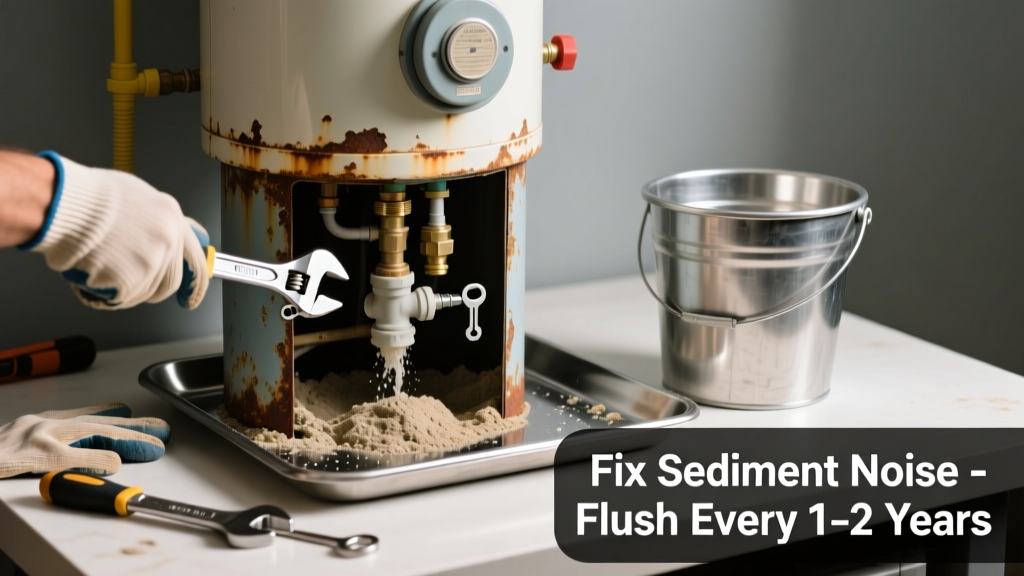
If your water heater suddenly starts sounding like a popcorn machine, a kettle whistling underwater, or a distant thunderstorm—especially when heating—it’s almost certainly sediment buildup in the tank. This mineral sludge (mostly calcium carbonate and magnesium) hardens on the tank’s bottom, insulates the heating element or burner, and causes dangerous overheating and noise. Ignoring it risks premature tank failure, reduced hot water output, and even pressure valve activation.
Quick Diagnosis
Before assuming it’s sediment, rule out these common culprits:
- Rumbling, popping, or banging sounds only during heating cycles — classic sediment signature
- Reduced hot water volume or temperature inconsistency
- Visible rust or cloudy water from hot taps
- Tank exterior feels unusually hot near the bottom but cooler at the top
- Pressure relief valve dripping or leaking after heating
Tools & Materials Needed
| Item | Purpose | Estimated Cost |
|---|---|---|
| Garden hose (50 ft, rubber, rated for hot water) | Drains tank without melting or bursting | $12–$25 |
| Wrench (adjustable or 3/4" socket) | Loosens drain valve; avoids stripping plastic threads | $8–$22 |
| Bucket (5-gallon) | Catches initial sediment-laden water for inspection | $4–$9 |
| Shop vacuum with wet/dry capability | Removes stubborn sludge if standard flush fails | $45–$120 |
| White vinegar (1 gallon) | Dissolves calcium/magnesium deposits; non-corrosive alternative to acid | $6–$10 |
Step-by-Step Fix
Follow this sequence — skipping steps risks incomplete removal or scalding:
- Shut off power and water supply: For electric units, flip the double-pole breaker. For gas, turn the thermostat dial to "Pilot" and close the cold-water inlet valve.
- Attach hose and open T&P valve: Connect hose to drain valve, run other end to floor drain or outside. Briefly lift the temperature/pressure relief valve handle to release steam and equalize pressure — you’ll hear a hiss.
- Drain 3–5 gallons, then pause: Open drain valve and let water flow into bucket. Stop after ~4 gallons. If water is brown, gritty, or smells sulfurous, sediment is confirmed.
- Perform a full flush: Keep hose connected, open cold-water inlet valve slightly while drain remains open. Let cold water surge through tank for 15–20 minutes — this stirs and carries out loosened sediment. Repeat until outflow runs clear.
- Optional vinegar soak (for stubborn scale): Refill tank halfway with white vinegar, let sit 2–4 hours (do NOT heat), then flush thoroughly with fresh water before restoring power.
When to Call a Pro
Stop and call a licensed plumber or HVAC technician if any of these apply:
- Your water heater is over 12 years old and has never been flushed — risk of valve corrosion or tank perforation is high
- The drain valve leaks or won’t close after flushing — replacement requires draining and depressurizing under controlled conditions
- You detect gas odor near a gas unit during or after the process
- Water pressure drops significantly throughout the house after refilling — suggests sediment migrated into pipes or pressure regulator damage
- You’re uncomfortable working around electricity, gas lines, or pressurized systems
Prevention Tips
Sediment builds up fastest in hard water areas (over 7 grains per gallon). According to the U.S. EPA, 85% of U.S. homes have hard water — making annual maintenance essential.
"Flushing your tank every 6–12 months can extend its lifespan by 3–5 years and maintain 90%+ thermal efficiency. Skipping it doubles the risk of premature failure." — Plumbing Manufacturers Institute, Residential Water Heater Maintenance Guide 2022
- Install a whole-house water softener if hardness exceeds 10 GPG
- Add a sediment pre-filter on the cold inlet line (replaces $20 cartridges yearly)
- Set electric heater thermostats no higher than 120°F — reduces mineral precipitation rate
- Mark your calendar: flush on the same date each year (e.g., first Saturday in March)
Can I use bleach to clean sediment from my water heater?
No. Bleach does not dissolve mineral scale — it’s designed for organic disinfection, not calcium carbonate. It can also corrode anode rods and degrade rubber gaskets. Stick to vinegar or citric acid solutions for safe descaling.
Why does my water heater make noise only in the morning?
Morning noise often coincides with peak household demand — multiple fixtures drawing hot water rapidly cools the upper tank layer, triggering the heater to fire more aggressively. That sudden heating across a sediment layer amplifies popping as trapped steam pockets collapse.
Is it safe to flush a water heater that’s over 10 years old?
It’s safe — if the drain valve operates smoothly and the tank shows no external rust or pooling. But proceed slowly: open the valve just ¼-turn first, check for cracks or weeping, and stop immediately if you see pinhole leaks. Older tanks may fail under agitation — consider scheduling replacement within 6 months if flushing reveals heavy sludge.
How do I know if the sediment has damaged my heating elements?
Electric heaters with failed lower elements often deliver only lukewarm water, even after flushing. Test continuity with a multimeter: disconnect power, remove element wires, and check resistance (should read 10–16 ohms). If it reads infinite (∞), the element is burnt out — replace it using a water heater element replacement guide.
Will flushing fix the sulfur smell too?
Sometimes — but not always. Hydrogen sulfide odor usually stems from anaerobic bacteria reacting with the anode rod (especially aluminum or zinc types). Flushing removes some bacteria, but persistent smells require replacing the anode rod with a powered anode or switching to aluminum-zinc alloy. See our sulfur smell troubleshooting page for step-by-step rod replacement.
Can sediment cause my pressure relief valve to leak?
Yes — sediment traps heat at the tank bottom, causing localized superheating and steam formation. That raises internal pressure beyond the valve’s 150 psi rating, forcing it to discharge. A leaking T&P valve after flushing often means the valve itself is faulty or clogged — replace it immediately, as it’s a critical safety component. Don’t ignore it — learn how to replace a T&P valve safely.
A noisy water heater isn’t just annoying — it’s your tank’s early warning system. Addressing sediment now protects your investment, keeps energy bills lower, and prevents emergency replacements. Most homeowners complete a full flush in under 90 minutes once they’ve done it once. Keep your hose coiled and wrench handy — next year’s flush will go even faster, and your tank will thank you with quiet, reliable service for years longer.