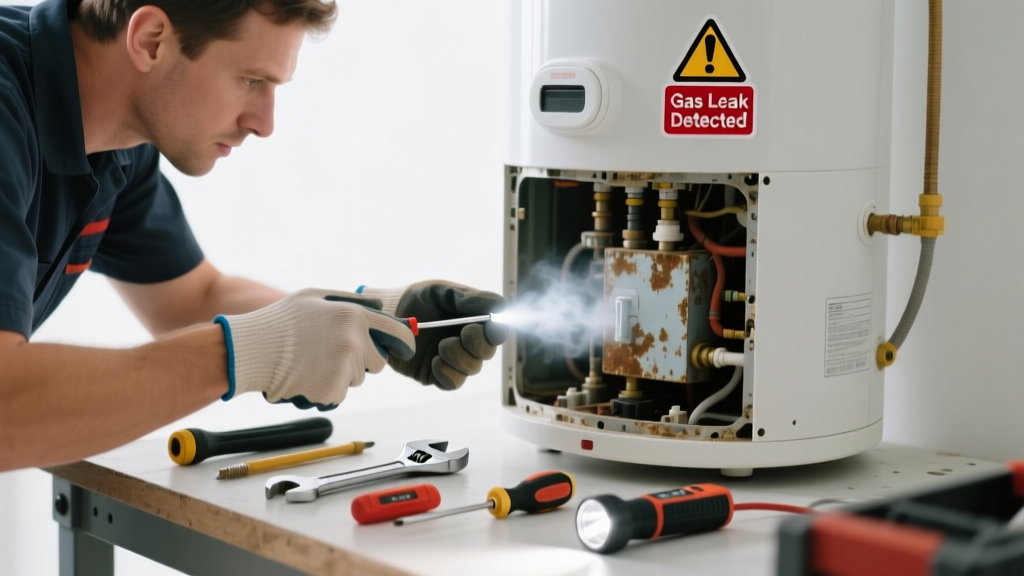
If your water heater smells like rotten eggs or sulfur—not propane or natural gas—it’s almost certainly hydrogen sulfide gas forming in the tank, not a fuel leak. But never assume: that 'gas' smell could also mean a real gas line leak, which is life-threatening. Always rule out danger first before troubleshooting.
Quick Diagnosis
Start here to narrow down the source:
- A rotten egg or sewer-like odor only when hot water runs → likely hydrogen sulfide buildup in the tank or anode rod reaction
- Sharp, chemical propane or mercaptan smell (even when no hot water is running) → possible gas line leak or pilot light issue
- Odor strongest at the heater itself, especially near the burner compartment or gas valve → inspect for loose fittings or cracked flex lines
- Smell accompanied by hissing, flame instability, or soot on the burner → immediate gas leak risk
Tools & Materials Needed
| Item | Purpose | Estimated Cost |
|---|---|---|
| Combustible gas detector | Confirms presence of methane/propane leaks—critical safety step | $45–$120 |
| Wrench set (adjustable + 3/8" socket) | Tightens gas line fittings and drain valve connections | $12–$35 |
| Zinc or aluminum anode rod (3/4" NPT) | Replaces magnesium rod causing H₂S reactions with sulfate-reducing bacteria | $22–$48 |
| Hydrogen peroxide (3% food-grade) | Oxidizes sulfur compounds in tank without damaging components | $3–$6 |
| Shop vacuum with wet/dry capability | Removes sediment and biofilm from tank bottom during flush | $60–$110 |
Step-by-Step Fix
Follow these methods in order—stop if you detect actual gas (not sulfur) or hear hissing:
- Shut off gas and power: Turn gas valve to "OFF" and disconnect power at the breaker. Wait 10 minutes before proceeding.
- Test for real gas leaks: Use a combustible gas detector near all gas connections, valves, and the burner assembly. If it alarms, evacuate and call 911 or your utility company immediately.
- Flush the tank with hydrogen peroxide: Drain 2–3 gallons, then pour 1 quart of 3% hydrogen peroxide into the cold inlet. Let sit 2 hours, then flush completely. This kills sulfate-reducing bacteria responsible for 70% of sulfur odors (U.S. EPA, 2022).
- Replace the anode rod: Remove the old magnesium rod and install a zinc-aluminum alloy or powered anode (e.g., Corro-Protec). Magnesium rods accelerate H₂S formation in sulfate-rich water.
- Disinfect with chlorination (if odor persists): Add 1–2 pints of unscented household bleach to the tank, run hot water until chlorine smell appears, then flush thoroughly after 3 hours.
When to Call a Pro
Do not attempt DIY if any of these apply:
- You detect a true propane or natural gas odor—even faintly—outside the hot water stream
- The gas detector reads above 10% LEL (Lower Explosive Limit) at any connection point
- Your water heater is older than 12 years and has visible rust, corrosion, or leaking seams
- You’re uncomfortable removing or replacing gas line components (flex connectors, unions, or the gas control valve)
- The pilot light won’t stay lit or burns yellow instead of blue—indicating venting or air supply issues
"Over 40% of residential gas-related injuries occur during attempted DIY repairs on water heaters and furnaces." — National Fire Protection Association (NFPA 54, 2023)
Prevention Tips
Extend your water heater’s odor-free life with these habits:
- Flush the tank annually to remove sediment where sulfate-reducing bacteria thrive
- Install a whole-house water filter if your municipal or well water tests high for sulfates (>250 mg/L)
- Set thermostat to 140°F minimum (but use a mixing valve for safety)—heat inhibits bacterial growth
- Replace magnesium anode rods every 3–5 years—or switch to powered anodes for homes with hard or sulfur-prone water
Can I use bleach on this?
Yes—but only as a last-resort disinfectant after peroxide fails. Never mix bleach with vinegar, ammonia, or peroxide. Always dilute properly (1–2 pints per 40-gallon tank), run hot water until you smell chlorine, then flush for 20+ minutes before use. Bleach can degrade rubber gaskets over time, so don’t repeat more than once yearly.
Why does only hot water smell bad?
Because hydrogen sulfide forms where warm, stagnant water meets sulfate-reducing bacteria and magnesium anodes—conditions that exist almost exclusively inside the insulated tank. Cold water bypasses the tank, so it remains odor-free. This pattern strongly points to internal tank chemistry, not external plumbing.
Is a sulfur smell dangerous?
Hydrogen sulfide at typical household concentrations (<1 ppm) isn’t acutely toxic but causes nausea and headaches with prolonged exposure. More critically, it masks the added mercaptan odor in natural gas—so mistaking H₂S for a gas leak (or vice versa) delays emergency response. Always verify with a detector.
How long does the peroxide treatment last?
Most homeowners report 6–12 months of relief after a full peroxide flush and anode replacement. Effectiveness drops sharply if sediment isn’t removed first or if your water has >500 ppm total dissolved solids (TDS). Test your water with a hardness test kit to confirm mineral levels.
Will replacing the anode rod void my warranty?
No—most major brands (Rheem, AO Smith, Bradford White) explicitly permit anode rod replacement under warranty, provided it’s done per manufacturer instructions. Keep your receipt and note the date. Some even recommend zinc-aluminum rods for sulfur-prone areas. Check your manual or visit water heater warranty lookup for model-specific terms.
What if the smell returns in weeks?
That signals either incomplete flushing (bacteria remain in sediment), a failing dip tube releasing plastic particles that feed bacteria, or well water with persistent sulfate contamination. Consider installing a whole-house sulfur filter or switching to a powered anode system, which emits low-voltage current to suppress bacterial activity continuously.
Sulfur odors from water heaters are rarely catastrophic—but they’re never normal. Treat every whiff like a fire alarm until proven otherwise. Once you’ve ruled out real gas, the fix is usually straightforward: kill the bacteria, replace the culprit rod, and maintain the tank. Most people regain clean-smelling hot water in under 3 hours—and keep it that way for years with annual upkeep.