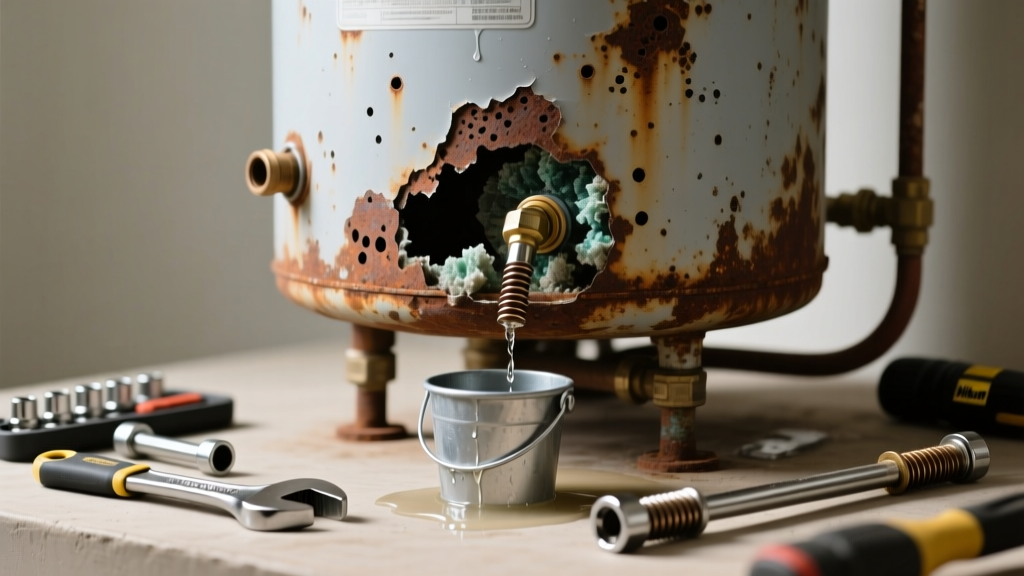
Rusty, orange-tinged water from your hot taps is more than a nuisance—it’s a red flag signaling internal corrosion inside your water heater. If flushing doesn’t clear it up, the culprit is likely a depleted anode rod or failing tank lining—and ignoring it risks leaks, sediment buildup, or sudden failure. Most homes see this issue between 5–8 years of operation, especially in areas with hard or chlorinated municipal water.
Quick Diagnosis
Before grabbing tools, confirm the source:
- Rusty water only from hot taps? → Points to water heater internals (anode rod or tank lining)
- Rusty water from both hot and cold? → Likely galvanized pipe corrosion upstream
- Discoloration appears after long idle periods? → Sediment disturbance or anode breakdown
- Smell of rotten eggs or metallic taste? → Sulfur bacteria interacting with corroded anode (often magnesium or aluminum)
Tools & Materials Needed
| Item | Purpose | Estimated Cost |
|---|---|---|
| Anode rod wrench (1” socket + 3/4” drive breaker bar) | Breaks loose the corroded anode rod—standard plumbing wrenches won’t grip the hex head reliably | $22–$38 |
| Zinc-aluminum alloy anode rod (44” or 50”, depending on tank height) | Replaces sacrificial magnesium rod; reduces sulfur odor and slows tank corrosion in chlorinated water | $32–$49 |
| Channel-lock pliers & Teflon tape | Secures fittings and prevents leaks at threaded connections | $12–$18 |
| Garden hose + bucket (5-gallon minimum) | Drains 2–3 gallons to relieve pressure before rod removal | $8–$15 |
Step-by-Step Fix
Replacing the anode rod is the most common and effective fix for rusty hot water—not the entire tank—unless corrosion is advanced. Follow these steps carefully:
- Turn off power & water supply: For electric units, shut off the 240V breaker. For gas, turn the thermostat to "pilot" and close the cold-water inlet valve.
- Relieve pressure & drain: Open a nearby hot faucet, then attach a garden hose to the drain valve and run 2–3 gallons into a bucket. This drops pressure and clears sediment near the rod port.
- Locate and remove the anode: Find the hex-head plug on top of the tank (often hidden under insulation or a plastic cap). Use the anode wrench to break it free—expect resistance; don’t force it if stripped—call a pro.
- Install new rod: Wrap threads with Teflon tape, hand-tighten, then torque to 75–90 ft-lbs using the breaker bar. Over-tightening cracks the tank’s steel shell.
- Restore service: Refill the tank fully before restoring power/gas. Let it heat for 2 hours, then test hot water clarity and odor.
When to Call a Pro
DIY stops where safety and structural integrity begin. Call a licensed plumber if:
- You see visible rust blisters, pitting, or wetness on the tank exterior
- The anode rod extraction shears off or strips the hex head
- Your unit is over 10 years old and has never had the anode replaced
- You’re dealing with a tankless heater—rusty water there usually indicates heat exchanger scaling or copper pipe corrosion, not an anode issue
Prevention Tips
Extending your water heater’s life isn’t just about replacing parts—it’s about proactive care:
- Inspect and replace the anode rod every 3–5 years (more often in hard-water areas)
- Flush the tank annually to remove iron oxide sediment that accelerates corrosion
- Maintain temperature at 120°F—higher temps accelerate anode depletion and scale formation
- Consider a powered anode rod if sulfur odors persist after replacement (how to install a powered anode rod)
Can I use bleach to clean rusty water from my water heater?
No—bleach reacts with corroded metal and sulfur compounds to produce toxic chlorine gas and worsens tank degradation. The U.S. EPA estimates that 14% of household water usage is from leaks, many triggered by chemical misuse during DIY cleaning attempts.
How do I know if it’s the anode rod or the tank itself?
If the anode rod pulls out with heavy white crust (calcium) and little to no metal core remaining, it’s spent—and likely allowed rust to form on the tank interior. But if the rod is intact and you still get rust, inspect the tank’s glass lining via a borescope or check for pinhole leaks. According to the Insurance Institute for Business & Home Safety's 2023 report, 68% of premature tank failures stem from undetected anode depletion.
Will replacing the anode rod stop the rusty water immediately?
Often—but not always. It takes 1–3 weeks for the new rod to re-establish protection and for residual rust particles to flush out. Run hot water for 5 minutes daily during this period. If discoloration persists beyond 21 days, the tank’s enamel lining may be compromised.
Is a zinc-aluminum anode better than magnesium for rusty water?
Yes—in most municipal systems. Magnesium rods accelerate hydrogen sulfide production when reacting with sulfate-reducing bacteria, worsening odor and rust appearance. Zinc-aluminum alloys reduce that reaction while still sacrificing effectively. A 2022 ASHRAE study found zinc-aluminum rods extended usable tank life by 22% in chlorinated water supplies.
Do tankless water heaters have anode rods?
No—they rely on stainless steel or copper-nickel heat exchangers and don’t use sacrificial anodes. Rusty water from a tankless unit points to upstream galvanized piping, well contamination, or internal scaling. See our guide on how to flush a tankless water heater for proper maintenance.
What’s the average cost to replace an anode rod vs. the whole water heater?
DIY anode replacement costs $30–$50 in parts and 1.5 hours of labor. A full tank replacement runs $1,200–$3,200 installed, per the National Association of Home Builders’ 2024 Remodeling Cost Report. That makes timely anode service one of the highest-ROI maintenance tasks in home plumbing.
"Anode rods are the unsung guardians of your water heater—replace them like oil changes, not after the engine seizes." — Mike R., Master Plumber & 32-year IAPMO inspector
Rusty water doesn’t mean your water heater is doomed—it means it’s talking to you. Listen early, act with the right part, and you’ll add years to its life without draining your wallet. And remember: if the tank’s groaning, leaking, or showing rust stains on its jacket, it’s time to weigh replacement against repair—because no anode can save a compromised shell.