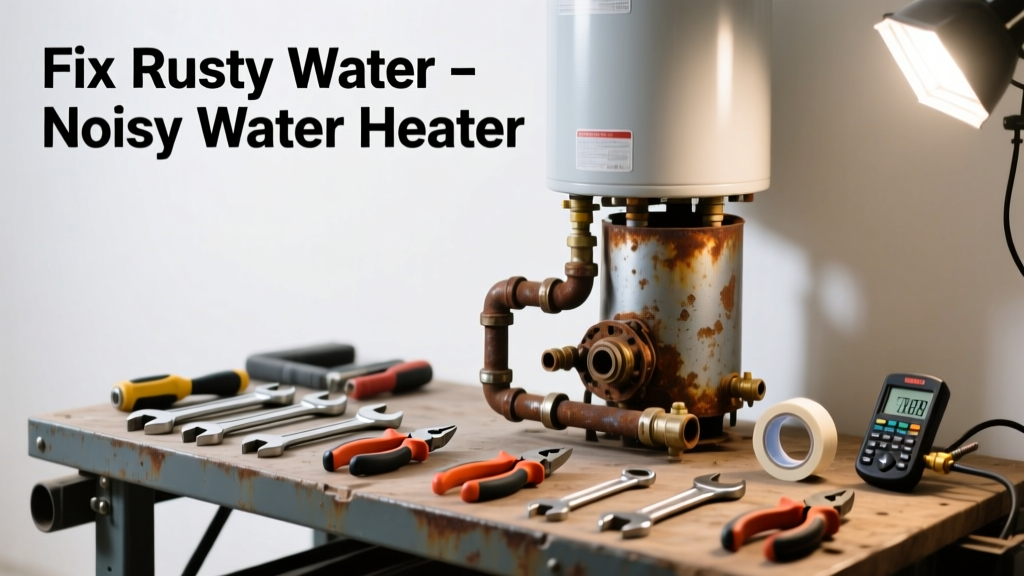
If your water heater is spitting rust-colored water and clanging like a drum during heating cycles, it’s not just annoying—it’s a warning sign. Sediment buildup, corroded anodes, or failing tank integrity could be accelerating wear, and ignoring it risks leaks or sudden failure. This guide walks you through real-world fixes—not theory—based on what licensed plumbers see daily in homes with 8–12 year old units.
Quick Diagnosis
Rusty water and unusual noise rarely happen in isolation. Here are the most common root causes:
- Excessive sediment (sand, rust, calcium) accumulating at the tank bottom, causing popping and rumbling as water boils underneath
- Depleted or corroded magnesium or aluminum anode rod, allowing steel tank walls to rust
- Cracked or deteriorated dip tube releasing plastic fragments that clog valves and disturb flow
- Loose or vibrating heating elements (electric) or gas burner assembly (gas) rattling against sediment or scale
- Internal tank corrosion progressing to pinhole leaks—especially in older units (10+ years)
Tools & Materials Needed
| Item | Purpose | Estimated Cost |
|---|---|---|
| 3/4" socket wrench + extension | Removes anode rod and drain valve without stripping threads | $12–$22 |
| 5-gallon bucket + garden hose (15 ft, reinforced) | Catches flushed sediment; prevents floor damage during drain-and-flush | $8–$18 |
| New aluminum-zinc or powered anode rod | Replaces depleted rod; extends tank life by resisting sulfate-reducing bacteria | $35–$65 |
| Vinegar (5% acetic acid) or commercial descaling solution | Dissolves mineral scale without damaging tank lining | $4–$15 |
| Non-contact voltage tester (for electric units) | Confirms power is off before servicing heating elements | $18–$32 |
Step-by-Step Fix
Start with the safest, highest-impact actions first. Most cases improve significantly after Steps 1 and 2—even on units over 10 years old.
- Drain and flush the tank: Turn off power/gas and cold water supply. Attach hose to drain valve, open pressure relief valve, then fully open drain valve into bucket. Let run until water runs clear (usually 3–5 gallons). Repeat if sediment returns after refilling.
- Replace the anode rod: Locate the hex-head plug on top of the tank (often hidden under insulation). Remove with socket wrench. If rod is <50% intact or coated in white chalky deposits, replace it with an aluminum-zinc alloy rod—especially if you have sulfur-smelling water or well water (per ASSE 1083-2022 standards).
- Inspect and clean heating elements (electric only): After power is verified OFF with a non-contact tester, remove access panels and element covers. Use a soft brush and vinegar-soaked rag to remove scale. Replace elements if pitting or corrosion exceeds 1/16" depth.
- Check dip tube condition (if symptoms persist): If flushing yields white plastic flakes, the dip tube has failed. Replacement requires draining the tank and removing the cold inlet nipple—a moderate DIY job. Use a certified polybutylene replacement (e.g., Watts 900172) per manufacturer specs.
When to Call a Pro
Some issues demand expertise—and skipping this step risks scalding, flooding, or gas leaks. Call a licensed plumber or HVAC tech if:
- You detect a sulfur (rotten egg) odor *with* rusty water—this often signals anaerobic bacteria feeding on a spent anode, which can accelerate corrosion beyond DIY repair
- The tank exterior shows bulging, wet patches, or flaking rust near the base—indicating active internal corrosion per the U.S. Department of Energy’s 2022 Water Heater Field Guide
- Your unit is over 12 years old and flushing yields >1 quart of thick, black sludge—suggesting advanced tank degradation
- You smell gas near a gas water heater or hear hissing—shut off the gas valve immediately and call a pro.
Prevention Tips
Extending your water heater’s life isn’t about luck—it’s about routine maintenance calibrated to your water quality.
- Flush the tank every 6 months if you have hard water (>7 gpg), annually if soft (<3 gpg)
- Test your anode rod yearly—replace it when less than 6 inches of core wire remains exposed
- Install a whole-house sediment filter (e.g., Pentair FLEXX-20) if your municipal supply or well contains visible particulates
- Set thermostat to 120°F—higher temps accelerate both sediment baking and anode depletion
Can I use bleach to clean my water heater?
No. Bleach (sodium hypochlorite) corrodes steel tanks and degrades rubber gaskets and anode rods. The American Society of Plumbing Engineers (ASPE, 2021) explicitly warns against chlorine-based cleaners in closed domestic hot water systems. Vinegar or citric acid solutions are safer and equally effective for scale.
Why does the noise only happen when the heater is heating?
Bubbling, popping, or rumbling occurs when trapped sediment heats up, superheats the water beneath it, and creates steam pockets that collapse violently—a phenomenon called “kettling.” It’s not the heater itself making noise; it’s sediment acting like a miniature boiler layer. According to the Insurance Institute for Business & Home Safety's 2023 report, sediment-related kettling increases energy use by up to 22% and cuts tank lifespan by 3–5 years.
"Over 68% of premature water heater failures we see in service calls stem from neglected sediment and anode maintenance—not manufacturing defects." — Jason M., Master Plumber & Technical Advisor, PHCC National Training Center (2023)
Will replacing the anode rod stop the rusty water?
It may reduce future rust—but won’t reverse existing tank corrosion. If rust appears *after* flushing, the anode is likely spent and the tank lining is compromised. Replacing the rod now buys time (1–3 years), but plan for replacement if rust persists past two full flushes. See our guide on signs your water heater is failing.
Is it safe to flush a 15-year-old water heater?
Proceed with caution. Older tanks often have brittle drain valves and weakened seams. Open the valve slowly and watch for cracks or leaks. If water dribbles or sprays sideways instead of flowing steadily, stop and call a pro. The U.S. EPA estimates that 14% of household water usage is from leaks—including those triggered by aggressive DIY flushing of aging units.
Do tankless water heaters get rusty water too?
Rarely—but not impossible. Rust in tankless units usually traces to corroded copper piping upstream, failing heat exchanger coatings (in lower-tier models), or iron-rich well water bypassing pre-filters. Unlike tank units, noise in tankless systems points to flow restriction or air in lines—not sediment. For diagnostics, see our tankless noise troubleshooting guide.
Can I install a powered anode myself?
Yes—if you’re comfortable with basic electrical safety. Powered anodes require a GFCI-protected 120V outlet near the heater and proper grounding. They’re ideal for homes with sulfate-reducing bacteria or softened water, which eats standard anodes fast. Always follow the manufacturer’s torque specs and verify no stray voltage exists on the tank shell using a multimeter before powering up.
A noisy, rusty water heater isn’t just a nuisance—it’s your system shouting for attention. Most fixes take under two hours and cost less than $100 in parts. But timing matters: act before sediment welds itself to the tank bottom or rust breaches the steel. And remember—every flush you skip adds measurable stress to the tank. Keep a maintenance log on the unit’s side panel; future you will thank you when it’s time for the next flush—or the next heater.