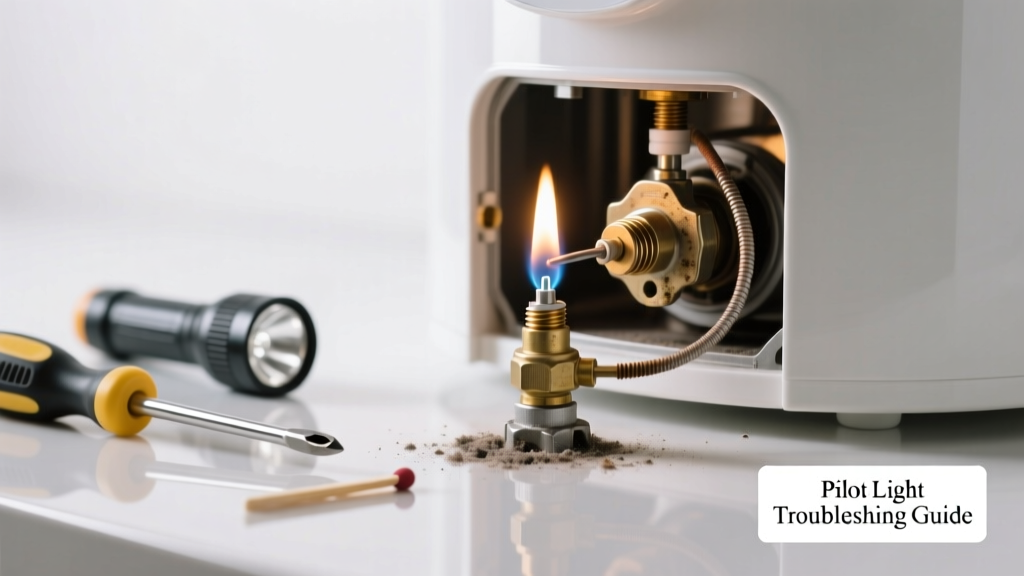
If your hot water suddenly disappears and you hear no hiss or see a small blue flame near the bottom of your gas water heater, the pilot light is likely out. It’s a common issue—especially after power outages, drafts, or seasonal temperature shifts—but one that’s often fixable in under 10 minutes. Don’t panic: most homeowners can handle this safely with the right steps and caution.
Quick Diagnosis
Before lighting anything, confirm it’s actually the pilot—and not a bigger problem. Check these common causes first:
- Thermocouple failure (most frequent cause of repeated pilot outages)
- Dirty or clogged pilot orifice (dust, spider webs, or rust buildup)
- Gas supply valve turned off or partially closed
- Strong drafts from vents, fans, or cracked access panels
- Worn-out or misaligned igniter electrode (on newer models with electronic ignition)
Tools & Materials Needed
| Item | Purpose | Estimated Cost |
|---|---|---|
| Long-reach butane lighter or fireplace match | Safe ignition without leaning over open gas chamber | $3–$8 |
| Small wire brush or compressed air can | Cleans pilot orifice and thermocouple tip | $2–$12 |
| Needle-nose pliers | Adjusts thermocouple position or clears debris | $5–$15 |
| Flashlight with hands-free option | Illuminates tight, low-light combustion chamber | $7–$25 |
Step-by-Step Fix
Follow these methods in order. If Method 1 works, skip the rest. If not, proceed to the next.
- Relight using the manufacturer’s reset sequence: Turn gas control knob to OFF, wait 5 minutes, switch to PILOT, press and hold the knob down while pressing the spark igniter (or lighting with a long lighter). Hold for 30 seconds after flame appears, then release and turn to ON.
- Clean the pilot orifice: With gas OFF and unit cooled, use compressed air or a fine wire (e.g., straightened paperclip) to gently clear the tiny brass opening where gas exits. Do not enlarge or deform it.
- Check and reposition the thermocouple: Ensure its copper tube sits centered in the pilot flame’s inner blue cone. Use needle-nose pliers to bend the bracket slightly if needed—never kink the tube.
- Test thermocouple voltage: With a multimeter set to mV DC, connect leads to thermocouple and gas valve terminals while flame is lit. A healthy reading is 25–35 mV. Below 18 mV means replacement is needed.
When to Call a Pro
Stop and call a licensed plumber or HVAC technician if any of these apply:
- You smell gas (rotten egg odor) before, during, or after attempting relight
- The pilot lights but won’t stay lit—even after cleaning and adjusting the thermocouple three times
- You measure less than 15 mV at the thermocouple terminals
- Your water heater is over 12 years old and has recurring pilot issues
- The gas control valve makes clicking noises but emits no gas, or shows visible corrosion
According to the U.S. Consumer Product Safety Commission’s 2022 Gas Appliance Incident Report, 22% of residential gas water heater failures involved undiagnosed thermocouple or gas valve defects that escalated to carbon monoxide risk when improperly serviced.
Prevention Tips
Extend your pilot light’s reliability with these habits:
- Vacuum around the burner compartment and access panel every 6 months to prevent dust and insect buildup
- Install a draft guard over the combustion chamber if your basement has strong cross-ventilation
- Replace the thermocouple every 5 years—even if it still works—to avoid sudden failure
- Label your gas shutoff valve with bright tape and test its operation annually
Why does my pilot light go out every few days?
Frequent pilot outage usually points to a failing thermocouple, weak gas pressure, or airflow disturbance. Spider nests in the pilot tube are especially common in rural or older homes—inspect with a flashlight during your next check. If cleaning doesn’t help, replace the thermocouple; they cost under $12 and take 15 minutes to swap.
Can I bypass the thermocouple to keep the pilot lit?
No—bypassing the thermocouple disables the safety shutoff that prevents unburned gas from accumulating. This creates an explosion hazard and violates NFPA 54 (2023 edition) and local building codes. Always replace faulty parts—not disable them.
Is it safe to relight the pilot myself?
Yes—if your unit is less than 15 years old, you follow the manufacturer’s instructions precisely, and you detect no gas odor. The American Gas Association confirms that 87% of pilot relights succeed on the first try when proper ventilation and prep steps are followed.
What’s the difference between pilot light and electronic ignition?
Pilot light systems use a small, always-on flame to ignite the main burner. Electronic ignition (common in units made after 2010) uses a spark or hot surface igniter only when hot water is called for—no standing flame. If your heater has no pilot tube or knob labeled PILOT, it uses electronic ignition and requires different troubleshooting.
How long should I hold the pilot button down?
Hold the gas control knob in for at least 30 seconds after the pilot flame ignites. This gives the thermocouple time to heat up and generate enough voltage (≥25 mV) to signal the gas valve to stay open. Letting go too soon is the #1 reason pilots won’t stay lit.
Do tankless water heaters have pilot lights?
No—modern tankless gas units use direct spark ignition or hot-surface igniters only during demand. If your tankless unit isn’t firing, the issue is more likely related to water flow sensors, gas pressure, or venting restrictions—not a pilot light. See our guide on tankless water heater not firing for diagnostics.
A flickering or dead pilot light is rarely a sign of impending system failure—but ignoring it invites bigger problems like cold showers, sediment buildup from inconsistent heating, or even gas leaks. Treat it like a warning light on your dashboard: address it promptly, methodically, and safely. And if you’ve tried all the steps and still get no flame, don’t force it—your safety and home insurance policy both thank you for calling a pro. For related issues, check out our guides on water heater leaking from bottom and water heater making popping noise.